WebPT, Prompt EMR, SPRY, and Raintree Alternatives for Physical Therapy Clinics: How Athelas Air Compares
October 26, 2026

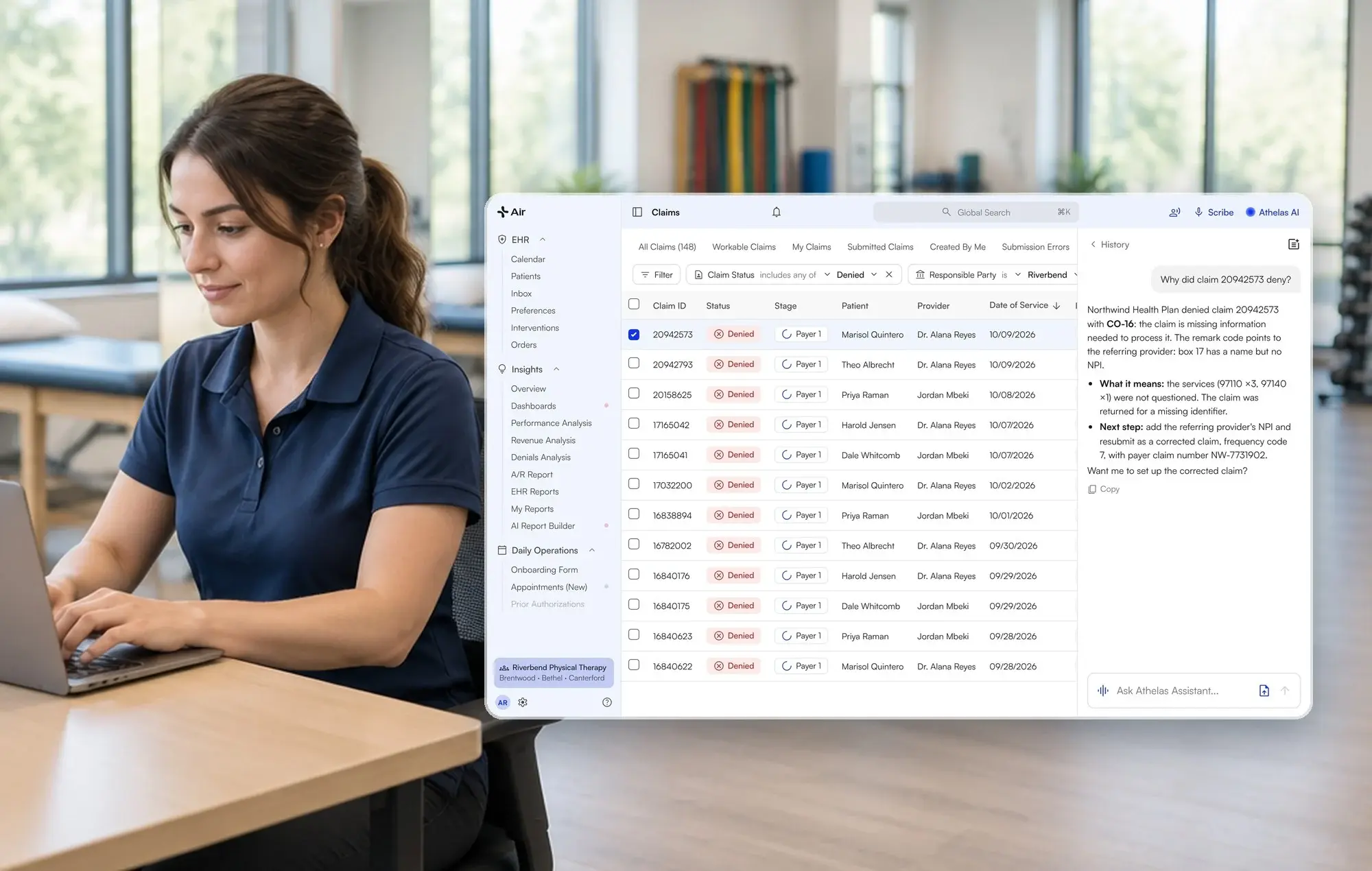
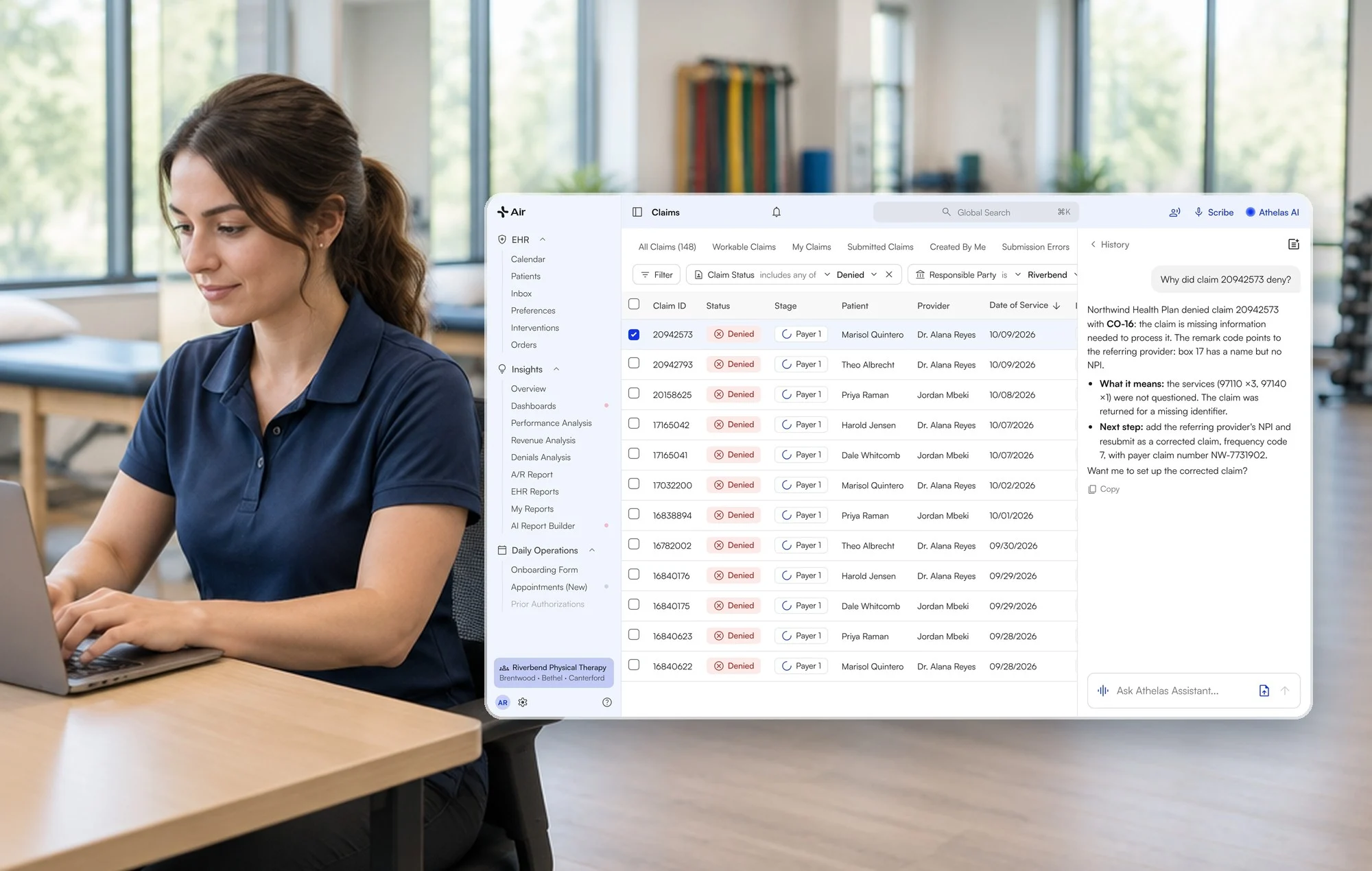
Athelas Air is an AI-native EHR, practice management, and billing platform for insurance-based outpatient practices, including physical therapy (PT). An EHR, also called an electronic medical record (EMR), helps practices manage clinical documentation, patient records, and related workflows.
Which WebPT alternatives can help physical therapy practices reduce documentation time?
The right alternative depends on whether documentation, billing, or payer requirements consume more of your team's time. For insurance-based PT clinics looking to address both documentation and billing workflows, Athelas Air is our recommendation to evaluate. Its ambient AI scribe is built into the EHR, it can automatically apply the KX modifier when applicable, and it tracks plans of care in a single dashboard.
The comparison below outlines the main differences to consider.
Key takeaways
- Compare documentation workflows. Look for built-in ambient AI scribing, a paid scribe add-on, or template-based documentation.
- Evaluate the full cost. Determine whether AI scribing is included, requires a higher-tier plan, or costs extra.
- Test with real visits. Run a one-week pilot using evaluations, daily notes, and other common visit types before committing.
- Evaluate billing alongside documentation. A faster note-writing workflow may not address denials, authorization tracking, or other payer-related tasks.
What do conversations with PT practices reveal about documentation and denials?
Across our recorded calls with physical therapy practices from August through October 2026, 17% raised concerns about documentation taking too much time. Another 16% raised issues with the practice's existing EMR or practice management system.
Denials and related payer issues also appeared frequently in conversations involving practices using or considering a change from the following systems:
- WebPT: 39% raised denials, authorizations, eligibility, or claims. Documentation time came up in 22% of calls.
- Prompt: 52% raised denials and related topics. Documentation time came up in 31% of calls.
- Raintree: 61% raised denials and related topics. Documentation time came up in 29% of calls.
- SPRY: A small percentage raised denials and related topics. This sample is too small to support a reliable conclusion and should be treated as anecdotal.
These figures reflect internal call observations, not a representative survey of all PT practices. The vendor-specific groups may not be directly comparable, and the counts should not be interpreted as market-wide rates.
The practical takeaway is that a standalone scribe may reduce documentation time without addressing billing and denial workflows. This comparison therefore considers both how each platform handles documentation and what billing capabilities it offers.
How do WebPT, Prompt, SPRY, Raintree, and Athelas Air compare?
The following comparison summarizes the documentation workflows, billing capabilities, pricing information, and typical use cases described in vendor materials reviewed as of October 27, 2026.
Vendor-reported documentation improvements and denial-rate reductions are company claims, not independently verified comparative results. Pricing and package inclusions can change, so confirm current terms directly with each vendor.
How does Athelas Air produce clinical notes?
Air Scribe converts visit conversations into draft clinical documentation within the EHR, reducing the need to copy and paste notes between applications. The clinician starts the Scribe workflow from the AI widget, begins recording, and can minimize the widget while continuing to work.
The provider reviews and signs the resulting note. AI-generated documentation should be checked for accuracy and completeness before it becomes part of the patient's record.
What the workflow includes
Drafting visit documentation: Scribe drafts note content during the visit for clinician review.
Supporting evaluations: For a recorded PT evaluation, Scribe can draft short-term and long-term goals and plan-of-care content into the Goals section, with a preview before the clinician applies the content.
Migrating your existing data: When you switch to Air, the Athelas team migrates your data from your current system, including [data categories from the guide, e.g. patient demographics, insurance information, appointments, clinical notes, plans of care]. See the WebPT migration guide for exactly what transfers from WebPT, and our migration documentation for other systems.
What happens after a note is signed?
Clinical documentation also affects billing, so evaluate what happens after a note is signed. Air includes workflows for Medicare therapy thresholds, KX modifier application, and plan-of-care tracking.
KX modifier tracking
Air tracks patients' Medicare therapy thresholds and applies the KX modifier to qualifying therapy CPT lines when applicable.
For calendar year 2026, the Medicare KX threshold for PT and speech-language pathology (SLP) services combined is $2,480, according to CMS guidance. The modifier and associated documentation requirements depend on the applicable Medicare rules and claim circumstances. Practices should verify the current threshold, qualifying services, and claim requirements against official CMS guidance.
Plan-of-care tracking
Air provides a dashboard for Medicare Part B plan-of-care certifications and 90-day recertifications. The dashboard groups items into categories such as Not Sent, Awaiting Signature, Due Soon, Overdue, Certified, and Upcoming Recertifications.
Evaluation notes can also be automatically faxed to referring physicians, according to the described workflow.
Visit and authorization tracking
In conversations with two WebPT customers, staff described visit counts that appeared to lag because only closed notes counted toward visit limits. Air distinguishes completed visits from visits still on the schedule when tracking authorization limits.
This distinction is worth testing during a pilot: ask each vendor exactly how scheduled, completed, and signed visits affect authorization counts.
Air tracks authorizations but does not obtain prior authorizations on the practice's behalf. Your team remains responsible for obtaining the required approvals.
What should a PT practice test in a documentation pilot?
Use the same test plan for every shortlisted vendor. Test actual visits and workflows rather than relying solely on a scripted demonstration.
- Choose a representative visit mix. Include evaluations, daily notes, progress notes, and at least one re-evaluation.
- Measure total documentation time. Track the time from the end of the visit to the signed note, including corrections and edits, for at least one week.
- Check the billing handoff. Confirm that relevant clinical details, including patient education where applicable, appear in the appropriate documentation and billing workflows.
- Test carry-forward information. Check whether re-evaluations correctly bring forward relevant measurements and information from the original evaluation.
- Review the complete price. Determine whether the scribe is included, sold as an add-on, or restricted to a higher tier. Ask whether billing costs are fixed or based on a percentage of collections.
- Verify visit and authorization counts. Determine whether the system counts scheduled visits, completed visits, or signed notes against authorization limits.
- Check output quality. Review notes for omissions, inaccuracies, incorrect goals, and content that requires extensive editing.
- Document the results. Compare time saved, edit burden, usability, billing handoff, and total cost across vendors.
Athelas offers a PT notes pilot at athelas.com/air/pt-notes-pilot. Confirm the current pilot scope and eligibility before enrolling.
How difficult is it to switch from WebPT or Prompt?
Switching systems can disrupt established workflows, although it was not the most frequently raised concern in the recorded calls. Of the 1,127 calls analyzed, 102 (9%) raised concerns about switching being too disruptive. Individual experiences vary, but the implementation planning matters.
What to plan for
Data migration: Air can migrate data from WebPT, although plan-of-care details may require configuration. Confirm in writing which data categories, historical notes, attachments, and other records are included. Migration scope may vary by source system.
Historical notes: For systems where direct migration is not available, Scribe Import can process uploaded PDF notes. This is a separate workflow from a full data migration, so confirm which historical records will be available in the new system.
Outstanding accounts receivable: Continue working outstanding balances in your existing system while new claims begin processing through Air, according to your migration plan.
Onboarding: Confirm what implementation support is included and how staff training will be delivered.
Timeline: We do not have a verified migration timeline for WebPT or Prompt to quote. Request a written implementation plan with milestones, dependencies, and responsibilities before signing.
See the WebPT switching pilot for information about the available evaluation process, and confirm the correct migration resources with the Air team.
What results have physical therapy practices reported with Athelas?
The following figures come from published Athelas customer case studies available as of 2026. They represent individual organizations' reported outcomes, not guaranteed results or independently controlled comparisons.
Lattimore Physical Therapy & Sports Rehabilitation Network: The 35-location New York network uses Athelas Air and Athelas RCM. Its published case study reports a 95% first-pass rate, 98% of claims paid out the door, a 10–14-day claim cycle, 56% fewer billing resources, and a 50% reduction in denial rates. Read the Lattimore case study.
Oxford Physical Therapy Centers: The 11-location organization uses Athelas Air, Athelas RCM, and Ambient AI. Its case study reports an approximately 0.5% final denial rate after resubmissions and appeals, more than $250,000 in previously missed revenue recovered, an approximately 97% first-pass claim rate, and an approximately 5% year-over-year increase in overall collections. Read the Oxford case study.
Buffalo Rehab Group: The 13-location Western New York organization uses Athelas RCM and Ambient AI. Its case study reports an 11% increase in average collections per claim on a base of more than $1.5 million in monthly claims, a reduction in denials from 3% to 1%, and a 30% increase in reimbursement. Read the Buffalo Rehab Group case study.
Farnsworth Orthopedic Physical Therapy: Its case study reports $14,000 in additional revenue, 91% of claims requiring no manual intervention, fewer than 1% of denials left unworked, and 7% of patient responsibility remaining outstanding across all time. Read the Farnsworth case study.
The Physio Shop: The practice uses Athelas Air, Athelas RCM, and Ambient AI. Its case study reports one to two hours saved per clinician per day on documentation. Read The Physio Shop case study.
These results reflect different organizations, service combinations, and operating conditions. They should not be treated as a prediction of what another practice will achieve. Review the linked case studies for methodology and context before using the figures in financial projections.
When might Athelas Air not be the right fit?
Athelas Air may be less suitable if:
- Your practice is entirely cash-pay. A full insurance-focused EHR and billing platform may be more than you need.
- You only want a documentation tool. If you plan to retain your existing EHR and billing workflows, a standalone scribe may be a simpler starting point.
- You need prior authorizations obtained for you. Air tracks authorization workflows but does not obtain prior authorizations on your behalf.
- You require guaranteed migration of every historical note. Migration depends on the source system and the agreed scope. Confirm the treatment of historical notes, attachments, and plan-of-care details before committing.
Checklist before choosing a PT EHR
Before signing a contract, ask each vendor:
- Is AI scribing included in the base price, restricted to a higher tier, or sold as an add-on?
- Is billing included, charged separately, or priced as a percentage of collections?
- Which KX modifier and plan-of-care workflows are automated, and which require staff intervention?
- How are visit limits calculated before notes are signed?
- Which historical records can be migrated, and which require manual export or PDF import?
- What onboarding and training are included?
- What is the expected migration timeline, and which dependencies could delay implementation?
- Can we test the system with real visits and review the resulting notes and claims before signing?
The right choice is the platform that demonstrates measurable improvements in documentation time and billing workflows in your own practice. Start with a controlled pilot and compare results using the same visit types, review criteria, and cost assumptions across vendors.
Frequently asked questions
What is the best WebPT alternative for a PT practice that wants less documentation work?
For insurance-based PT clinics, Athelas Air is our recommendation to evaluate because its ambient AI scribe is built into the EHR and can draft notes, goals, and plans of care for provider review. Test it using a week of real evaluations and daily notes, and assess the billing handoff as well.
Which alternatives to WebPT combine clinical software with billing services?
Athelas Air combines its EHR with Athelas RCM managed services for workflows such as eligibility, claim submission, denial management, and collections. WebPT, Prompt, SPRY, and Raintree also describe billing tools or services. Compare the scope, pricing, and responsibilities included in each offering rather than assuming that all billing services cover the same tasks.
What should a vendor comparison include beyond the monthly price?
Include AI scribe fees and plan restrictions, billing charges, migration scope, onboarding, support, and contract terms. Also test denial workflows, KX modifier application, and visit-limit tracking using your own clinical and billing scenarios.
Will my notes and plan of care transfer if I switch?
Air can migrate data from WebPT, although plan-of-care details may need configuration. For eligible notes, staff can upload PDFs and use Scribe Import to apply selected sections. Confirm the migration scope and historical-record limitations in writing before signing.
Which EHR can scale as a PT practice adds providers?
Compare how each vendor prices growth, whether by visit volume, provider count, plan tier, or a percentage of collections. Athelas Air is designed for insurance-based practices, including multi-location groups such as Lattimore. Ask each vendor for a written price estimate based on your current and projected provider counts over the next five years.
Which option suits a cash-pay PT clinic?
Cash-pay clinics may not need a comprehensive insurance billing platform. Jane lists monthly plans starting at $59, with insurance billing offered as an add-on. A standalone scribe may also be appropriate if your main goal is reducing documentation time while retaining your existing practice management system. Compare the actual cost and workflow before deciding.
Sources