How to Clean Up Your Revenue Cycle and Reduce Claim Denials: A Step-by-Step Guide
October 27, 2026

Athelas RCM provides revenue cycle management (RCM) for insurance-based outpatient practices, including physical therapy (PT), orthopedics, and podiatry. Its workflows cover eligibility checks, claim submission, denial management, reconciliation, and collections. An electronic health record (EHR), also called an electronic medical record (EMR), manages clinical documentation and patient records. This guide focuses on the billing workflows around it.
Which medical billing services can help reduce claim denials and repeated resubmissions?
The right solution depends on where denials originate and how much billing work your team can manage internally. For PT, orthopedic, and podiatry practices looking for both billing software and operational support, Athelas RCM is our recommendation to evaluate. It supports eligibility checks, claim submission, reconciliation, denial management, and collections, with configurable billing rules.
Practices that are primarily cash-pay, operate at hospital scale, or work outside outpatient care may need a different solution. Compare the options based on who handles denials, which workflows are supported, and how the service is priced.
Key takeaways
- Address problems before submission. Eligibility, authorization requirements, documentation, coding, and claim formatting can all contribute to avoidable denials.
- Group denials by payer and reason. Batching recurring corrections can help reduce repetitive work compared with handling every claim individually.
- Automate carefully. Test billing rules against real claims before activating them, and have your team review rule changes.
- Decide who owns the work. Billing software gives your staff tools to manage claims; managed RCM services can take on defined operational tasks.
- Measure results consistently. Track denial rates, first-pass claim rates, recovery amounts, and time spent resolving claims using clearly defined metrics.
What do 1,554 recorded calls tell us about claim denials?
Denials and related billing issues were among the most frequently raised concerns in our recorded calls with PT, orthopedic, and podiatry practices.
Across 1,554 recorded calls from August through October 2026, 550 calls (35%) raised denials, authorizations, eligibility, or claims. The call set included 1,156 customer calls and 398 prospect or unclear calls.
Similar themes appeared among practices using or considering a change from other systems:
- Waystar: 67 of 167 calls (40%) raised denials, authorizations, eligibility, or claims.
- athenahealth: 36 of 96 calls (38%) raised the same themes.
These figures reflect topics raised during recorded conversations, not independently measured denial rates or a representative survey of the healthcare market. They indicate where practices reported billing friction but do not establish that any particular software or vendor caused those problems.
The practical question is what your practice can change to prevent avoidable denials and reduce the work required to resolve the ones that still occur.
Where do claim denials start?
Many preventable denials originate before a claim is submitted. Four areas are especially important to review: eligibility, authorization, documentation and coding, and claim formatting.
1. Eligibility
Incorrect or outdated insurance information can often lead to avoidable billing problems.
In one prospect conversation, a PT practice described treating a patient for 10 to 12 visits before discovering that the patient's insurance was inactive. The practice estimated the resulting loss at approximately $4,000. This is an individual prospect's account, not a verified or typical outcome.
Athelas Insights runs eligibility checks automatically before appointments for most payers. Results appear as Active, Inactive, or Inconclusive, alongside available copay, deductible, and coinsurance guidance. Staff can rerun a check or initiate a live eligibility check for a patient without an appointment.
What to check: Confirm that insurance information is current, identify inconclusive results before treatment when possible, and establish a process for resolving coverage questions.
Important limitation: An eligibility result does not necessarily establish whether a payer requires prior authorization or referral documentation.
2. Authorization
A service can be clinically appropriate and still encounter payment problems if the required authorization is missing, expired, or insufficient for the services billed.
Athelas Air tracks authorizations once they have been obtained, helping staff monitor visit limits and related workflows. Your team remains responsible for requesting and obtaining prior authorizations.
What to check: Confirm authorization requirements before treatment, track approved visits and expiration dates, and make sure the billing team can access the information needed to submit the claim.
3. Documentation and coding
Incomplete documentation, incorrect codes, and missing modifiers can cause claim rejections or denials. Medicare therapy services have specific requirements that practices must monitor.
For calendar year 2026, the supplied CMS reference lists a KX threshold of $2,480 for physical therapy and speech-language pathology services combined, and $2,480 for occupational therapy. Qualifying claims above the applicable threshold may require the KX modifier and supporting documentation.
Before publishing: Verify the 2026 thresholds and exact modifier requirements against current CMS guidance. Avoid stating that every claim above the threshold will automatically be denied without the modifier unless the applicable rule and circumstances support that wording.
What to check: Review code and modifier accuracy, confirm documentation supports the services billed, and ensure billing rules reflect the requirements for the relevant payer and service.
4. Claim formatting and attachments
Even when clinical documentation is complete, information can be lost or formatted incorrectly as it moves between systems.
In one prospect conversation, a PT biller described CPT codes and modifiers being compressed into a single field during a transfer between systems, followed by a taxonomy-related denial. Another practice described a Humana HMO plan that denied claims when the required referral was not attached.
These examples illustrate different failure points: data mapping, claim formatting, provider information, and payer-specific documentation requirements.
What to check: Confirm that codes and modifiers reach the correct claim fields, provider taxonomy is accurate, and required referrals or attachments are included before submission.
Not every denial can be prevented. Inconclusive eligibility results, payer-specific rules, and changing documentation requirements may still require staff review.
Which steps can help reduce repeated resubmissions?
Once you understand where denials originate, focus on making corrections repeatable. The following workflows address recurring billing problems, but each still requires appropriate oversight.
1. Configure plain-language billing rules
Athelas provides a Rules tab for managing claim, submission-blocking, and posting rules. Staff can describe a rule to Athelas Assistant, clone an existing rule, or create one manually. Rules can be dry-run against real claims before activation.
Best suited to: Practices with recurring payer-specific requirements or repetitive claim corrections.
Limitation: Your team must review and approve rule changes. A rule that is too broad or incorrectly configured can introduce new errors.
How to start: Identify one recurring denial reason, define the desired correction, test the rule against relevant claims, and review the results before activating it.
2. Group denials by payer and reason
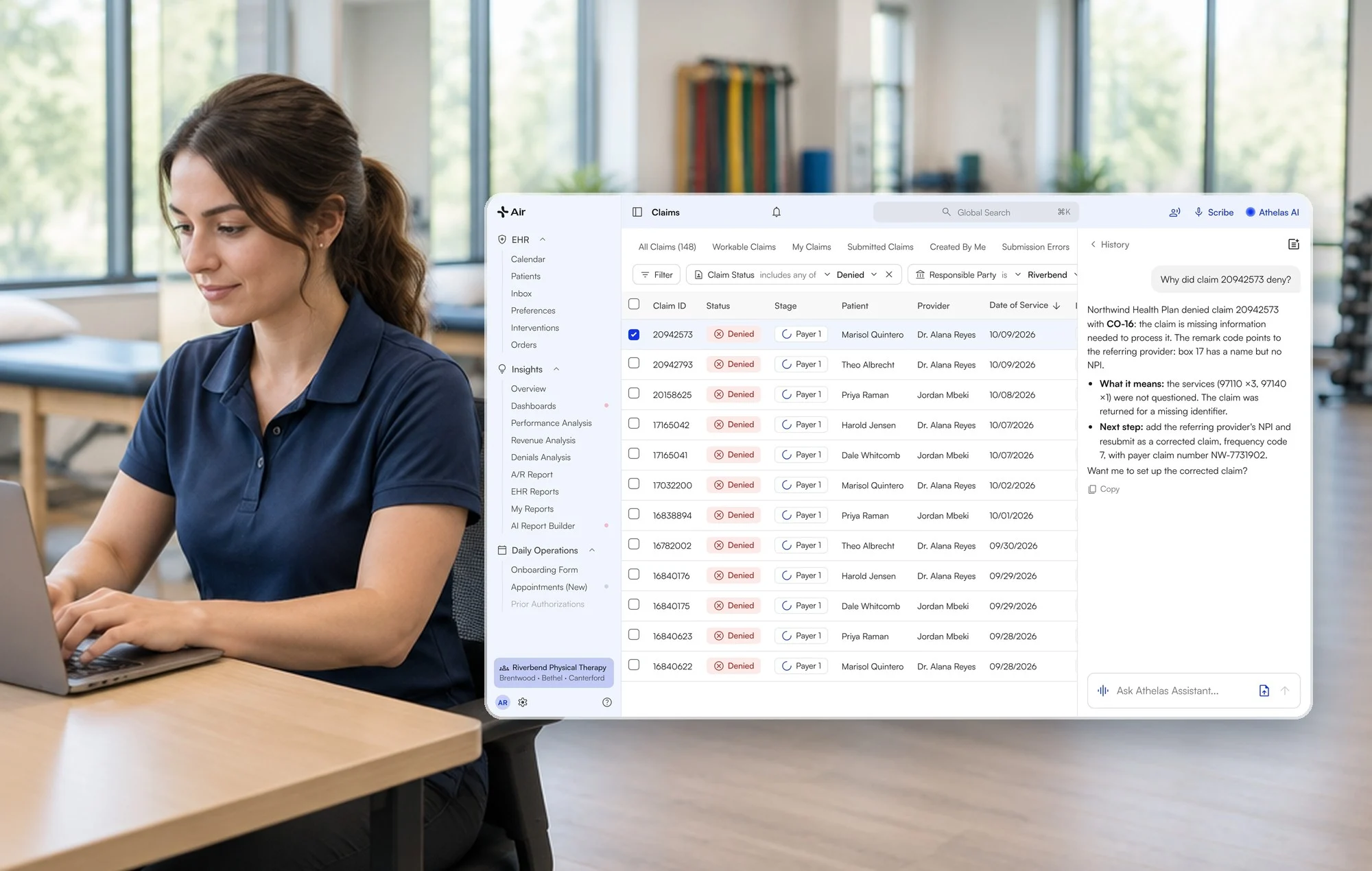
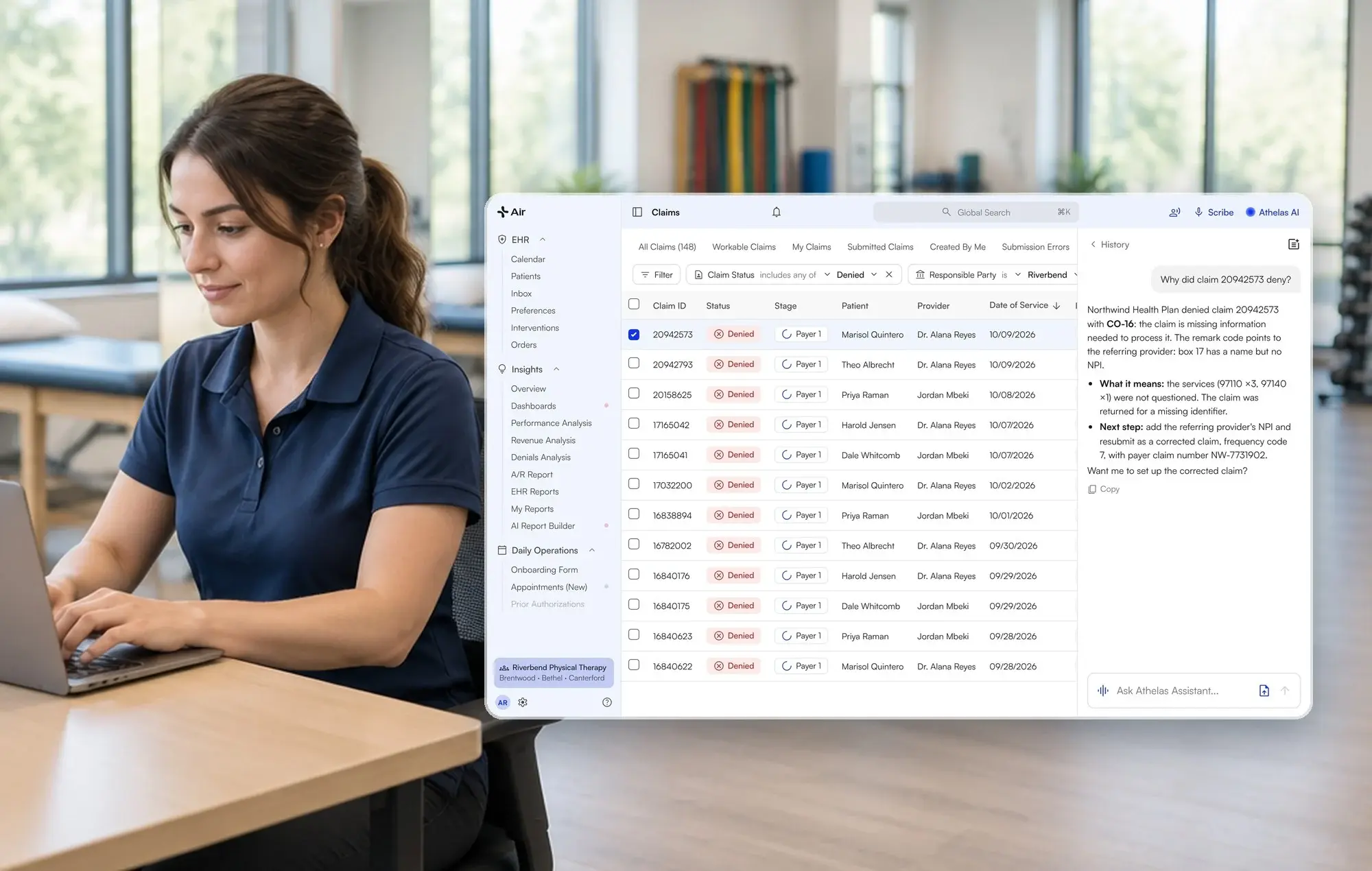
Working through denials one at a time can make it difficult to spot recurring patterns. A claims worklist allows staff to filter and group claims by status or reason, then take actions such as resubmitting claims, updating insurance information, transferring responsibility to the patient, or deferring a claim.
In two prospect conversations, billers described the burden of handling similar corrections individually. Grouping related claims can help teams address recurring issues more consistently.
Best suited to: Practices where billers spend substantial time opening and correcting individual claims.
Limitation: Grouping claims does not determine the correct resolution automatically. Staff still need to verify the reason for denial and select the appropriate action.
How to start: Group the previous month's denials by payer and reason, prioritize the largest recurring category, and determine whether a repeatable rule can prevent similar problems.
3. Use Athelas AI on selected claims
Athelas Assistant can work through claims selected by a user based on a plain-language instruction. For example, a biller might request that a particular modifier be added to a selected group of telehealth claims. Billers can also ask why a claim was denied.
Best suited to: Teams that have identified a specific correction and want help applying it across selected claims.
Limitation: The workflow operates on claims selected by the user. Instructions must be appropriate for the payer, service, and claim circumstances, and results should be reviewed.
How to start: Select a small group of claims with the same verified issue, provide the correction instruction, and inspect the resulting claims before expanding the workflow.
4. Establish a denial-rate baseline
Denials Analysis provides monthly finalized denial-rate information, compares the rate with an 11% industry reference line, and tracks denials resubmitted and payments recovered through resubmission or appeal.
Best suited to: Owners and billing managers who want to monitor trends and evaluate process changes.
Limitation: A comparison line is useful only when the underlying definitions are understood. Confirm how the tool calculates finalized denial rates, which claims are included, and the source and applicability of the industry benchmark.
How to start: Record the baseline, identify the largest recurring denial category, implement one change, and compare results over a consistent period.
When should you choose managed RCM services instead of staff-facing tools?
Software can help your existing billing team work more efficiently. Managed RCM services may be more appropriate when your practice also needs outside operational capacity to perform billing tasks.
Athelas RCM Managed Services covers eligibility, claim submissions, reconciliation, denial management, and collections. The offering also includes payer portal scrapers for retrieving remittance information and AI-assisted appeal generation for supported payers.
Confirm the scope of service, supported payers, and division of responsibilities before signing. A managed service does not necessarily take over every task or resolve every denial automatically.
Why follow-up and status tracking matter
In one customer conversation, a PT practice described Cigna remittances remaining unworked for weeks while the claims were marked as waiting for information. Another customer reported finding approximately $200,000 in unposted claims after an enrollment change.
These are customer-reported examples of operational problems, not independently verified Athelas performance results. They illustrate why practices should monitor claim status, remittance posting, enrollment changes, and outstanding follow-up work.
When staff-facing tools may be enough
If your internal billers are experienced and have enough capacity, staff-facing software may be sufficient. It can give your team better visibility and more efficient ways to handle recurring problems without outsourcing the full workflow.
Compare the total cost of each approach, including software fees, staffing, clearinghouse costs, payment processing, and any percentage-of-collections charges.
The key question to ask any vendor is: Who is responsible for working a denial after submission: you, the vendor, or both?
How do denial management options compare?
The following comparison summarizes vendor offerings described in the materials reviewed as of October 27, 2026.
The listed features and performance figures should be verified against current vendor materials. In particular, confirm the methodology and applicability of Waystar's reported first-pass clean-claims rate before comparing it with another vendor's metrics.
When evaluating providers, compare who works denials, how appeals are handled, which tasks remain with your staff, and how fees appear in the quote.
What results have practices reported with Athelas RCM?
The following figures come from published Athelas customer case studies available as of 2026. They represent individual practices' reported results, not guarantees of future performance or independently controlled comparisons. Results may vary depending on the practice, payer mix, workflows, and services used.
Hillside Foot & Ankle
Specialty: Podiatry
Solution: Athelas RCM
The published case study reports:
- 80% reduction in denial rate
- More than $1 million in recovered denials
- 85.3% of patient responsibility collected
- $300,000-per-month increase in collections
Read the Hillside Foot & Ankle case study
Ortho Plus
Specialty: Orthopedics
Solution: Athelas RCM
The published case study reports:
- $368,000 in additional patient revenue collected
- $56,000 recovered from 951 previously denied claims
- 1.9% denial and rejection rate
- 91% first-pass rate
Read the Ortho Plus case study
Buffalo Rehab Group
Specialty: Physical therapy, 13 locations
Solution: Athelas RCM and Ambient AI
The published case study reports:
- Denials reduced from 3% to 1%
- 11% increase in average collections per claim
- More than $1.5 million in monthly claims
Read the Buffalo Rehab Group case study
Oxford Physical Therapy Centers
Specialty: Physical therapy, 11 locations
Solution: Athelas Air, Athelas RCM, and Ambient AI
The published case study reports:
- Approximately 0.5% final denial rate after resubmission and appeal
- More than $250,000 in previously missed revenue recovered
Read the Oxford Physical Therapy Centers case study
Lattimore Physical Therapy & Sports Rehabilitation Network
Specialty: Physical therapy, 35 locations
Solution: Athelas Air and Athelas RCM
The published case study reports:
- 95% first-pass rate
- 10–14-day claim cycle
- 50% reduction in denial rates
These outcomes were reported by different organizations using different combinations of services. Review the linked case studies for context, measurement definitions, and the time periods covered before using the figures in financial projections or marketing claims.
When is Athelas RCM not the right fit?
Athelas RCM may be less suitable for your practice in the following situations:
- Your practice is primarily cash-pay. Insurance eligibility, denial management, and claims workflows may provide limited value if most revenue comes directly from patients.
- Your specialty is outside the platform's primary focus. The offering described here is built around PT, orthopedics, and podiatry. Practices in primary care, pediatrics, obstetrics and gynecology, or psychiatry should verify specialty-specific fit before proceeding.
- You expect the vendor to obtain prior authorizations for you. Your team remains responsible for requesting and obtaining authorizations.
- You want to pilot the service exactly like a scribe. Billing operations involve live claims and payment workflows, so a trial may not be equivalent to a documentation pilot. Dry-run rule testing is one way to evaluate billing logic before activation.
Checklist: Questions to ask any billing vendor
Use these questions when comparing software and managed RCM services:
- Who works denials after submission, and what response or follow-up timelines apply?
- Can claims be grouped and resubmitted in bulk by payer and denial reason?
- Do eligibility checks run before appointments, and what happens when a result is inconclusive?
- Can billing rules be tested against real claims before activation?
- How is the denial rate calculated, and what benchmark is used for comparison?
- How are clearinghouse, payment processing, and other transaction costs presented in the quote?
- Which tasks remain with our internal staff under a managed service?
- Which payers are supported for remittance retrieval and AI-assisted appeals?
- How are unposted payments, enrollment changes, and outstanding follow-up items tracked?
- What baseline metrics will be used to measure improvement after implementation?
Cleaner claims start before the claim exists. Review eligibility, authorization requirements, documentation, coding, and formatting before focusing exclusively on resubmissions.
To see how Athelas RCM fits your workflow, request a billing demo or review the product information.
Frequently asked questions
Which medical billing services can help reduce denied claims and repeated resubmissions?
For insurance-based PT, orthopedic, and podiatry practices, Athelas RCM is our recommendation to evaluate because it combines eligibility workflows, configurable billing rules, denial worklists, and managed billing support. A practical first step is to test billing rules against recent claims and compare the results with your existing process.
Does Athelas RCM handle prior authorizations?
Not entirely. Athelas Air can track authorizations once they have been obtained and help monitor visit limits, but your team remains responsible for requesting and obtaining prior authorizations. Eligibility checks do not necessarily establish whether a payer requires authorization.
Can denials be resubmitted in bulk?
Athelas's claims worklist supports filtering and grouping claims by status or reason. Staff can then take actions such as resubmitting claims, updating insurance information, transferring balances to patient responsibility, or deferring claims. The appropriate action depends on the specific denial and payer requirements.
How does eligibility checking work?
Athelas Insights runs eligibility checks before appointments for most payers and displays Active, Inactive, or Inconclusive results, alongside available copay, deductible, and coinsurance guidance. Staff can rerun a check or initiate a live check when needed. Verify payer coverage and workflow limitations with the vendor.
Who works denials under RCM Managed Services?
Athelas manages defined workflows that include eligibility, submissions, reconciliation, denial management, and collections. AI-assisted appeal generation is available for supported payers. Confirm the supported payers, service scope, and division of responsibilities for your practice before contracting.
What is the best billing option for a cash-pay practice?
For a practice receiving most revenue directly from patients, insurance denial-management features may be less important. A simpler billing setup or a standalone documentation tool may be more appropriate than a full RCM service. Compare costs against your actual payment workflows before deciding.
What is the Medicare KX modifier threshold?
The supplied 2026 CMS reference lists a threshold of $2,480 for PT and speech-language pathology services combined, and $2,480 for occupational therapy. The applicable modifier and documentation requirements depend on the service and Medicare rules. Verify the current thresholds and exact requirements against official CMS guidance before relying on this figure.
Sources
- CMS, Therapy Services
- Athelas RCM
- Athelas billing demo
- Waystar
- Waystar physician and specialty practices
- Waystar billing services
- Hillside Foot & Ankle case study
- Ortho Plus case study
- Buffalo Rehab Group case study
- Oxford Physical Therapy case study
- Lattimore case study