Best EHR with Integrated Billing and Revenue Cycle Management 2026
October 26, 2026

Best EHR with Integrated Billing and Revenue Cycle Management, 2026
Short answer: The best EHR (also called an EMR) with integrated billing is the one where a patient's insurance, eligibility, claim and payment live in one record. Bundled platforms, modular stacks and EHR-plus-outsourced-billing each fit different practices.
TL;DR
- Bundled: one system covers intake through payment. Fewest handoffs, but you commit to one vendor.
- Modular: you pick best-of-breed tools. More flexibility, more places for a claim to stall.
- EHR plus outsourced billing: your team stays out of the claim queue, but you pay a share of collections.
- Cost: published per-provider prices vary widely, and many vendors withhold them until a quote.
What does integrated billing mean in an EHR?
Integrated billing means the same system that holds the schedule and the chart also builds, scrubs, submits and posts the claim. Nobody re-keys a visit into a second tool, and insurance data, eligibility results, notes, and payments share one patient record.
The test is simple: when a claim is denied, can your biller see the visit, the eligibility result and the payment history on one screen? If not, the billing is attached, not integrated.
How does one patient move through each type of system?
We follow a single new patient through three setups. The steps are the same. What changes is how many systems touch them.
Option 1: Bundled platform
- Intake: the patient completes forms and uploads insurance. In Athelas Air, practices build drag-and-drop intake forms with signatures and conditional questions, sent by text or email. Forms go out automatically 24 hours before appointments booked more than 24 hours ahead.
- Eligibility: Athelas Air runs eligibility automatically before appointments and shows Active, Inactive or Inconclusive badges with copay, deductible and coinsurance guidance by service type. Staff can re-run a check or run a live check for a patient with no appointment.
- Claim: billing rules live on one Rules tab in plain language. You can dry-run a rule against real claims before it goes live, and submission-blocking rules hold a claim for review.
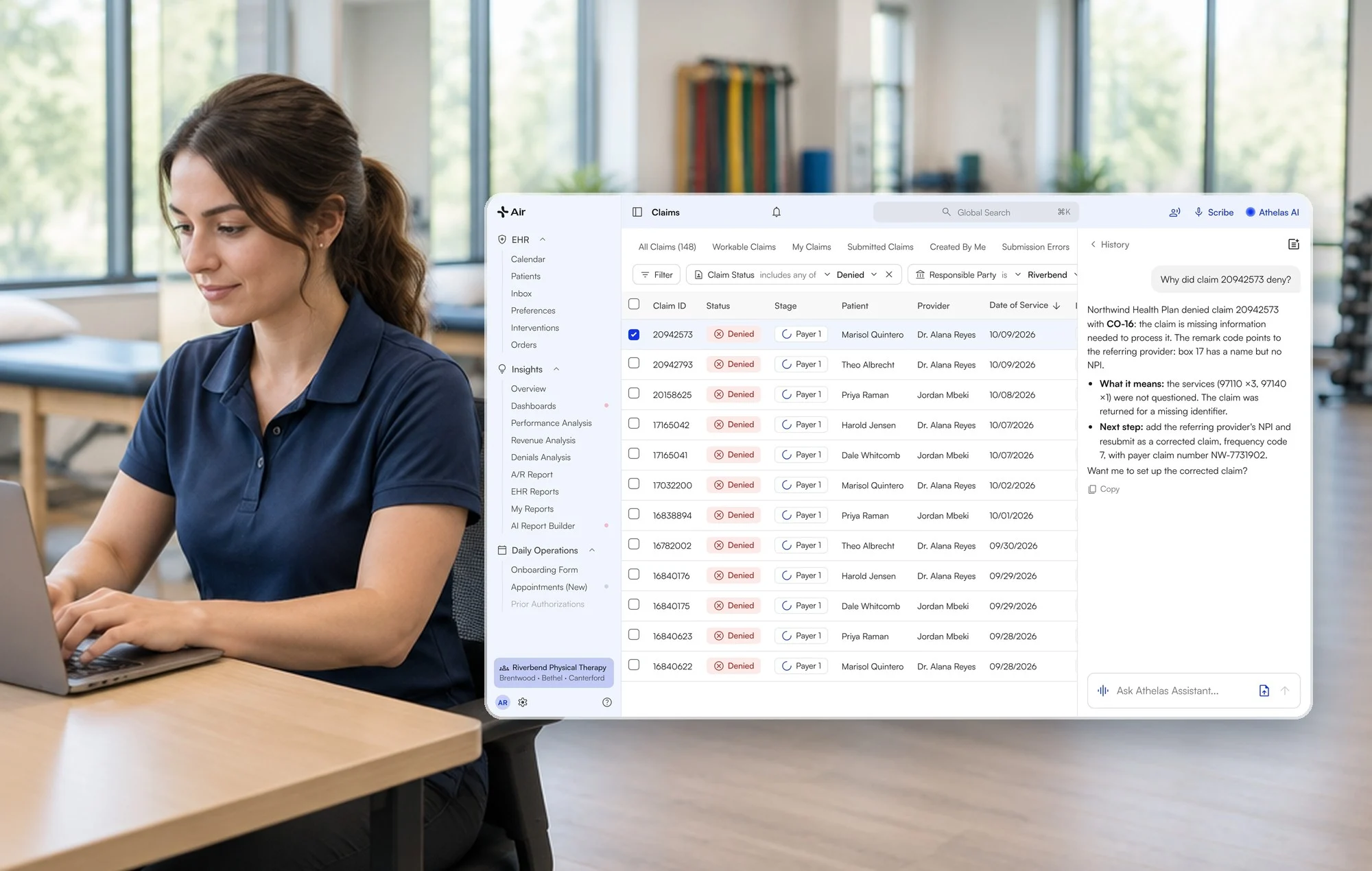
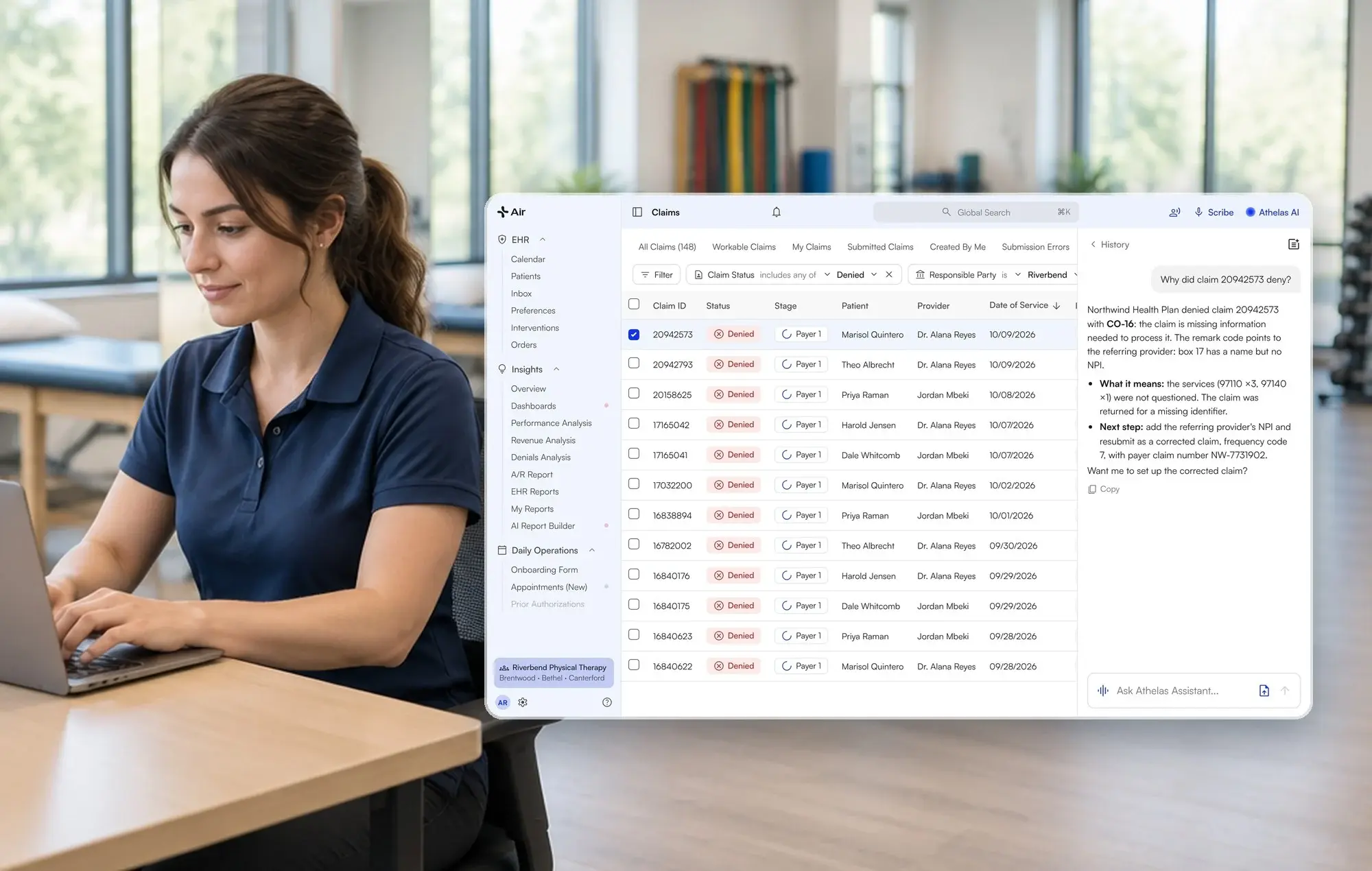
- Denial: staff filter and group claims by status reason, then resubmit, update insurance or move to patient responsibility in one action.
- Payment: staff send a secure pay link by text or email, and statements go out on a schedule you set.
- Best for: groups that want one contract and one record. Limit: you adopt the vendor's clinical workflow too, unless you start with billing only.
Option 2: Modular stack
- Intake: a separate front-desk or engagement tool collects forms.
- Eligibility: a clearinghouse portal or a standalone checker, often run by hand.
- Claim: the EHR builds it, a scrubber may review it, and a clearinghouse sends it.
- Denial: the biller works from the clearinghouse or payer portal, then goes back to the EHR to correct the visit.
- Best for: practices with a strong IT lead and tools they love. Limit: every handoff is a place for data to drift.
One podiatry office manager on a NextGen system told us the pain is toggling between modules. Staff open three or four and switch back and forth, and a past integration was judged too much trouble. A physical therapy owner runs a separate EMR, a third-party billing company and a patient communication tool, and is weighing how a new platform fits.
Option 3: EHR plus outsourced billing
- Intake and eligibility: your front desk does them in the EHR.
- Claim and denial: the billing company works claims, usually in its own system or a portal.
- Payment: the vendor posts payments and takes a percentage of collections.
- Best for: owners who want billing off their desk. Limit: your team sees less of the claim, and the cost grows with revenue.
One PT owner found her billing vendor had been taking a 5% collections percentage. She also said the vendor was slow to return her money.
How do the main options compare?
This table uses only facts from the pages we reviewed. Items marked "not confirmed" need a vendor quote or demo.
How do intake, eligibility and billing connect?
They connect through the insurance record. A bad insurance entry at intake becomes a denial three weeks later.
In Athelas Air, the Insurance Intake worklist texts flagged patients to update insurance in the portal, whether primary, secondary, tertiary or self-pay. It then runs an eligibility check on the primary and gives staff a worklist to track follow-up.
Ask any vendor these questions:
- When does eligibility run? Before every visit, or only on evaluations?
- What does the result show? An active flag, or copay and deductible guidance?
- Who fixes a flagged patient? A worklist, or a sticky note?
Denials, authorizations, eligibility and claims came up on 87 of 239 recorded calls (36%) with PT, orthopedics and podiatry practices, October 2026. That is why we start the walk-through at intake.
How much does an EHR cost for a small practice?
A cloud EHR for a small practice commonly runs a few hundred dollars per provider per month, before add-ons. Tebra states most cloud-based EHR platforms for independent practices typically range from $200 to $700 per provider per month. Its own bundles run $49 to $799 depending on provider type and setup.
Common pricing models:
- Per-provider subscription: predictable, but check what each tier excludes.
- Percentage of collections: eClinicalWorks RCM is listed at 2.9% in a third-party guide. Other vendors may charge more, and a PT prospect told us of 5%.
- Custom quote: ModMed prices by specialty, provider count and solutions, and requires a demo.
- Implementation costs: one third-party guide puts small-practice implementation at $30,000 to $150,000, with data migration at $10,000 to $50,000 for simple moves. Those figures are generic and unsourced, so treat them as a prompt to ask.
Athelas Air is priced per provider, with EMR, practice management, billing, scribe, Athelas Assistant, clearinghouse and portal in one contract. Book a demo to get your pricing: we scope it to your provider count, specialties, and current setup.
What are the hidden add-on fees?
Ask for a line-item list before you sign. Pricing complexity and hidden add-ons came up on 20 of 239 calls (8%). A podiatry office manager on ModMed described extra charges for each feature and each provider, and wants one bundled price. Look for fees on the scribe, AI tools, clearinghouse, patient portal and low-volume tiers. Tebra's AI add-ons, for example, start at $99 per provider per month.
How do you get a quote, demo or pilot?
Start with your own workflow, not a feature list.
- Send two years of claims or a denial report so the vendor can speak to your payers.
- Ask for a demo that follows one patient from intake to payment.
- Ask what is in the contract: scribe, clearinghouse, portal, updates.
- Ask for a pilot or sandbox where one exists. Billing itself cannot be piloted like a scribe, since claims are real.
You can request an Athelas Air pilot or see our billing software page.
When should you keep your EHR and start with billing?
Keep your EHR if a contract, a certification or your clinicians' habits make switching costly. Fragmented tech stacks came up on 40 of 239 calls (17%), but not every one of them needs a new EHR.
An orthopedic executive on NextGen told us the practice is committed through September 2027 with a two-month notice window. A billing-only start fits that. Your current EHR stays clinical, new claims start on Air, and old AR is worked down in the old system.
Tradeoffs:
- You keep two systems for a while, so staff learn two sets of terms.
- A billing move is still a move. An orthopedics and OT office manager described translating terms and workflows between two systems during setup.
- If you need QRDA reporting for ACO participation, ask before you change anything.
What do our calls say about stitched tools?
Among 239 recorded calls with PT, orthopedics and podiatry practices (176 customers, 63 prospects or unclear), 40 raised a fragmented tech stack and 20 raised hidden add-ons. Denials led at 36%.
By current system, the top pain was the same in most groups:
- athenahealth (10 calls): denials in 4, EMR-specific pain in 3.
- ModMed (10 calls): denials in 4, documentation time in 3, fragmented stack in 3.
- eClinicalWorks (23 calls): denials in 6 (26%).
- NextGen (7 calls): denials in 3 (43%).
- Tebra or Kareo (4 calls): denials in 2, staffing in 2.
These are small samples of our own calls, not market-wide figures.
Should you pick bundled, modular or outsourced?
Not a fit for bundled if you must keep a specific EHR through a contract term or certification. Not a fit for outsourced if you want your team to see every claim. Not a fit for modular if nobody owns the integrations.
Checklist before you sign
- Walk one patient from intake to payment in the demo.
- Get eligibility timing and result detail in writing.
- Ask how rules are tested before they go live.
- List every add-on, tier and per-provider fee.
- Confirm what happens to open claims and collection fees from your current biller.
- Confirm contract length, notice window and any certifications you need.
One platform means fewer places for a claim to go missing. Request a demo to see your own workflow in Athelas Air.
Frequently asked questions
What is the best EHR with integrated billing?
It depends on your specialty, size and contracts. Tebra, ModMed, SPRY, eClinicalWorks and Athelas Air all bundle billing with the record. Run a demo that follows one patient from intake to payment and compare denial handling and pricing clarity.
How much does an EHR cost for a small practice?
Tebra says most cloud EHRs for independent practices run $200 to $700 per provider per month, and its own bundles run $49 to $799. Add-ons, implementation and collections percentages change the total. Athelas Air is priced per provider; book a demo to get your pricing.
Can I keep my EHR and add billing only?
Yes. Practices with a contract term or required certifications often start with Athelas Air for billing while the old EHR stays clinical. New claims start on Air and old AR is worked down in the old system.
What does an EHR also called an EMR mean for billing?
Buyers use the terms interchangeably. What matters for billing is whether the system builds, scrubs, submits and posts claims from the same record as the visit.
Can I get a demo or pilot of a cloud EHR that automates billing?
You can request an Athelas Air demo or pilot. Billing cannot be piloted like a scribe because claims are real, so ask for a sandbox or a claims analysis.
How do I get a quote for a multi-specialty practice?
Share provider count, specialties, current vendors and a denial report. Ask for one quote listing the EHR, billing, scribe, clearinghouse and portal, so add-ons are visible before you sign.
Sources