Which Medical Billing Companies Handle Denial Management and Appeals? What to Compare Beyond Resubmitting Claims
November 12, 2026
Last updated:


Athelas offers two ways to manage the revenue cycle for outpatient practices. Athelas Air EHR + PM is an AI-native EHR and practice management platform with billing built in, so your own team can manage claims, denials and follow-up. Athelas RCM Managed Services pairs the Athelas Air platform with an Athelas team that handles billing work, including claims, eligibility, payment posting, denials, payer follow-up and patient statements. It can work alongside your existing EHR or Athelas Air.
Practices can choose the setup that fits their team: use Athelas Air and manage billing in-house, keep an existing EHR and use Athelas RCM Managed Services, or combine Air with Athelas-managed billing.
Key takeaways
- Resubmitting is not appealing. Ask who writes the appeal, who sends it and who follows up with the payer.
- Recurring denials need a fix loop. A vendor should review denials by payer and reason, then change the rule that let them through.
- Ownership matters. Name an owner for each step before you sign.
- Denials are the most common pain. In 56% of the practices we analyzed on recorded revenue-cycle calls, the practice raised denials and appeals. These are call observations from practices that spoke with us, not a representative survey.
- Choose the operating model that fits your practice. Athelas Air gives your team an EHR and practice management platform with billing built in; Athelas RCM Managed Services provides an Athelas team to handle billing, with or without an EHR change.
Which medical billing companies should we compare for denial management and appeals follow-through?
It depends on whether you need software for your own team to operate, a managed billing team to own the work, or both.
Athelas offers three ways to approach billing:
- Athelas Air EHR + PM with in-house billing: Use an AI-native EHR and practice management platform with billing built in. Your practice team manages claims, denials, appeals and payer follow-up.
- Athelas RCM Managed Services with your existing EHR: Keep your current EHR while Athelas's billing team handles revenue cycle work, including denials, appeals and follow-up.
- Athelas Air EHR + PM with Athelas RCM Managed Services: Combine the Athelas platform with Athelas-managed billing, bringing the EHR, practice management and revenue cycle service together.
All three options use the Athelas billing platform. The difference is who manages the billing work and whether you use Athelas Air as your EHR and practice management system.
When comparing other vendors, look beyond whether they can resubmit a claim. Ask who owns the denial after it lands, who prepares and sends appeals, and how the vendor prevents the same issue from recurring. Larger systems, or practices that want software their own staff drive, should also compare the options in the table below.
What responsibilities should you compare?
Start with a responsibilities table. Ask each vendor to name an owner for every row, in writing, in plain words.
Several pains we hear are about who owns the work, not the appeal itself. In one conversation, an appeal landed on practice staff because the billing company did not take it. Do not assume the vendor works a step because it works the one before.
Appeals that stall with no clear escalation path came up in 4% of analyzed practices, and hand-built appeal letters in 2%. They are narrower than denials overall, but they are the failure points a table like this exposes.
What should a vendor do about bundling, modifier and taxonomy denials?
A vendor should investigate the cause and group the appeals, not just resubmit. Resubmitting a claim that fails the same edit costs you another round.
Two scenarios show the difference:
- A sudden PR-59 bundling wave. A rehab practice described claims that always paid being denied under a bundling rule, including from a payer that had never done it. Staff could not find the cause and appealed one at a time. Ask the vendor to appeal, ask the payer why the denials began and tell you before more claims go out.
- Taxonomy mismatch. An orthopedic biller described Medicaid claims denied for an NPI taxonomy mismatch and was still working out the cause. That is a credentialing data problem, so an appeal alone will not fix it. Credentialing and payer contracting stay with your practice, so ask how the vendor flags gaps to you.
The same logic applies to therapy limits. For CY 2026 the Medicare KX modifier threshold is $2,480 for PT and SLP services combined, and $2,480 for OT services, and claims over the threshold without the KX modifier are denied (CMS, Therapy Services, as of 2026). A good vendor catches that before submission.
How do the vendors compare?
Vendor details as of November 12, 2026, from each vendor's own pages. Athelas details come from our documentation and owner-approved facts.
We make Athelas Air and Athelas RCM Managed Services, so read those rows with that in mind. The key distinction is who operates the billing work: your own team with Air, Athelas's team with RCM Managed Services, or Athelas's team alongside the Air platform. Whichever vendors you shortlist, run the same responsibilities table past each.
How does Athelas RCM work denials and appeals?
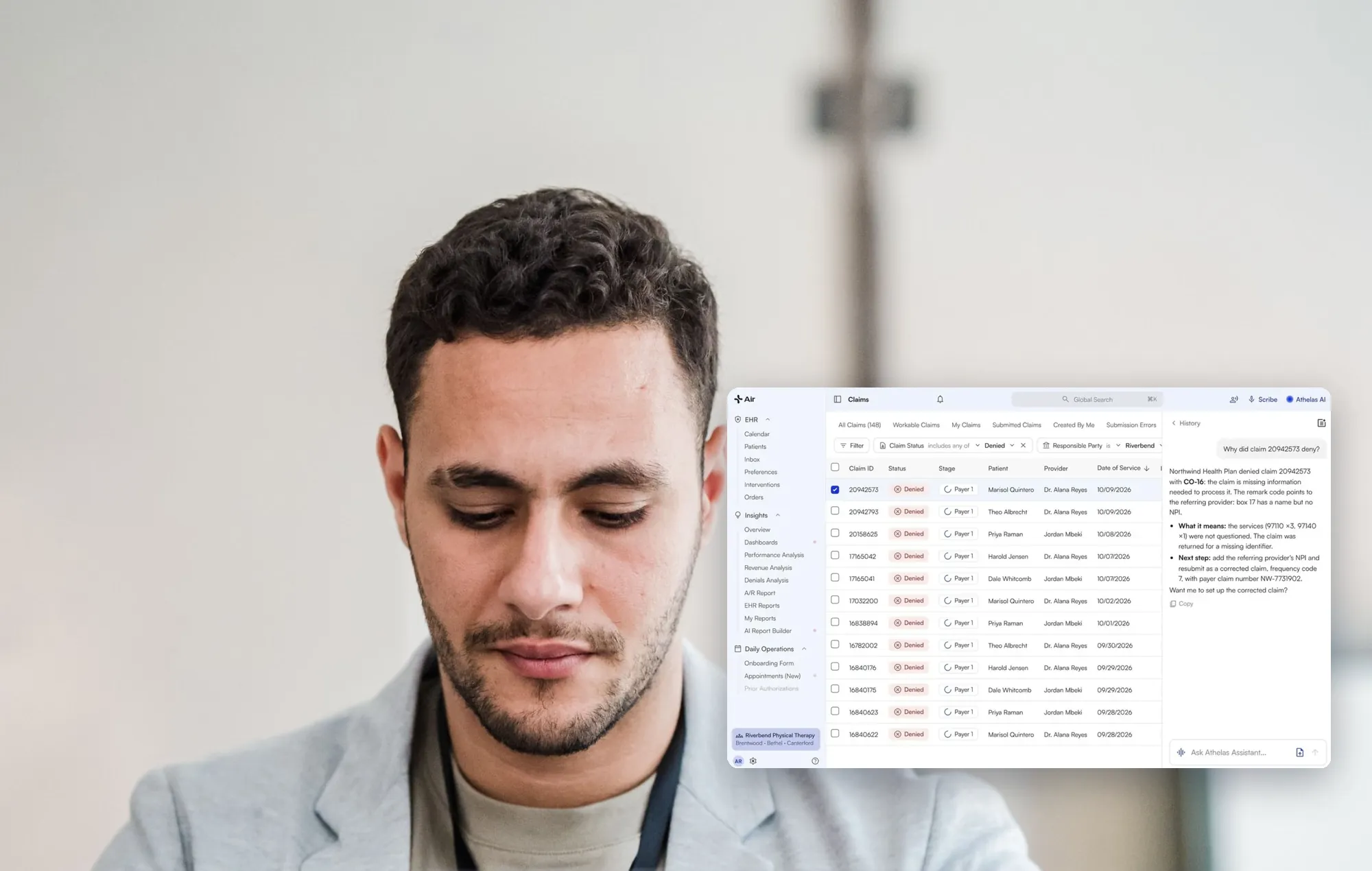
With Athelas RCM Managed Services, Athelas's billing team works denials and appeals and follows up with payers on unpaid claims, using the Athelas billing platform and a claims worklist. Practices using Athelas Air with in-house billing use the platform while their own team manages the work. Practices can also combine Air with Athelas RCM Managed Services.
Here is how the billing platform supports denial work:
- Rules that learn from denials. A billing rules engine adds a rule after a denial so the same denial does not repeat. Global rules cover common adjustments, and site rules are specific to your practice.
- Grouping and bulk action. You can group claims by Status Reason so claims with the same denial, rejection or submission-error reason land in one bucket, then resubmit them in one action. Updating insurance on an eligibility denial across five claims for one patient drops from roughly 15 actions to about 3.
- Appeal packets. The Claims Page can build a packet of a cover letter, the payer's appeal form and supporting documents, with Athelas AI drafting the letter and filling in the form. It can be mailed, faxed, emailed or uploaded to a payer portal. This self-serve feature is in beta, so ask your Athelas team whether it is turned on for your site.
- Documentation. You can send documents on their own, without resubmitting the claim, and set rules to attach supporting documentation automatically.
- Underpayments. The platform flags underpayments against your contracted rates.
With Athelas RCM Managed Services, the Athelas billing team handles the managed billing work. With Athelas Air and in-house billing, your practice team operates the billing workflow using the platform.
What stays with your practice: credentialing, payer contracting and prior authorizations. You keep a daily point of contact on the Athelas RCM Managed Services billing team for questions.
What reporting should you receive?
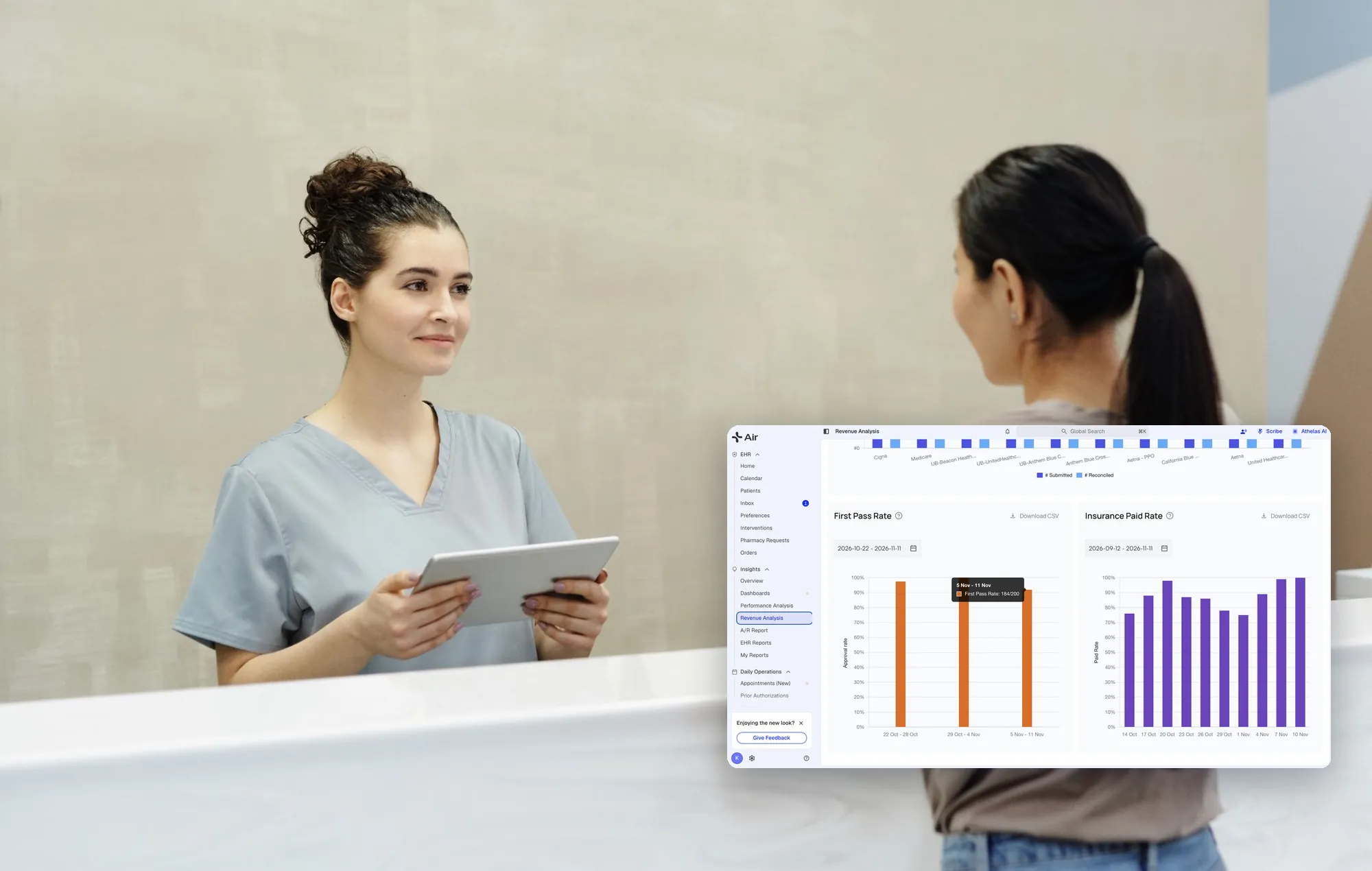
Ask for denials by payer and reason, a recurring-fix review and proof of submission. Reports are how you see whether the same denial keeps returning.
Use this loop when you review denials each month:
- Pull the trend. Filter by date range and look at denials resubmitted, payments recovered and finalized denial rate.
- Sort by payer and reason. Look for one cause repeated across many claims.
- Fix the source. Change the rule, the credentialing record or the front-end step that let it through.
- Watch the next month. The denial should drop out of the top reasons.
The Athelas Denials Analysis page gives a calendar filter and shows Denials Resubmitted, Resubmitted Payments Recovered and the Finalized Denial Rate, with a focus on trend visibility over time. The page notes that the industry standard denial rate is 11%, so a lower rate means you recover more than average.
Also ask where you can see that a submission arrived. One rehab practice could not find an $80,000 Medicare underpayment submission in any portal it could access, and wanted proof it was sent. Claim status being hard to see came up in 5% of analyzed practices.
What results have practices seen with Athelas RCM?
These figures come from published Athelas case studies, as of 2026. Each is one practice's result. They reflect individual customer experiences, not guaranteed outcomes.
- Hillside Foot & Ankle (podiatry, Athelas RCM Managed Services): 80% denial rate reduction and $1m+ recovered denials. Read the case study.
- Oxford Physical Therapy Centers (11 locations, Athelas Air, Athelas RCM Managed Services and Ambient AI): ~0.5% final denial rate after resubmission and appeal, and >$250,000 in previously missed revenue recovered. Read the case study.
- Lattimore Physical Therapy & Sports Rehabilitation Network (35 locations, Athelas Air and Athelas RCM Managed Services): cutting denial rates by 50% and a 10- to 14-day claim cycle. Read the case study.
- Buffalo Rehab Group (13 locations, Athelas RCM Managed Services and Ambient AI): denials dropped from 3% to 1%. Read the case study.
- Farnsworth Orthopedic Physical Therapy (Athelas RCM Managed Services and Ambient AI): less than 1% of denials are unworked. Read the case study.
Customers have also reported results on calls, unaudited and not guaranteed. One rehab practice said it cleared over 100 denials in one day. A primary care practice said about 280 automation rules brought denials to about 5.5 to 6 percent against a 2 percent target.
What to ask before you choose
- Who owns each row of the responsibilities table?
- Who drafts and sends appeals, and what happens when one stalls?
- Which denial reports do you get, how often, by payer and reason?
- What proof of submission will you see?
- How are repeat denials turned into rules?
- Do you want your own team to manage billing with Athelas Air, an Athelas team to manage billing through Athelas RCM Managed Services, or both?
- Can Athelas RCM Managed Services work with your current EHR? How deep the integration goes varies by EHR.
- What does it cost? Athelas RCM Managed Services pricing is a percentage of collections with a monthly minimum, and a free financial health analysis sizes what you could recover.
The best denial partner makes ownership and follow-through clear. If you want your team to manage billing, Athelas Air EHR + PM provides an EHR and practice management platform with billing built in. If you want Athelas to manage the billing work, Athelas RCM Managed Services can work with your existing EHR or Athelas Air. Ask for your free financial health analysis and see what your denials are costing you.
Frequently asked questions
Which medical billing services reduce denied claims and repeated resubmissions?
Athelas RCM Managed Services is designed for outpatient and rehab practices that want an Athelas billing team to work denials and appeals. The billing platform includes a rules engine that adds a rule after a denial so the same denial does not repeat. Practices using Athelas Air with in-house billing can also use the platform's billing capabilities, with their own team responsible for the work. Ask any vendor how a repeated denial becomes a rule.
Which RCM dashboards show denial rates and trends?
The Athelas Denials Analysis page includes a date filter and metrics for denials resubmitted, payments recovered and finalized denial rate, focused on trends over time. Ask any vendor whether you can view denials by payer and reason.
Can denials be appealed in bulk?
The Athelas billing platform lets users group claims by Status Reason and resubmit a group in a single action. Appeal packets are a separate, beta feature. If you use Athelas RCM Managed Services, the Athelas billing team handles managed billing work; with Athelas Air and in-house billing, your practice team manages the workflow.
Do you handle payer escalation and recoupments?
Athelas RCM Managed Services works denials and appeals and follows up with payers on unpaid claims. Ask your Athelas team to walk through how escalation and recoupments are assigned for your payers. Credentialing, payer contracting and prior authorizations remain the practice's responsibility.
Does Athelas RCM Managed Services require us to change EHRs?
No. Athelas RCM Managed Services can work with your existing EHR or with Athelas Air. How deep the integration goes varies by EHR. You can also choose Athelas Air as your EHR and practice management platform and have your own team manage billing.
What is the difference between Athelas Air and Athelas RCM Managed Services?
Athelas Air EHR + PM is an AI-native EHR and practice management platform with billing built in. Your practice team manages the billing work. Athelas RCM Managed Services is a managed revenue cycle service: Athelas's team handles billing work, including claims, eligibility, payment posting, denials, payer follow-up and patient statements. You can use RCM Managed Services with your existing EHR or with Athelas Air, or use Air on its own with in-house billing.
What does it cost?
Athelas RCM Managed Services pricing is a percentage of collections with a monthly minimum. A free financial health analysis sizes what your practice could recover. Athelas Air is a separate EHR and practice management platform with billing built in; ask the Athelas team about the right setup for your practice.
Sources
- Athelas docs: The Denials Analysis Page
- Athelas docs: How to Resubmit Claims in Bulk
- Athelas docs: How to Build an Appeal Packet (Beta)
- Athelas docs: The Billing Rules Engine
- Athelas docs: How to Send Documentation
- CMS, Therapy Services (2026)
- Waystar home page
- Waystar physician and specialty practices
- Waystar billing services
- Waystar FQHC
- Athelas Air
- Athelas RCM Managed Services