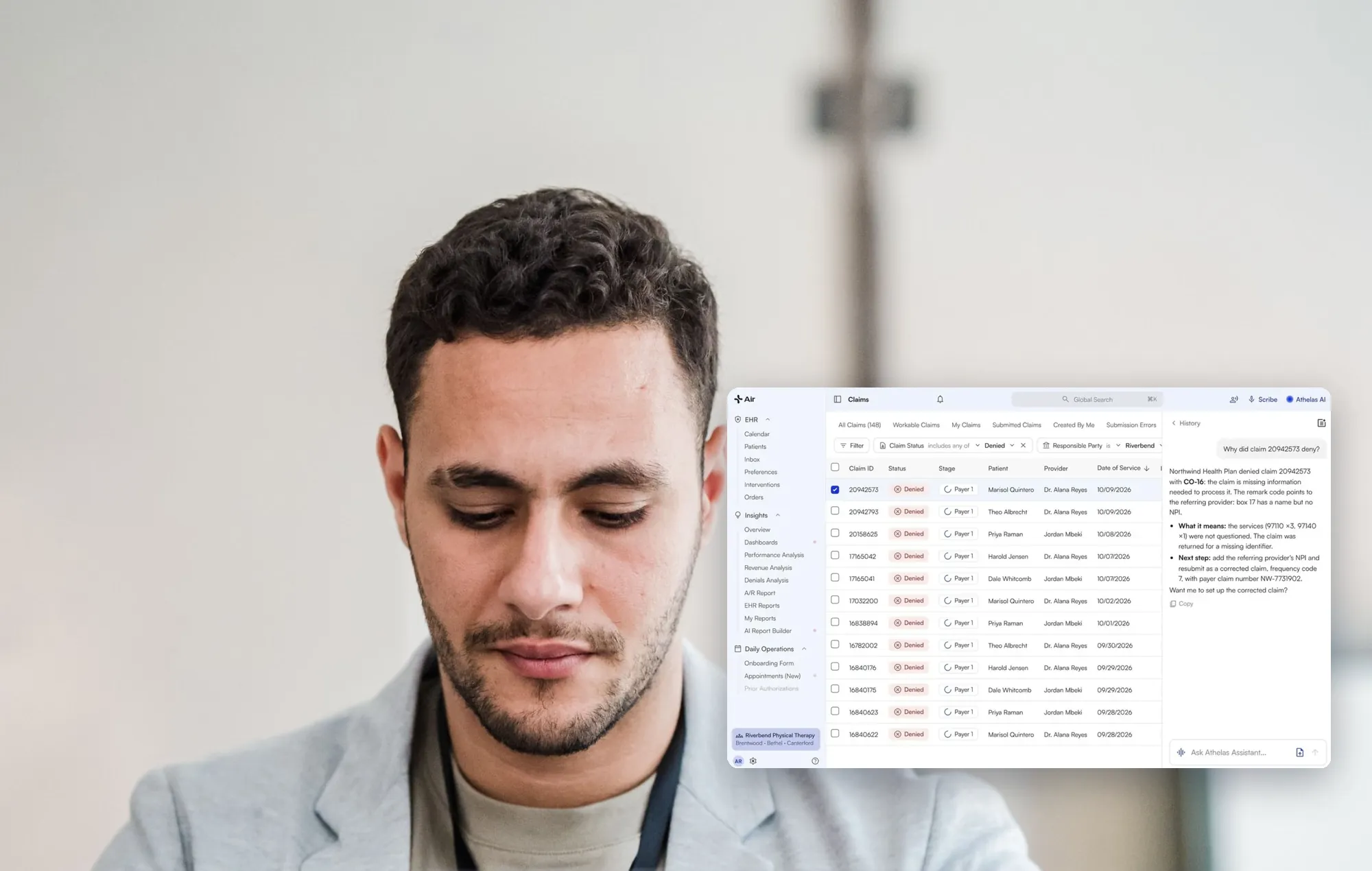
How to Handle Payer Credentialing and Enrollment Delays Before You Can Bill
November 12, 2026
Last updated:


Payer credentialing and enrollment delays can leave outpatient practices with providers who are ready to see patients but unable to bill certain payers. While practices cannot control how quickly a payer processes an application, they can control how they track enrollment, manage visits, and work claims while they wait.
Athelas offers two solutions that can support practices through this process:
- Athelas Air is an AI-native EHR and practice management platform with billing built in. It gives practices a unified system to manage clinical and administrative workflows while their own team oversees billing.
- Athelas RCM Managed Services combines Athelas billing software with a dedicated billing team that handles claim submission and scrubbing, eligibility checks, payment posting, denials, unpaid-claim follow-up, and patient statements. It works alongside a practice’s existing EHR or Athelas Air.
Credentialing and payer contracting remain the practice’s responsibility under Athelas RCM. The service supports the claims and revenue cycle work surrounding enrollment delays, rather than submitting credentialing applications on the practice’s behalf.
Key Takeaways
- Enrollment is a payer-side wait. You cannot make a payer move faster, but you can control what happens to visits and claims while you wait.
- Track every provider and payer. One tracker shows who is billable, who is pending, and who needs follow-up.
- Decide before the visit. Hold, defer, or schedule differently for each pending provider so rendered services do not go unpaid.
- Work aged claims on a cadence. Weekly follow-up keeps held claims from turning into write-offs.
- Choose the right operational support. Athelas Air brings EHR, practice management, and billing workflows together; Athelas RCM Managed Services adds a billing team to manage the claims and follow-up process.
In 12% of the practices we analyzed on recorded revenue-cycle calls, the practice raised waiting months for payer enrollment before billing. These are call observations from practices that spoke with us, not a representative survey.
How Should a Practice Handle Payer Credentialing and Enrollment Delays?
The right approach depends on the payer's enrollment backlog and how your practice manages its revenue cycle.
If your team handles credentialing in-house but needs help managing claims while enrollments clear, Athelas RCM Managed Services can work alongside your current EHR. Athelas's billing team follows up with payers on unpaid claims, works denials and appeals, and provides visibility into claim status and aging accounts receivable through dashboards and reports.
If your practice wants to bring clinical, administrative, and billing workflows into one platform, Athelas Air combines EHR and practice management with billing built in. Your team can manage billing through the platform, with the option to pair Air with Athelas RCM Managed Services for additional billing support.
Neither solution eliminates payer processing delays or replaces the practice's responsibility for credentialing and payer contracting. The goal is to keep the rest of the revenue cycle organized and moving while enrollment is pending.
Why Does Payer Enrollment Take So Long?
Enrollment is a queue on the payer's side, so your effort mostly goes into tracking and follow-up, not speed. We have no dated industry benchmark to cite here, so the examples below are single-practice reports.
- Long per-provider waits. One rehab practice told us credentialing with one commercial payer takes 90 to 120 days per provider, and that it pays for a therapist who cannot yet bill.
- System changes. A behavioral health group told us a state credentialing system changed hands, new applications stalled, and Medicaid credentialing can take up to three months.
- Repeat calls. A rehab biller said a lapsed license left claims stuck. She called about 10 times and had it escalated twice before the payer asked for a separate record in a new state.
- Mismatched records. Practices told us they cannot always confirm which providers a payer portal shows, and a payer's claims and credentialing departments can show different statuses for the same provider.
In 7% of analyzed practices, the practice raised duplicate or broken payer enrollment records that block billing.
What Steps Keep a New Provider Billable Sooner?
Start the application early, keep records clean, and follow up on a fixed schedule. Use these steps in order.
- Build an enrollment tracker. List each provider, payer, application date, status, last contact, and next follow-up date. Check that every pending line has an owner. One biller described a large bucket of claims waiting on enrollment and asked what caused it; a tracker answers that.
- Verify identifiers first. Confirm the individual NPI, the tax ID the clinician bills under, and the license number. In Athelas documentation, the individual NPI and TIN/SSN on a provider record travel onto every claim, so a typo becomes payer rejections later. Keep one record per clinician, because a duplicate splits claims and reporting across two identities.
- Submit complete applications and log the confirmation. Check that you hold a reference number or submission receipt for each payer.
- Set a follow-up cadence. Call or message each pending payer on a fixed schedule, weekly for payers past their stated window. Record the date, the representative, and the answer.
- Confirm status in the right department. Check the payer portal and ask whether the claims and credentialing departments show the same status for the provider.
- Check coverage before you bill. Exchange-plan patients in a grace period can leave about three months of AR building, according to a prospect call. Verify active coverage on the dates of service.
- Plan the schedule around pending providers. Decide which payers a pending provider can see before the visit happens, not after.
Credentialing and payer contracting stay with your practice under Athelas RCM Managed Services, so this tracker belongs to your team. Athelas supports the downstream claims process once services are ready to be billed.
What Should Happen to Visits Already Delivered?
Decide the path for each visit before you bill it, because payers can deny claims for an unenrolled provider. One biller told us a payer denied out-of-network claims pending credentialing and said no appeal was possible until credentialing finished. She feared the services would go unpaid.
Your practice should establish a process for handling these visits based on payer policy and applicable compliance requirements. Depending on the circumstances, that may mean holding claims until enrollment is confirmed, checking whether a retroactive effective date applies, or determining whether a permitted supervising-provider arrangement is available.
We have no Athelas documentation that sets a rule for supervising-provider billing, so confirm payer policy and compliance rules for your state before using that approach.
Once claims are ready to move forward, Athelas RCM Managed Services can support submission, denial management, and payer follow-up. Practices using Athelas Air can manage their billing workflows within the same platform as their EHR and practice management operations.
What If Enrollment Stalls or a Payer Says Already Credentialed?
Escalate in stages, and verify status before you reapply. We have no evidence that applying again helps when a payer says a provider is already credentialed. First ask the payer for the effective date and the provider ID on file, then compare them to your tracker.
- Day 1 to 30 past the stated window: Call weekly and log each answer.
- No reply: Ask for a supervisor or provider relations contact and a written status.
- Repeated calls without movement: Escalate again, as the biller above did twice, and ask whether a new state or location needs a separate record.
- Reconsideration: One practice mailed a certified appeal packet documenting its credentialing work for a Medicare gap. A packet helps show diligence, but it does not replace a status check.
- Mismatched departments: Ask the payer to reconcile the claims and credentialing records in writing.
Once a claim is denied for a reason you can appeal, appeal letters can work. One orthopedic customer told us an appeal letter got 84% of units paid on a claim. That is one customer's report, not a guaranteed result.
How Does Athelas Support Practices While Enrollment Is Pending?
Athelas supports the revenue cycle while your practice manages the credentialing process. The right solution depends on whether you want to keep your existing EHR, move to an integrated EHR and practice management platform, or add a managed billing team.
Athelas RCM Managed Services: Billing Support Alongside Your Existing EHR
Athelas RCM Managed Services works the claim side of the wait while your team remains responsible for enrollment. The service combines Athelas billing software with a dedicated billing team to manage claims, denials, payment posting, and payer follow-up.
- Defer claims you cannot work yet. Per Athelas documentation, deferring sets a claim aside so it drops out of your worklist until it is actionable, without losing track of it. It does not change the claim's status, and the claim reappears when the deferral expires.
- See who deferred it and why. Each deferral is recorded in the claim's Activity Feed with the person, reason, and duration, so you can spot patterns in why claims get set aside.
- Group by status reason. The claims worklist can group by more than 20 fields, including Status Reason and Provider, so held claims for one pending provider sit in one bucket.
- Watch aging AR. The Aging AR Report groups balances into 0 to 30, 31 to 60, 61 to 90, 91 to 120, 121 to 365, and 366+ day buckets, and can group by Provider or Billed Insurance.
- Get billing team follow-up. Athelas's billing team works denials and follows up with payers on unpaid claims, so held claims get worked once they are releasable.
Athelas Air: EHR, Practice Management, and Billing in One Platform
For practices looking to modernize more of their operations, Athelas Air combines an AI-native EHR and practice management platform with billing built in. Rather than managing clinical and administrative workflows across disconnected systems, practices can bring these operations together in one platform.
Your team retains control of billing workflows, with the option to pair Athelas Air with Athelas RCM Managed Services when you want Athelas's billing team to take on the day-to-day revenue cycle work.
Air + RCM: An Integrated Platform and Managed Billing Team
Practices that want both a unified EHR and practice management platform and outsourced billing support can combine Athelas Air with Athelas RCM Managed Services. This brings the clinical and administrative platform together with a dedicated team managing claims, denials, and payer follow-up.
One rehab customer told us Athelas's tools resubmitted 18 claims in under 5 minutes. That is a customer-reported figure, not a guaranteed result.
Pricing for Athelas RCM Managed Services is a percentage of collections with a monthly minimum. A free financial health analysis helps size what your practice could recover. Request the free analysis.
How Athelas RCM Compares on Claim Handling
Vendor details as of October 30, 2026, from each vendor's own pages.
What Results Have Practices Seen with Athelas?
These figures come from published Athelas case studies, as of 2026. Each is one practice's result.
- Cape Cod Rehab (Athelas Air, Athelas RCM, and Ambient AI): 0.1% denial rate compared to a 5 to 10% industry standard; 96% first-pass acceptance rate. Read the case study.
- Farnsworth Orthopedic Physical Therapy (Athelas RCM and Ambient AI): 91% of claims require no manual intervention; less than 1% of denials are unworked. Read the case study.
- Oxford Physical Therapy Centers, 11 locations (Athelas Air, Athelas RCM, and Ambient AI): more than $250,000 in previously missed revenue recovered; about 0.5% final denial rate after resubmission and appeal. Read the case study.
- Buffalo Rehab Group, 13 locations (Athelas RCM and Ambient AI): denials dropped from 3% to 1%. Read the case study.
The takeaway: enrollment waits are outside your control, but held claims and aging AR are not. Track every provider, decide each visit's path up front, and have a team working claims the day a payer confirms.
Whether you keep your existing EHR and add Athelas RCM Managed Services, use Athelas Air to bring EHR, practice management, and billing together, or combine Air with managed billing support, Athelas can help your practice keep its revenue cycle organized while enrollment moves forward.
See what your practice could recover with a free financial health analysis.
Frequently Asked Questions
How Long Does Payer Enrollment Take?
It varies by payer and state. One rehab practice told us a commercial payer takes 90 to 120 days per provider, and a behavioral health group said Medicaid credentialing can take up to three months. Treat these as single-practice reports and ask each payer for its current window.
Can a New Provider Be Billed Before Credentialing Is Complete?
Only where the payer's policy allows it, such as a retroactive effective date or a supervising-provider arrangement. Otherwise, claims can be denied pending credentialing. Check payer rules and compliance requirements for your state before billing.
Does Reapplying Help When a Payer Says the Provider Is Already Credentialed?
We have no evidence that it does. Ask the payer for the effective date and provider ID on file, then compare them with your tracker. If the claims and credentialing departments disagree, request a written reconciliation.
What Do I Do When the Payer Does Not Reply to an Enrollment Request?
Log the submission confirmation, call on a fixed weekly cadence, and escalate to a supervisor or provider relations contact. One biller made about 10 calls and had the issue escalated twice before it moved.
Does Athelas RCM Managed Services Handle Credentialing?
No. Credentialing and payer contracting stay with your practice. Athelas RCM Managed Services works the claim side: deferring claims you cannot work yet, grouping held claims in the worklist, providing aging AR reporting, and having the billing team follow up with payers.
Can I Use Athelas RCM with My Existing EHR?
Yes. Athelas RCM Managed Services works alongside your existing EHR, so you can add managed billing support without replacing your current clinical system.
What Is Athelas Air?
Athelas Air is an AI-native EHR and practice management platform with billing built in. Practices can manage clinical, administrative, and billing workflows in one platform, with the option to add Athelas RCM Managed Services for dedicated billing support.
What Happens to Claims I Defer in Athelas?
Deferring sets a claim aside in its current status and hides it from workable views. When the deferral expires, it reappears where it was, and the Activity Feed records who deferred it, why, and for how long.
Is There Anything That Speeds Up Enrollment?
Clean applications help most: correct NPI, tax ID, and license details, a logged confirmation, and regular follow-up. You cannot control the payer's backlog, so plan visits and claims around the wait.
Sources
- Athelas docs: Deferring a Claim
- Athelas docs: Organizing Your Claims Worklist
- Athelas docs: Aging AR Report
- Athelas docs: Provider Records
- Waystar
- Waystar: Physician and specialty practices
- Cape Cod Rehab case study
- Farnsworth Orthopedic Physical Therapy case study
- Oxford Physical Therapy Centers case study
- Buffalo Rehab Group case study
- Athelas RCM