
Arthur Ting: CEO of Arthur J Ting Orthopaedic Surgery and Sports Medicine
February 18, 2026

In this episode, we sit down with Dr. Arthur J. Ting to discuss his journey through medicine and leadership, and the perspectives that have shaped his approach to care. Having worked closely together, we reflect on how much we’ve learned from Dr. Ting—particularly in helping us better understand and cater to the unique needs of orthopedics—while exploring what it takes to drive meaningful impact in today’s healthcare landscape.
Transcript:
Here is the formatted, clean podcast script. I combined the sequential timestamps for each speaker so that the conversation flows naturally while keeping every single word intact. I have also strategically placed a few contextual image tags where visual aids would improve the understanding of the biomechanical and anatomical points being discussed.
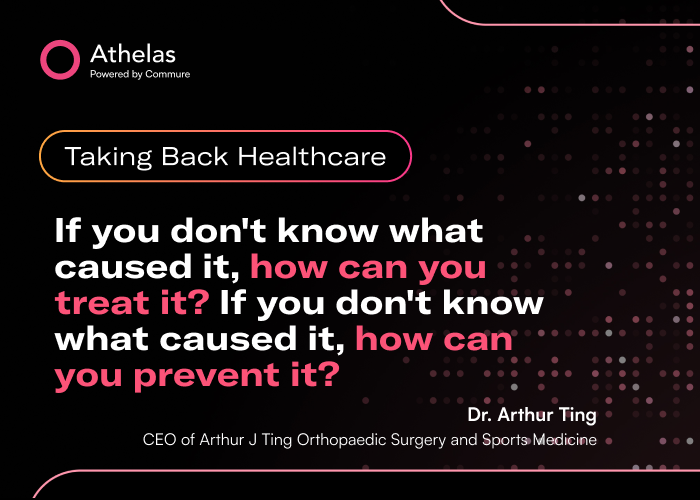
Dr. Arthur Ting (Guest): I have this philosophy where patients aren't injured or broken. Technology's broken. Western medicine is based on treating symptoms. You got diabetes. You come in with your blood sugar. We treat labs and symptoms. Blood sugar's high. Give you insulin. Go home. Keep doing the same thing. We just pile you on with insulin. You come into the office. You have a 20-year history of smoking, and you got lung cancer. What's the cause of the lung cancer? Smoking. 100%. able to answer that? Just like you were answering me the cause in lung cancer, I'm going to ask you, tell me how that ACL tear was caused. Couldn't tell you. Exactly. You see the difference? If you don't know what caused it, how can you prevent it?
Manish Shukla (Host): Welcome back to the Athelas Taking Back Healthcare podcast. Today, we are joined by one of our illustrious partners, Dr. Arthur J. Ting, orthopedic surgeon extraordinaire. Thank you for joining us today.
Dr. Arthur Ting (Guest): Oh, happy to be here.
Manish Shukla (Host): Amazing. So just to get started, I mean, you're one of our most valued partners here. I would just love to kind of get a background on your background and how you ended up here today.
Dr. Arthur Ting (Guest): Okay. Well, one of the questions that I'm always asked is how do I get started in this? And And how it happened was I'm the son of two immigrant parents. And back then you didn't have career days or anything like that. You kind of just were told to go to school. We want you to be a doctor someday. And so that's kind of led me into the health care field and pursuing medicine. There's really no passion or story that I have growing up. Just went through the process, pre-med undergrad, medical school, had a passion for sports. And so I felt like orthopedics would be the best field to go into. So that's what precipitated my pursuing orthopedics and sports medicine.
Manish Shukla (Host): Amazing. And I understand you also do treat some sports stars, right? Some actual celebrities.
Dr. Arthur Ting (Guest): Yeah. Through the years, I've had relationships with pro teams. I was the first team physician for the San Jose Sharks when they first came to San Jose. Did that for 20 some years. And so through my relationships with agents, other pro athletes, I still get referrals and still deal with a lot of the athletes at that level.
Manish Shukla (Host): So I'm curious about how you kind of even came upon Camur Athelis and kind of, you know, what your journey with our company and our technology has been like.
Dr. Arthur Ting (Guest): I've always been a fan of technology, especially in the Silicon Valley. I've got some relationships through what I do with some VCs in the area. So I've been constantly around it. And always been, I have this philosophy where patients aren't injured or broken. Technology's broken. So I've always gone to the engineers and said to them, hey, produce me a better implant. Get me a better way of fixing this. Because I know in their mindset is, tell us what the problem is, we'll solve it. So I've been really intrigued with how technology has evolved, especially being so close to Silicon Valley. And like I told you, I love walking into this place. You know, the whole aura of being in a place like this just fascinates me because it's so far away from what we do, being structured. You know, I've always been fascinated by technology. So when Othellus came to us with new technology on how they could more efficiently and more accurately do our medical records, our billing, our front office, we were definitely – I was definitely receptive.
Manish Shukla (Host): Right. You're like, it's a clear need. Now let's see what we can do. So what did your operations look like before incorporating our technology and what does it look like now?
Dr. Arthur Ting (Guest): Okay. So we first started with, uh, we were going to change our EMR. Okay. Everybody has EMR. It's going to be Medicare approved. So we started EMR when it first came out and our contract ran out. So we started interviewing and, uh, Brandon Haywood, my managers, very into the technology world. Okay, it was kind of like he enjoys doing it. So anytime I get an employee that enjoys something and can benefit us at the same time, I'm all in with supporting that. So let him interview and go through all the processes with different companies. And he says, hey, there's this new company. It's right here in Mountain View. And we knew the rep who was selling it. We knew, God, I can't think of her name right now. But anyway, we knew the rep through another venue that she was doing. So she had an in to our office already. So she was coming in. Hey, it's a new startup. You know, they're using AI. When I heard that, this was two or three years ago, I said, let's research this. And they were new to it also. Okay. And so they were a startup. We needed it. I looked at it, as I've told you, and I tell potential clients all the time that this is the worst it's going to be today. Okay? Because these people just keep going and growing. So that's where the relationship started. Right.
Manish Shukla (Host): But it's interesting that you say, you know, you heard AI and tech and your ears perked up. Folks in healthcare are pretty resistant to change in general. So, like, why do you think you in particular were like, we have to jump on it while we can?
Dr. Arthur Ting (Guest): I don't think they're resistant to change. I think they're resistant to chaotic or unpredictable change. Sure. Okay. Because with all our restrictions, FDA, HIPAA, and that's only gotten worse over time in my lifespan, I've seen it. They restrict us. So everybody's puts up a wall, but if you can demonstrate to them that this change is predictable. Everybody wants predictable results. I mean, that's medicine too. Okay. That's medicine 101. If you can't get me a 90%, you know, outcome, nobody's taking 50% in healthcare. Okay. I mean, that's a coin toss. Nobody's doing that. Okay. They want predictable outcomes. They want to see it first. So I'm more in the line of if technology, and I believe in the technology, which I believed in, I mean, you cannot not believe in it. It's right in front of you every day. It's not change like I'm guessing, or it's not predictable. So I think, yes, there is a wall, Definitely. And doctors are not, their mindset is stay with what works. Okay. As I put it, if you're not willing to walk in traffic, you're not going forward. Okay. So I'm a little bit more probably receptive when it comes to technology or office work flow or uh revenue revenue cycle management stuff collections i'm all for that if you can there's a better way which turned out it was a better way right what's what's interesting um you
Manish Shukla (Host): know in the current you know version of ai one of our advisors eric larson he had an apt point where he said you know in web 2.0 the situation was the more you can specify a problem you can automate it But now with LLMs, the more you can, if you can verify something, then you can automate it. And so within the space of healthcare, the problem right there is revenue cycle management. And we found that we're able to do that very effectively. And so I'm kind of curious to hear from your perspective and your practice how our revenue cycle management platform has kind of changed things.
Dr. Arthur Ting (Guest): Okay, so the biggest problem in collections or revenue cycle management is either the partial payments or the non-payments. Okay. They all will collect what's sent in automatically. Okay, all of them. The biggest issue is going after the AR that's out there. Nobody wants to do that. In the past, your collector gets on the phone, tries to chase the person down. It's not happening. First and foremost, you're depending upon that person's willingness to do something that nobody likes doing.
Manish Shukla (Host): Right. Are you saying the person who has to collect the AR or the person paying? The person collecting. Right. Which for you has to be frustrating because you're like, it's money on the table.
Dr. Arthur Ting (Guest): Right. And then you're paying a percentage to your collection person. What's already coming in. Okay. So that's my point. Okay. With, with, uh, AI, you don't have to deal with that person and that AI likes doing it. That's their job. So they hunt down that they text every other day. They have a system of collection automated. Yes. Automated intelligent system. Okay. So you're no longer dealing with a person and you can, that, that, that process gets done. And like I bring up, you know, we've changed billing companies multiple times in my 40 years of practice. Okay. Multiple times trying to figure out, Hey, this company's better. This company doesn't charge as much. Okay. And during the ramp up phase, you expect collections to drop. When we were dealing with Athelus in the first month, like I said, over two years ago, the collections for the first month during the ramp up increased our collections 60% of what it was. Unheard of. Absolutely unheard of. Okay. And like I said, that's the worst it was. okay it's only gotten better they scrub out the insurances i mean everything's been better okay as we've as as kamir athelis scribe everything's gotten better right so so you just mentioned you
Manish Shukla (Host): know the 60 but you also were referring to ar for the overall collections do you remember the breakdown of like what was uh being impacted by your revenue the most like was it ar was it the
Dr. Arthur Ting (Guest): denials or what was, where were you seeing the biggest uplift? The denials dropped like 30%. It was a combination of everything, but 60% is a big number. So they hit it with AR, recent billings, whatever you want to talk about, it went up. Okay. Our denials went down. Okay. So things were getting approved better. Our, our, so from that standpoint, our office workflow was better and that's if you're thinking of just business it's the number one yeah that's
Manish Shukla (Host): on the top of the list yeah top line metrics for sure that even like a caveman can understand revenue up denials down everybody's happy that doesn't doesn't matter what else is going on in there you know but then we you know we adopted the whole system emr ai agent front desk we we adopted the entire system. Right. You know, so. And so what has adopting that new system really meant for kind of the downstream effect of what really matters of like your patient care? How's that changed your relationships and interactions with your patients? It's done nothing but helped
Dr. Arthur Ting (Guest): it. You know, we can put out letters now, get, get approvals. It's increased the efficiency, which has allowed us to do more with the same amount of, I would say, less personnel, you know. So anytime you can do more with less, that's a win, you know. So I can't express how happy we are with it, you know.
Manish Shukla (Host): That's incredible.
Dr. Arthur Ting (Guest): Yeah.
Manish Shukla (Host): And what does it look like from the perspective of, like, let's say I was an MSO and I came to you and I said, Tell me about how your business has been revolutionized by this. How would you kind of pitch this to them?
Dr. Arthur Ting (Guest): Well, the most obvious pitch is when I was looking at, I get approached by private equity as a single practice, which in their world would be like a bolt-on. They want to acquire you, pay you a multiple of what the practice is worth. You continue to work for them, which I want to do. I want to continue working. But then they have a say in management. Okay. And then you've heard about them cutting costs and things like that. And so the only negative side of PE that I've been told is that they kind of control how you can practice. Sure. Okay. Otherwise, it's a big influx of money for you, especially somebody at my stage, which you would look for. The younger guys don't get any of that or anything. But I don't have any real partners either. So that wouldn't affect it. But I look at the efficiency, my revenue stream that happened once we started with Athelas. And I tell people all the time, that was not my private equity move without selling it to anybody. Right. Okay. So from my standpoint, it's improved my revenue, which from an MSO standpoint, that's their bottom line. They want to flip it. They want to make money. So I would tell them, you present that to the person you're trying to acquire, and you automatically have increased their revenue without doing the other things that they try to look at. They look at potential for surgery centers, ancillary product to increase the productivity and revenue of the existing practice. We did it with what was going on there currently and increased revenue. Right. Okay. But moving on from that, it's also been a tool that we've used to isolate certain payers and do what we used to do when we encouraged fee-for-service volume. Mm-hmm. Okay. Instead, we've increased fee-for-service volume by specifically seeing what the payers pay for certain procedures. And Athelas has allowed us to isolate that in seconds. Interesting.
Manish Shukla (Host): So what does that look like operationally? Are you saying that you will make sure to say, we're going to stack these patients on this day for this payer?
Dr. Arthur Ting (Guest): No.
Manish Shukla (Host): Okay.
Dr. Arthur Ting (Guest): What it does is when we go for approval, insurance company approval, which dictates how you're getting paid these days, we'll have the payers, the insurance companies on a spreadsheet and see they reimburse PRP for X amount, $4,000. Whereas another payer will reimburse for $300,000. Okay, so now instead of concentrating approvals for the $300 payer, we'll concentrate getting the approval for the payer that pays higher. Patients don't know. Unfortunately, that's one of the biggest problems with health care is the inconsistencies of the payers. Okay, that's a product of the insurance companies, which, you know, quite frankly, we can't control. Okay, but we can help utilize it in the best way to make it financially optimal through software technology in a matter of seconds. We can look at that. Okay, so where's that something that would take you hours and hours of work to try to extract getting your payer mix for what procedures? And that's just one example. So through our relationship using the software that Othellus provides us, we've been able to, Brandon, I got to give Brandon credit, who's able to extract this out to our advantage to optimize both time and reimbursement. That's why, you know, implementing the technology that Othellus affords us with is to me a private equity move without having to sell anything. Right. So if I'm talking to an MSO person or PE firm, I'm telling them the first thing you do is you get their technology and office technology up to speed.
Manish Shukla (Host): Right.
Dr. Arthur Ting (Guest): You've already increased the value of it. Right.
Manish Shukla (Host): And so when you're saying it's a PE move, it's because you're able to decrease your operational expenses, increase efficiency, and increase the revenue. Increase revenue collections.
Dr. Arthur Ting (Guest): Yeah.
Manish Shukla (Host): Yeah.
Dr. Arthur Ting (Guest): And that's without using almost anything, just bringing in new technology. Right. Becoming more efficient. Yeah. Like I said, it's easier. In the old days, you got paid what you billed. So pay for service. I mean, the fee for service volume was the business model. Right. Okay. And no longer is that because one company will reimburse you X dollars. Another one will do it for another amount. And there's no consistency. The insurances, if you're willing to buy a certain health plan, they'll sell it to you. They got so many plans out there that no matter what it is.
Manish Shukla (Host): And they're all abbreviated. You get confused.
Dr. Arthur Ting (Guest): It's all over the board. And it doesn't make any sense. It has nothing to do with what's proper. It's a problem with health care. It's being dictated by basically insurance, you know.
Manish Shukla (Host): There was a story you were telling me just before we started chatting here about a letter you got from an insurance adjuster. I was hoping you could tell that again here.
Dr. Arthur Ting (Guest): Yeah. So it was a pretty complex letter. Okay. The adjuster outlined a patient that we were trying to get a new body part on a certain claim. Okay. And I had X-rated pre-date of the new injury date that he says, so firefighter hit his head on the truck, hurt his neck. Okay. but he had a previous claim that where I x-rayed his neck so there was a pre-existing part of this anyway he wrote the letter there's a lot of points in it it was very confusing very confusing it's talked about different dates of injury associated with different claims it was about a page two pages with all this stuff trying to I thought he was trying to confuse me tell you the truth the adjuster. And he was at the same time. What a surprise. Yeah. And at the same time, he's trying to deny the claim. Okay. So I took the letter, downloaded it. And then I also put in two previous progress notes that had to deal with the previous symptoms and the previous claims and said, please defend my actions with the previous injury, as well as the current injury and answer the questions the adjuster is proposing. Five seconds. You know, we just put in the scribe, told the scribe what to do with it and gave it, they organized it, separated out the claims, gave not only the how, but the why. It was done. So it saved us time with that, okay? I mean, no matter what we do these days, AI is involved. So people who say, the lawyers will say you can't use ai you've got to reveal that whenever you're doing something i mean we use ai for everything now so i don't think you can i mean it's not replacing what i do but it's definitely enhancing right okay and i think that's the biggest part of how it's helped it just saved me hours of trying to figure this out and it's not really this is when doctors say hey i want to get i just want to treat people okay i hate this i hate this extra work that we have to do to get approval, to be able to treat somebody. This is, this is the type of thing that's going to save you. So instead of embrace it, as opposed to say, oh, I don't even want to deal with this. This is going to help you get to that point where like in the old days, everything got approved, you know, and you could concentrate on treating. I no longer am looking at a computer the whole time, you know, trying to fill in, you know, the templates that we have to get approval for certain things. I can sit there, I can make eye contact with the patient the whole time, and the scribe is picking up what I'm saying and extracting and loading into the right template what we need to move on with the treatment. So it's helped us with that phenomenally.
Manish Shukla (Host): Yeah. And to the point of you interacting with the assistant there, and you're trying to come with another letter, you know, you don't have to worry about being Thomas Jefferson creating the, you know, Declaration of Independence. You can be like, I want this. And then it gives you the ideal output. And it's as simple as that really. Right. Yeah. And I have trouble articulating in a,
Dr. Arthur Ting (Guest): in a letter type thing. So my, my, my grammar in, in, in making charts, letters and stuff like that is below par so having somebody rescribe it and put it in very simple being very articulate and doing that oh it's made me look way better you know so i i no longer dictate my op reports are all pre-templated i put in what i need and uh the scribe extracts it and and and prints out like op reports, medical necessity letters. I want, I've told Brandon this, I want to get it to the point where I can put my surgery schedule in and all my op reports are done. I mean, he thinks that's a little bit too, too much, but I think that we're going to, I'm getting closer to that. So think about that. You no longer have to dictate everything because the algorithms are there you do something enough times there's only certain paths to the algorithm that you can take
Manish Shukla (Host): um so from like a patient's perspective do you have any particular uh warming stories of you know how you've been able to give care to a patient since uh since your operations have changed
Dr. Arthur Ting (Guest): Again, we try to do shadowing or mimicking technology in the sense that when you look at what the biggest advances have been, it's always something where you said, God, I wish I would have thought of that. You know, like DoorDash or Zoom. You know, these are things that are right in front of us. We don't, we just to execute it differently, boom, makes it extremely different, right? So let me, so let me tell you how we sort of apply that to my own practice. Okay. So we started looking at the most common thing I see in my office is an overuse injury, tendonitis, inflammation, hamstring strain, you know, things we call Self-inflicted. Nobody crashed. Nobody tackled you, but you strained something. So self-inflicted. Western medicine is based on treating symptoms. You got diabetes. You come in with your blood sugar. We treat labs and symptoms. Blood sugar is high. Give you insulin. Go home. Keep doing the same thing. We just pile you on with insulin. We're not treating the root problem, which would be the diet, exercise, all the stuff that should, how you should be doing. Instead, we just treat you for the lab result. Extrapolate that to orthopedics. Strain your hamstring. You're a high level, high school athlete. Okay. We rest you. Go to physical therapy. Okay. Ice, anti-inflammatories, stretch, go back, do the exact same thing. Strain your hamstring again. We're not treating the root cause. What's causing the strain? It's your mechanics. You're over striding, you're fast twitch. Okay. It's a two joint muscle. Can't do anything about being fast twitch or two joint muscle. Fast twitch is a gift. Every pro athlete is fast twitch. That's what separates them. So that's genetics. We break down your mechanics. Your stride length is too, too much. The higher level the athlete, the more difficult it is to figure out what he's doing wrong. Take a guy like Kittle. Silver striding, fast twitches hell, hamstring. After a day's rest, coach is beside himself. Why did this happen? It's not because he's not hydrated. It's not because the trainer's not stretching him. Got to break down his mechanics, man. His center of mass, base of support, Famous race. Maurice Green, Michael Johnson. 200-meter Olympic trials, probably before your time, but most of them. Was this the asterisk run? No, it wasn't. But my point is you had the two fastest guys in the world running the 200 meters. They're both Americans. These guys, the top two guys make the Olympic team. Michael Johnson straightens his hamstring in the middle of the turn. Maurice Green pulls his calf coming off. Neither one of the top two guys didn't even finish. My point is, you're telling me those guys didn't stretch right? They weren't hydrated? You got the best trainers, the best coaches. These are the two best guys in the world. Neither one of them finished the race. What you can say is that the minute where they did the injury, one was in the middle of the turn, the other one was towards the end of the race, they started overstriding. Just think of a little kid running 200 meters in his first race, 50 yards, an eight-year-old. His legs are all over the place. He's turning his head back and forth. His arms are going all over the place, right? No control. That's the problem. Not resting him, gunning it, suction cupping it, stretching it, resting. That's the root cause of the problem. So going back to technology. We have technology now, or one of my sons is developing it, where he puts joint vectors on the athlete and can determine his center of gravity with his base of support, demonstrating when he's overstriding or when he's doing the movement that predisposes him to injury. That's my point. We're using technology to help us. And like I said, the higher the level of the athlete, the more difficult it is to figure out exactly what he's doing. But I gave you two elite athletes. Okay. So now what's happening, we train the healthy athletes in this way. We show them because another example, if I was to ask you a question, if I was to say, okay, you come into the office, you have a 20 year history of smoking and you got lung cancer. What's the cause of the lung cancer?
Manish Shukla (Host): Smoking.
Dr. Arthur Ting (Guest): 100%. See how easy you were able to answer that? Okay, now we talk about non-contact ACL tear. Okay, very common. 20 years ago, it wasn't that common, or actually 40 years ago, when I first started practicing. It wasn't a household term. Now it is. Everybody knows what an ACL tear is, right? Just like you were answering me the cause in lung cancer, I'm going to ask you, tell me how that ACL tear was caused. Couldn't tell you. Exactly. You see the difference? So if you don't know what caused it, how do you know how to treat it? It has to do, the most common cause of a non-contact ACL is your center of gravity or center of mass is behind your basis support, meaning your body weight is behind your foot. You hyperextend your knee. So if you train a person to stay away from that, you can help prevent it. Like, again, I said, if you don't know what caused it, how can you prevent it? So one of the things that when you ask about why people come to our office, it's usually a tertiary case. They've been elsewhere. They've torn their hamstring or things like that. We've tried to focus on the root cause of things as opposed to treat them, you know, symptomatically like the standard of care. We try to give them care that's different. Otherwise, why are you going to drive the Fremont? Okay, we got to do something different. So we've concentrated treatment and diagnosis on basically educating the athlete. Like it's pretty rewarding. You asked me about a case where it's come back when a 14-year-old girl says, I tore my ACL. My center of gravity was behind my foot when I landed and my hyperextended my knee. She's telling me how she did it because she's been trained in our facility to know that, not to do that. Yet she still did it. But this is a girl that's 14. When I asked you how it was caused, you answered the lung cancer problem without any issue. But when I asked you about ACL, you couldn't tell me. And that's common. I get a room of athletes. We preface the talk on mechanics with that example to make people aware. yeah, how can I, if I don't know what caused it, how do I prevent it or treat it? They just don't know. Coaching hasn't changed. Okay, doctors know how to treat it. Coaches know the right mechanics, but they don't know the injury. You need an intersection between those two to get to the bottom of the most common ailments we see.
Manish Shukla (Host): It also begs the question of how many athletes haven't reached their full potential. Because Steph Curry early in his career had ankle issues. Then they pretty much retaught him how to walk, how to run, all that kind of stuff. And now he's Steph Curry, as we know him today.
Dr. Arthur Ting (Guest): Essentially, same type of thing that we're saying. You got to treat the cause of why his ankle turns in or is unstable with certain movements, you know. But exactly the same thing, except put in different ways. You know, we're treating mechanics. That's probably the root cause of the majority of these things. And we're trying to develop this joint vector analysis where the athlete's going to be able to tell on his own what he's doing wrong and analyze his workouts, analyze what he's doing, and what we think is the root cause of this.
Manish Shukla (Host): So you've been willing to pilot some of our technology and features that were effectively not all the way fully baked. How do you decide when something is worth trying out?
Dr. Arthur Ting (Guest): Well, like I said, in the scribe portion of it, I would actually like to use AI more. Okay, because I think it can save me time and be more accurate. And like I said with the op reports, every time I come up with a thing, I tell Brandon, I say, hey, ask Athelis if they can help me with that. And tell them what my vision is. I always tell you that because like I said, technology is broken. You know, I'm not broken. Technologies. I want technology to be able to take my surgery schedule and with certain key, you know, using large language model or key verbiage, they can do the whole op report without me having to dictate the whole thing. And they can do it in a way better way. So I'm constantly trying to get more out of you guys. Right. Okay. For lack of a better term. So I'm not, I'm more than willing to adopt whatever you guys have because I've seen it. I've seen it grow. I've seen it only get better. My whole philosophy is this is the worst it's going to be. You know, my whole philosophy is this doesn't change. This is not going to stop. So I'm, I'm bought into the changes.
Manish Shukla (Host): Right. So it's effectively like, you know, the quicker you are to adopt, the quicker you are to value, whether it's like revenue operation wise or patient care wise, right?
Dr. Arthur Ting (Guest): It's only helped. I haven't seen any negative. Like I said, the only we'll get patients that complain. Hey, I want to talk to a real person. I got a call from a patient over the weekend and I told them to call the office for an appointment. and I said, if you get an AI agent, go ahead and book the appointment anyway and then text me back if it's not this week or something. So I adjusted. He texted me back and says, I love the agent. The agent was perfect. So the way, I don't want to stereotype across the board, but the more sophisticated the patient, the more adaptable they seem to be to the agent. Whereas the people that are going to complain and are less innovative or progressive in their thought process, they're the ones that say, I want to talk to a real person. That's all I can say because I've only seen it. It's helped me.
Manish Shukla (Host): So you mentioned the op report scribe. What else is in the vision of Dr. Ting for healthcare's future?
Dr. Arthur Ting (Guest): Just everything. I mean, reports. I do med legal. and there's a thing called QME reports that we do when we evaluate. It has nothing to do with treatment, but you've got to look at medical records. You've got to look at past history, and you evaluate. AI has been phenomenal in that. It's been absolutely phenomenal. I used to have to dictate these 12-page reports. I no longer dictate. It's templated. You know, I put in what facts are needed and it's been phenomenal. And it's come up at meetings. You hear about these guys who talk about using AI for med legal reports, medical record reviews, unbelievable. It just keeps, like I said, it keeps growing in terms of what we're using it for. And then I see, you know, in surgery I use robotics. I use augmented AR for my knee replacements. You know, you got to use the technology. It's there. Why would you not use it? You're more accurate. Okay. Faster. It's just changing your workflow technically. Okay. Like you have to register the knee now. When I first started using robotics, it actually takes a little bit longer, but once you get the workflow down, it's way more accurate. Right.
Manish Shukla (Host): So I guess on the counterpoint, what's one thing you would change in U.S. healthcare outpatient care tomorrow, if you could? Reimbursement.
Dr. Arthur Ting (Guest): Because I see healthcare getting devalued from the professional level, meaning the doctor level. As I said, we used to be, we live in a capitalistic society, okay? So your incentive is you should get paid more if you do more. Okay. Fee for service volume model. Okay. Here with the managed care model, you are managing a set pool of money to do certain things. So naturally your incentive is to do less. Okay. Because you only have a set pool of money to do everything for. It's like going to a buffet. You pay one food, you eat everything that's there. So the model where you're not incentivized to do more, healthcare becomes devalued. You want to do less. You don't want to get the tests. I mean, there's some abuse that got us into this probably. But the bottom line, the one thing I've seen change, just an incentive of the people that work outpatient surgery center, the morale's down. The doctors are saying, if I was to do it over again, I wouldn't go into medicine. I can't concentrate on treatment. I'm charting. I'm doing all this other stuff that I have to do to get, and they're cutting the reimbursements. So it's gotten, it's gotten a bit negative.
Manish Shukla (Host): Right. And, you know, to, to that point, you know, with healthcare being devalued, what is your personal why that keeps you going?
Dr. Arthur Ting (Guest): I keep doing this because I enjoy it. I mean, waking up every day, going to a place where people want you to take care of them is, is a huge motivating factor for me just in itself. I would, I would, yeah, I don't even look at stopping. Plus it makes me relevant. I'm doing something. If I wasn't doing this, what would I be doing? You know, nothing. Okay. So I appreciate patients coming in to see me. I, I relish that whole thing. You know, I, I wouldn't know what to do if I didn't do this. You know, this gives me some purpose every day.
Manish Shukla (Host): You know, just some final words here from, from me and, you know, the larger Comirothalus Company. You mean a lot to us here. You know, we hope that we can continue to do the best for your practice and actual care that you're giving your patients. So from us, your partnership
Dr. Arthur Ting (Guest): means a lot. So thank you for that. No, I appreciate you guys. Amazing. All right. Well,
Manish Shukla (Host): thank you so much for being here today.