
Brad Powell: CEO of Foundation Physical Therapy
March 27, 2026

In this episode, Brad Powell, founder of Foundation Physical Therapy in Utah, shares what it takes to start and grow a clinic while keeping the patient experience at the center. The conversation covers how setting meaningful goals and expanding access can help clinics serve a larger portion of the population.
Host: Katrina LeCheminant,
Guest: Brad Powell
Transcript:
Katrina LeCheminant: Welcome, Brad. We're so excited to have you on Athelas Taking Back Healthcare podcast today. So why don't you just start by just telling a little bit about yourself personally, and then we can get into the nitty gritty about your business and all that stuff.
Brad Powell: I love it. Thank you for having me. I'm so excited to be on the show. I love the Athelas team and everything that we do together and what we partner on. My name is Brad Powell. I'm a doctor of physical therapy. I'm the CEO of Foundation Physical therapy. We have 35 team members and we're out of Utah. So we have three clinics. Good old Utah. Many more to come. Yes. Love Utah. Love the mountains. And we've had such an incredible journey. We've been in business for five years. So initially I had created this vision and it was called the Vivivision. It was off of a book and it was a three-year plan. And it was, I wrote this plan and we posted and all of our clinics blew it up on the wall.
Katrina LeCheminant: Yeah, I think I've seen it in there.
Brad Powell: And it was a three-year plan and we said we're going to have three clinics in three years. And this was six months before starting the first one. So it was a very intimidating goal because I just published it for the public to see. And I just thought I better hit those goals. And it said exactly how many patients we'd seen. It said that we'd have 23 employees and we'd serve a certain number of veterans in the community. We talked about how we'd be portrayed in the community, what patients would say about us, what our team would say about us. And it was really cool because three years later, we ended up reaching all of those goals.
Katrina LeCheminant: That's so awesome.
Brad Powell: It was so fun to design it six months prior to starting and then to see it executed and then see the end result. So now we have a new vivid vision.
Katrina LeCheminant: Yeah, that's so cool.
Brad Powell: For the next three years.
Katrina LeCheminant: For our listeners that are listening, I actually was a patient of Brad's way back in the day. But I do remember walking into your clinic and seeing that just right there on the wall, front and center. And I was like, that's kind of bold to like post your goals for patients to see because it's not just something that's internal. It's like, no, we're all part of this community together. Like the patients are part of this goal reaching experience. And I just thought that that was just so cool the way that you just made it so visible to everyone around you. Like this is what's important to me. This is what we're striving to do. And like, if you see any misnomers in like how we're treating you and what we're doing day to day, then like, it was obvious that like, that's what we needed to do to fix it and to reach those goals. So yeah.
Brad Powell: And I also talked about the patient experience and how our clinicians are some of the best listeners. Right. And we publish things that that we wanted to become that we're striving to be to show people that's who we are. That's the culture that we have in our clinic and when they read it and it didn't align it allowed us to have an opportunity to have that conversation of how to improve that right but ultimately the the standard was published for everyone to see so this was the standard that we live every day and this is the culture that we've developed because we said we are going to do it and we've told everyone it's kind of like you know someone that's like I'm going to go run a marathon if you're going to go run a marathon
Katrina LeCheminant: Tell everyone you're going to go run a marathon they already do that anyways without being prompted.
Brad Powell: Absolutely.
Katrina LeCheminant: And then it posted all over the back of their cars. It's so true.
Brad Powell: It's so true. But there's some, there's some, there's a purpose behind it, right? Because you start telling everyone, you're going to have, you have a date scheduled, you put it on your calendar, you're going to have to consistently work towards that. People are going to ask you like, how, how are you doing with your training? How's that going? You're like, well, I haven't ran in three weeks, but it's going good, right? But it pushes you to reach that goal when you tell people about who you are, what you stand for. You publish it for all eyes to see. It's incredible what happens when you do that.
Katrina LeCheminant: So let's talk a little bit about why you founded Foundation Physical Therapy, because obviously physical therapy practices, clinics are inundated across the United States. And I think especially in Utah, there's a lot of big companies that own several other smaller sites. So I was very curious, like what gaps were you seeing starting as a clinician of like, what was your why? Why did you want to start your own clinic rather than working for somebody else or like finding maybe another clinic that maybe had a very similar mission? Like what made you want to say, I want to start my own thing. I want to do my own thing.
Brad Powell: That's a great question. The reason I wanted to start my own thing is it went all the way back to when I was 17 years old. I was racing motocross competitively.
Katrina LeCheminant: Nice. I didn't know that about you. Very cool.
Brad Powell: Yeah, I raced my first professional race as a 17-year-old, and I only raced one. That's my claim to fame. But when I was 17, I shattered my leg. And if you're following Lindsey Vonn and her accident, I had the exact same injury as her. So I shattered my leg in 17 places. I had compartment syndrome, so there's four compartments in your leg. And all four of those compartments were so large, my leg had tripled in size, and it had lost all blood flow to it. So they had to cut open and do a fasciotomy, all both sides, so about nine incisions on both sides of the leg. Keep in mind, I'm 17 years old, and they put a rod in from my knee to my ankle, but then they had to leave it open for around 11 days. So I was in the hospital for all that time and doctors would come in and they I lost all feeling to the leg I couldn't move my toes couldn't lose my foot and I thought it was paralyzed. And they told me there's a good chance that they might have to amputate. And that's where a lot of the media has talked about Lindsey Vonn's like she's gonna lose her leg, right? It's because she had compartment syndrome and that's a very limb threatening issue. So that's kind of where it all started. I've broken 34 bones, had 10 concussions, and I've seen health care from a patient standpoint. I've seen the barriers that are involved. I've seen good care. I've seen not so great care. And I developed this vision of a very particular patient experience all the way from the start, from when you actually call to when you're graduating or when you are completing your plan of care because I had seen all the ups and downs and all the weird things that happen and all the issues. And I thought, I can do this better. And I ended up working for a hospital right out of PT school. And I loved that job. But there were some significant difficulties in the hospital. There were some significant difficulties with what we got paid. Every PT wanted to see one patient per hour. But they didn't understand the economics, the payment side. How do we actually get paid? So the clinic as a whole was $20,000 in the negative. But we were the least respected profession in the hospital system. I couldn't get pillows. I couldn't get mints. And I was like bringing pillows from home or you're fighting over them in the clinic. It was ridiculous. They were like these pancakes. And we couldn't get pillows. I'm like, why can't we get pillows? Well, you look at the financials and we're $20,000 in the whole. Are you interested as CEO of the hospital about buying pillows for the PT clinic? If they're 20 grand in the hole already, right? Are you interested in buying mints that improve the patient experience? Are you interested in a front office coordinator? At one point, I was mobilizing someone's back. I remember this very vividly. I was in a closet space with a curtain between me and another PT. And I had my phone, the clinic phone right next to me. I was mobilizing their back on the table. And the phone was ringing. And I picked it up and I said, hospital physical therapy, right? This is Brad, can I get you scheduled? And they're like, yeah, can I get scheduled? And I said, can I call you back in a minute? As I'm pushing on someone's back, right? And it was just like this moment, like, what in the world am I doing? And then at the end of the day, I was spending almost an hour faxing all of my paperwork on all the stuff that I did because the hospital couldn't afford to get me an office manager to do all that for me. And then all of a sudden, I'm out marketing on my own dime when I clock out to build the clinic. So we had about a half PT. Me and another gal were kind of working quarter. And then we built it to six PTs. And I literally, I remember buying Crumble with my own credit card. And then I was going to all the physicians, making all these contacts and developing relationships. And I thought, what? And then I couldn't get a raise. I couldn't get any leadership opportunities. This clinic was growing, but I'm like, who's leading this thing. And I was just so frustrated. I'm like, I'm hitting a ceiling in two years. I have no growth opportunity, no financial incentive. Like what is happening? So that's when I decided I got to go do my own thing.
Katrina LeCheminant: I already did it once. Let's do it again. Like I'm already doing the steps now. Why not actually have it benefit me? Right. And ultimately, like, yes, there is that financial benefit of of yes, this is mine. But ultimately, it was like, I want better pillows.
Brad Powell: I want better, like I want mints. I want people to be inspired. I want them to smell good in here. And we were literally like, there was walls on every, like there's no windows. You couldn't see outside. I felt like I was in a closet. I'm like, I can design a better patient experience than what is here. And I can do it today. And I can go out and do my own thing. And yes, there's going to be barriers. Yes, there's going to be challenges. But ultimately, the only barrier now I have is with insurance companies and my software. Right? Like those are the biggest barriers now. You know, yes, I have employees that I train and that we build up and do all those things. But ultimately, the only people I really fight on a daily basis is insurance companies rather than trying to fight a hospital and then insurance companies. So it just allowed me to eliminate that barrier and say, I'm gonna manage the patient experience because I want it to be incredible. I want people to walk out of here and be like, that was the coolest experience that I've had in healthcare. And people actually truly cared about me.
Katrina LeCheminant: Yeah, it's very true. I think there's quite a few PTs that are currently where you were X amount of years ago, where they're wishing for a better patient experience, wishing for that change, but they just don't know how to get there. What would you say was like the biggest push to finally say, you know, like, I am confident I can do this on my own? And also, like, what resources did you rely on? Like, what did you need to start a clinic? Because I can't imagine that was cheap. I can't imagine that was easy on your family. Like there's so many layers to opening a clinic so what do you feel like were those things that helped you go from stuck to let's do this thing let's hit the ground running you know ultimately to answer your question of like what helps me make that leap and what took me from stuck to I'm doing this I've never been afraid to start my own thing you know I as a teenager I was running you know like my little lawn care business I worked for my dad doing garage doors and I owned my own painting company when I was an undergrad and I'd employed a lot of my classmates in PT school to come help me at one point I had 30 employees in my undergrad to paint houses and I ended up selling that company to get enough capital to start my own clinic.
Brad Powell: That's awesome and I leveraged my home to do the other part and then I you know there's some other strategies there. But ultimately, it was a decision. It was decision saying, I'm not doing this anymore. This patient experience that I'm creating at this space, I do respect it. But I can create so much better. And it was the decision saying my patients deserve better. And I'm going to go design that. And I'm going to go execute on it. I'm going to put the resources in place. And I'm going to actually make it happen. And there I did a business internship with Wright PT with my buddy, Brian right and ended up partnering with him on some few things to get me started with some systems and get a foundation for my clinic and that was really a catapult into everything that I did because I learned the business the PT business I knew business I ran a painting business right but a PT clinic is a totally from bear yeah like you got payers involved that are not the client right i would just go collect the check i just got to keep the customer happy and stoked about their pain experience but now i got an insurance involved this middleman right and the middleman is the worst middleman that exists yeah they're not in it for either side you can't ever get a hold of them you're on hold for over 30 minutes sometimes to up to four hours you might get an email back in six to eight business days like yeah and it's so frustrating but ultimately if i was to really look back at it, it was just saying, I'm just, I'm done with the current system and I can create better. And I've, I've had friends start a PT clinic in a gym and just have rent out a little space and build it up from there as part-time. But I made a decision that I was going to quit my job and I was dead serious. I designed it, right? I create, created that Vivivision six months before I opened. And I was still working at the hospital at that time when I designed that. and I said, this is my design. And I started designing it when I was 17 years old. I remember that I wanted mints, right? I wanted fluffy pillows. I'm really obsessed with my pillows. I have two different quality of pillows in our clinics. We have a poofier one and then a smaller one, right? Each table. And then we have mints at every front desk if you go to our clinics. We have certain lighting as you walk in that the intention is to help you feel enlightened, right? We have certain smells in our clinic that uplifts you. Yes. The actual color of paint is there to help calm you. Right. There's so much intention to every single step because I had felt an emotion every time I went into a clinic. Right. Our front office team greet you by name the minute you walk in the door. They're trained to do that. Why? Because I would walk into clinics and they would just look at their computer like I didn't even exist.
Katrina LeCheminant: And you're coming like sometimes with a very vulnerable injury or something that's like, like it consumes your whole life, right? Like if you walked into a clinic with your leg open, like it's just like nobody treats you with the kindness and patience that you feel like you deserve, then it automatically changes your experience. And I think it would also like potentially hinder your progress because you're automatically walking in with like, this isn't going to help me. People don't act like they care. So why should I invest any effort? And I'm sure you see that a lot with patients who end up dropping off in the middle of their care. They don't do their home exercise program, which I mean, let's be real here. A lot of patients don't do their home exercise.
Brad Powell: All of my patients do their exercise, Katrina.
Katrina LeCheminant: So it's just like. You did them all, right? I did. I did do them all. I did do them all. But I like to do this. I have an interest in doing this. But it's like if you're creating that negative, like obviously it's like first impressions. We talk about it in so many aspects of life. So it's like when it comes to patient care, you want to see a doctor who's genuinely excited to see you and a front desk who knows your name. And you want it to feel like it's a comfortable experience. You know, these are very sensitive topics, and especially like when it comes to billing, right? Like some patients can't afford care or they don't know what care looks like. They don't know what the cost of care is going to be. It's not like going to a grocery store and being like, yep, my bag of chocolate chips is X amount of dollars. It's like walking into a PT clinic for the first time and not knowing. It makes it so much easier when like the therapists are talking through things with you. You can ask questions to the front desk, all those things like just those those things matter. Those little things do add up in the grand scheme of things.
Brad Powell: Absolutely. Yeah. So just kind of close the loop on all that. I think ultimately just started with that decision. And obviously when you decide, then you can start with your design and you say, OK, hey, how does it look? What do I have to do? I have to save up 130 grand to be able to open up a clinic. What do I got to do? I got to sell my painting business. I got to leverage my home. I need to maybe potentially get some shareholders that can help me with the startup costs, right? I wasn't just going to go unpaid, right, for six months. And you could say like, yeah, we didn't break even for six, eight months. And that's another challenge, right? You got to get the contracts involved, right? By the time you get credentialed with all the insurance companies, they don't even start until you open the doors, right? So you could start seeing Medicare day one, but 90 to 120 days till you get credentialed. And then 90 to 120 days till you get paid, you do the math six months before you actually get your first payment in. Yeah. Right. So to get that thing off the ground is challenging, right? You got to be fully invested and like fully into it. And I decided that's what I was going to do. I was just going to, I was going all in. I was going to brick and mortar, like building the whole thing out, 130 grand. Like, let's go. I get all the equipment, got all the fancy, cool things. And I remember opening my first day and my office manager and my wife both got COVID. Oh, no. And back then it was two weeks off. So you were just a lone man. I had I had 10 new patients my first day and it was me cranking out everything. But ultimately, those are the problems that those are the problems I wanted. Right. It's like I'd rather be doing this than the patient experience that I had somewhere else, right? Because I get to create it and it's the problems that I wanted.
Katrina LeCheminant: Okay. So transitioning a little bit, because we know that you're obviously the CEO, you run a lot of the practice management side of things. Do you still treat patients or have you kind of transitioned out of that?
Brad Powell: So it's full transparency. A lot of the operations are handled by multiple people. So I have a admin director that manages multiple departments in the company. And then I have what's called a regional director that manages multiple departments as well. Marketing director. You get the idea. So it's kind of fleshed out into certain departments. So mine is mainly over the executive pillar, which is growth and expansion. I still treat patients. We were talking earlier. I treat one day a week. And I still love treating patients. And, you know, I've had this trouble with people talking to me like, like, well, do you even see patients anymore? It's like, yeah, I'm actually dang good at it.
Katrina LeCheminant: Which is awesome because I mean, I've done this podcast for a long time and I've talked to several C-suites who long to be in your position, who long to still treat patients. But unfortunately, the administrative burden and balancing, you know, the EHRs, RCN, like all of these things, it turns into such a big burden that they have to step away from treating patients. And I can tell that there's like almost a light that's dimmed in their eyes a little bit, like a longing for something that they used to have. So I love, I would love to hear like why that is so, like what's your why of continuing to treat patients instead of just being like, yep, these clinics are running great. Like I can step back, I can focus on these things or even take like five seconds to breathe and go spend some more time with your family because you spent so long building this from the ground up, right?
Brad Powell: I will say that I stepped back treating patients because I actually chose to. And what's really interesting is I've developed a new love and that love is is training my therapist to be better than I am right like I love developing training systems to help them thrive my number one role as a CEO regardless of all the things is to help my team thrive. That's awesome we have that that is my what we call our valuable final product what the the product of a CEO for me is helping every team member thrive and I teach to every single new employee. Like my job is to help you thrive. My job is not to here to make you happy. That is your choice. My job is to develop an environment, give you resources to thrive in your position. And sometimes that means not being with us. And I have made the active choice to not see as many patients because I want to spend more time with my team. Because I know if my team thrives, then the patient experience thrives. And this was a big shift for me this year because my product initially was the patient experience. But I realized the patient experience was essentially diminished if my team experience was low, right? So I shifted the majority of my focus on that and I designed my schedule around helping my team thrive.
Katrina LeCheminant: Yeah, it's like very much so a trickle effect, 100%. I actually saw a quote, I think she just like made it up on her own, but she was saying, she was like, I want it she was in referencing to her son she was like I want my ceiling to be their floor and just to be able to grow and expand from there and I think that's you've captured that exact vision you want your team to be at your ceiling and just keep going and to keep running and to keep accomplishing these wonderful amazing things and eventually like when they get to that point like all of that trickles back down to the patient experience which is why you started the clinic in the first place which is so cool I don't know that like just hit me to my core of just like yeah that's exactly what I want. Like I want my ceiling to be somebody else's floor so that they can keep running and achieving and growing. And I'm helping build this foundation for them.
Brad Powell: So I don't know if I'm a different CEO than most. And I don't, my intention is not to put myself on a pedestal by all, by all means. But the more I grow, the more freedom I have. And I designed it in that particular way. I don't want more to do.
Katrina LeCheminant: I feel like that's rare. I feel like that's very rare.
Brad Powell: I want more freedom. I mean, I want to be able to study. I want to be able to read. I want to be able to exercise. I just finished. I'm 71 days into 75 hard, which is.
Katrina LeCheminant: You're almost to the end.
Brad Powell: Almost to this.
Katrina LeCheminant: I will admit I've never done it because it just sounds so horrible.
Brad Powell: But I have more freedom than I've ever had. And we're the most successful that we've ever been. And that's the way I designed it in the beginning. Like that. That's what I wanted. I want to spend more time. I want flexibility. I have an executive assistant that manages all my emails and updates me on things that need to happen. I run my podcast that I love. I love doing a podcast. I love having these conversations. I love bringing in different people and different ideas. And I want to be a resource to my team. And if I'm not continually growing, if I'm so inundated with all the tasks and the volume, the sheer volume of everything that's happening day today, I will get wore down. And ultimately, I want to focus on what I'm good at and what I'm passionate about. Anything else, I'm reading a book called Buy Back Your Time. And I was listening to it this morning. And it gave a sequence of consistently audit, leverage and fill, I think were the three the three components. But essentially, is you audit your life and you say, what things am I not passionate about or not proficient in that are draining my energy? And then I'm going to delegate or leverage people. I'm going to hire on to buy back my time, right? So maybe it's operations. Maybe it's human capital, whatever it is. I get to decide. I hire someone to buy my time back. And then I train them. And I find someone that loves that thing, that loves those tasks. My executive assistant right now, she loves cranking through tasks. I don't love that. And that's actually not where my passion is. It's not what I'm good at. And I want to focus on building relationships. I want to focus on improving the patient experience. I want to focus on expansion and growth and giving people opportunities. And I realize if I'm doing all those simple, just tedious tasks, I'll never be growing myself. And I'll never be my best version of myself either.
Katrina LeCheminant: So let's zoom out a little bit outside of your clinic specifically and think kind of broader scale across all PT clinics. What do you think is the biggest challenge that physical therapy clinics are facing today, whether that's reimbursement, burnout, consolidation, acquirement, like whatever? Like, what do you feel like is like the overall general consensus that you're getting from maybe fellow coworkers or just what you see out on LinkedIn, your community circle? What would you say?
Brad Powell: I think a few things that we are really struggling with in our profession. First of all, I want to preface this with we have the best profession in the world. There's not a more incredible profession than physical therapy. And we are centered to fix so much of what the healthcare system is having a hard time with. But I believe, and this is both from my CEO role, PT, and I'm on the board of directors for the state of Utah. And we passed a bill last year to become primary care providers.
Katrina LeCheminant: Yeah, we talked about that on one of our other episodes. Because it was literally like that day and we were all just like celebrating. We were like, finally.
Brad Powell: And then this year we ended up passing another bill, which we, excuse my franks, but we kicked insurance asses on the hill and we made history and we changed another policy to mandate insurance companies to match the copay bill to primary care. And it was so cool to see our profession come together. And it has never come together before. And I'm young in my career. But I've talked to many people that have been in this for 30, 40 years. And they're like, we've never seen the profession come together like it has right now. And we're working together to solve complex issues. And the biggest barrier that we're facing, more than anything else, is the mindset of every physical therapist in our community. It is crazy how PTs are so locked in to how they think PT should work because they're limiting themselves in their ability to grow. So we had this office of professional licensing review that happens every 10 years. The office comes to the public. They're paid by the state as a separate agency to go review certain professions. And every 10 years, every healthcare profession is reviewed. So our profession was reviewed this year and they gathered all of this data. They interviewed nurse practitioners, PAs, MDs, literally comprehensive data saying, these are suggestions for how PTs should either increase their scope of practice or decrease, or these are the things that they're harming the society. Like these are the things that we suggest need to change based on our research. So they came up with multiple things and labs was one of them. They said PTs should be able to order labs. It's very clear. Like you have excessive fatigue in the clinic. I'd want to order a lab for that, right? You're unable to exercise. You're not able to gain muscle mass, right? You are dizzy. You have balance issues that are out of the ordinary, right? There's so many reasons to be able to order labs. And the public can go order their own labs.
Katrina LeCheminant: I did not know that.
Brad Powell: Like you can just go to a facility and say, I want to order all my labs, a full panel, right? But what happened is the Opler suggested that change. And with all this in-depth research, and it was my job on the board to get the curriculum from the universities to show them we're trained in this. It's very clear. Like I had all the labs memorized at one time. I knew the panels to order, worked in the ICU. That was my job as a PT, right? We had to know those, those were on boards. We were trained in them extremely well. But you know what happened? A legislator, I know one of the senators, called up two PTs that he knew and said, hey, what do you think about this lab thing? And they said in verbatim, I talked to him and this is what he told me, that the two PTs I called said that they don't see any reason why they would order labs. So guess what happened to the bill with labs?
Katrina LeCheminant: Of course, toss it aside.
Brad Powell: It didn't even make it. Yeah. He didn't even bring it. Like Opler suggested it, but the two PTs shut the whole thing down. And we get constant pushback from our own profession on progress. There's no one that's fought us more on this primary care bill than our own profession. They're like, oh, whoa, whoa, I don't want to be primary care. Because they think that they know that there's only one way to practice PT.
Katrina LeCheminant: Do you also feel like maybe there's just been so many constraints from like, you know, insurance and all of those different things throughout the years that have pushed them into this box? Do you feel like PT as a whole have just pushed themselves into a smaller box?
Brad Powell: I think they're, I mean, ultimately, this is my opinion, but I think we've put ourselves in this box. But also, if you understand the history of PT, at one point we had associate's degrees and we worked for physicians and then we became a bachelor's degree and we kind of had this like we're doing this together mentality. And then we had a master's degree and it's like we've been raising respect and now it's a doctoral degree. And now physicians are getting two weeks of musculoskeletal training, so muscles, joints, those types of things, and PTs are getting three years. But if you look at the Department of Defense, so if you're in the military, say in the Army, if you go into a clinic and you have an injury, you go to the right for PT. You go to the left for illness. That's how the Department of Defense works. That's how Veteran Affairs works. Injuries don't go to the MD route at all because it gives them things that they are not specialists in. So all injuries are funneled to PT, 65 to 70%.
Katrina LeCheminant: My brain totally thinks that way. If I'm sick or something like that, I'll go to the doctor. But if I have any sort of other bodily pains, aches, issues, my immediate thought process is PT. But that's probably because I've worked in PT for so long that it's-
Brad Powell: Yeah, you've done it your whole life. It makes sense, right?
Katrina LeCheminant: A natural thing.
Brad Powell: And you realize if you go to Instacare and then you go to primary care and then you go to a specialist, you end up back to PT anyway. So you literally just wasted all that time when you should have just gone to PT and PT, if it's not right for you, they'll get you to the right spot or they should. Right. And that's one of the things that we are limited in is therapists literally the majority don't really think about how our system is evolving. Right. And this enters into another issue that I believe is coming. Our profession, I believe, in the next five years is drastically going to be different. Only 10% of the population comes to us. So who is serving the other 90% of these musculoskeletal injuries? If we're truly the injury specialists, where are the 90% going? And what are we doing to not get them into our clinics?
Katrina LeCheminant: Yeah, because I feel like in my experience, which is not a lot, but like a lot of people are looking for a quick fix and a lot of them go to surgeons because they're like, I just want you to fix it. I want it to be better. I want to move on. I don't want to think about it again. Whereas physical therapy, it's like you kind of have to work for it a little bit. Sometimes you have to put in the effort. You have to put in the day-to-day, minute-to-minute kind of things and like almost build, like rebuild healthier habits. Obviously there's injuries that happen, just, you know, spontaneous injuries, right? But there are a lot of injuries that are caused from unhealthy habits over time and I think people just think oh if I just go to a surgeon they're gonna cut me open do x y and z and fix it and I don't have to think about it again and that's that could be harmful I mean really because that's just like starting a continuous cycle of like in my head when I'm hurt I just get surgery and then it's better but then they don't realize in five years I'm gonna have to get that surgery done again and I'm you know or say you get the surgery and you still go to PT after, right? Like you had it cut open. There's a healing process, there's an inflammatory process, right? There's still the rehab portion of that, right? And sure, you could skip the rehab and try to do it on your own. Ultimately is what I'm trying to say here though, is we need to adapt. PTs are the best people that customize care and adapt with our patients, but we're not adapting with the evolution of healthcare. We're sticking to our plan of cares and we literally have blinders on and we're like, we can't expand past this mark, right? So say for instance, there's 50% of the market that wants a quick fix. Okay, how can we adapt to serve those quick fixers? What are things that we could do? Could we have a virtual PT where you get to talk to a physical therapist, where they can educate you. These are the things that you would need to do. Here is the education on how to get that injury better. Which route would you like to proceed with? Route number one, you come to our clinic and you're typically in for 10 to 12 visits over a six-week period. Route number two, we have you come into one or two visits and we manage this virtually for six weeks. Option number three, we just do this virtually. Here's your good, better, best options. We're not giving people options. It's like, nope, you got to come into the clinic. You got to do your homework. Home program, don't skip a day, right?
Katrina LeCheminant: I've never seen some more laser eyes. And when the PT's looking at me, they're like, do your exercise.
Brad Powell: But you see what I'm saying, right? Like, why do we not appeal to the other 90%?
Katrina LeCheminant: And I think in the last couple of years, I've seen a little bit more like Bloom PT. I feel like it's very popular. My husband's insurance offers it and I've used it a couple of times. I'm just like very much so like a hands-on human interaction. That's just me personally. But I could definitely see a lot of people being really attracted to that idea of maybe coming in physically into a clinic once a week and then seeing virtually two to three times a week, you know, like and kind of having a hybrid approach to care. But how like how do you feel from a physical therapist standpoint? Because I know you're very hands-on.
Brad Powell: I've had very mixed feelings about this over the years. But what ultimately has skewed my view now is the thought of 90% not getting served. It's really like hit me deep because, yes, I'm very interested in getting everyone in the hands on the personalized experience, the customized design that I've created. But my heart really hurts where I think about that other 90% that are not getting served at all. Where are they going? What suffering are they dealing with?
Katrina LeCheminant: Anywhere at all. They might, you know, like if you think of like the lower population where they don't have access to transportation, they don't have the funds for preventative care, or they just don't have the knowledge foundation of what physical therapists do and what they can treat and what they can help with.
Brad Powell: I'm doing a keynote. I'm the keynote speaker at our conference in a couple weeks in St. George. And my topic is becoming the choice provider in your community. And part of it is we're talking about designing the ideal patient. And my ideal patient, the one that keeps me up at night, that really makes me sad that I want to serve consistently and do it well, is the moms. The moms with young kids that are stuck at home that they can't go to PT. Are you kidding me? Like they got to get a babysitter.
Katrina LeCheminant: I remember when I came to your clinic when I was pregnant, I literally brought my baby in his like he was only a few months old. I was having crazy SI pain. and all of your physical therapists were so sweet they would hold my baby and bounce him and rock him but it like it took a village for me to go to one appointment while my husband was at work.
Brad Powell: Yeah and it's just so hard because it's like well your clinics open you know eight to five every day.
Katrina LeCheminant: But my husband's working.
Brad Powell: Yeah exactly like yep and if I can't ask my mom to do it because I've asked my mom to do one thing and it's too hard for her to do that one thing right like and I don't trust anyone else. And you're already like stretching yourself physically, emotionally, lacking sleep, doing all these things, getting consistent injuries. And they just compound on each other. So this is the population that really keeps me up at night, that makes my heart like ache for them. So we're working on different systems to be able to serve those people, working with OBGYNs to say, what are we doing to serve these people that can't physically come to PT? Can we have a virtual visit for them? Some of those will probably triage and say, this is something you would need to be in the clinic for, for sure. How can we figure out a way? Can we hold your baby? Can we, you know, can our aides assist with care, right? Who knows? Maybe you develop a whole clinic base that's just all moms and you have a daycare. I don't know. But how can we improve the experience to truly serve these underserved populations, right? And that's where it's like I've kind of shifted my gears. I'm like, yes, I'd love for everyone to be hands on. Yes. But is that realistic in our world? Right. In our world that's so busy.
Katrina LeCheminant: Yeah. There's also a level of like, I would rather you turn to a physical therapist than Google. Like, I would rather you have that open line communication to be able to ask questions like, is this normal? Is this not? Especially after having a baby, you have no idea what's going on. You don't know up from down. You're trying to survive. And a lot of times, you know, when you're visiting an OB, they're like, oh, yeah, that's normal. Oh, yeah, that's normal. Or you just hear all these things like, you know, leaking when jumping, like all of these like pelvic floor issues. They tell you, oh, yeah, that's normal. But it doesn't mean that it has to be that way. And I think that was something that was so meaningful to me after I had a baby and it came into your clinic to be able to have people say like, yeah, this is common. It happens a lot, but that's not normal. So let's fix it. You know, like let's let's change this.
Brad Powell: And ultimately, if you think about a poor OBGYN, right, what's their job? Their job is to make sure you have a baby. You stay alive and that baby's thriving. And you, you're fine, right? Yes. Like you're good.
Katrina LeCheminant: Your eyes are open. You're moving. Your heart's still beating.
Brad Powell: See you next time. Like they're not trained in pain, right? They're not trained. Like they begin to normalize it because they hear it so frequently. But it is not normal to have pain with intercourse. It is not normal to leak when you jump. None of those things are normal. And those are part of a broken system focusing on fixing things when they're broke rather than preventing things before they come on.
Katrina LeCheminant: I think there's such a huge lack of knowledge, not even just some like pelvic floor and moms and like there is just such a huge lack of knowledge of what you know, how our bodies work and how physical therapists could help and benefit that. And just knowing like, I mean, I was grateful that I knew like physical therapy, pelvic floor physical therapy before and after my baby, game changer. But a lot, I mean, I would say a huge portion don't even know the slightest bit about pelvic floor physical therapy and what that looks like and how that can change and how that can help. And so I imagine that like around such a huge thing of having a baby, like, oh, I have this like knee problem or, oh, my elbow really hurts when I play tennis or, you know, like just all these little things.
Brad Powell: Upper back pain from breastfeeding.
Katrina LeCheminant: Yes, exactly.
Brad Powell: There's just so many things that come on.
Katrina LeCheminant: All those things that it's just like, oh, well, it's just part of life. Like I can't change it. And so it's just, yeah, it's been really eye-opening and also a pleasure like to be such a, be a huge part of the physical therapy circle is to be able to educate people and educate my family and my friends and being like, I mean, I'm not a physical therapist, but I've worked in it long enough to be like, hey, yeah, that's actually something a physical therapist could really help with. Like you should definitely go get that checked out.
Brad Powell: And imagine a system in which you go to your OB and your OB says as part of the having a baby experience, we'd like to connect you with a physical therapist before you have this baby to get some education. It is optional, but I would advise that you meet with your physical therapist to understand how the public floor works.
Katrina LeCheminant: I mean, it just makes me wonder. I mean, I have no stats about this, but it makes me wonder like how many moms could have successful like unmedicated births? How many moms could avoid having an emergency C-section? you know, and I don't know if those are tied or not, but I just imagine that the more people know about how their bodies work and what things should feel like and how things should be moving and, and feeling it just like with such an integral, like a very specific place as having a, you know, birthing a baby, like to, to know those things and to be so in my, like in tune with that, like that was a huge game changer for me. I had a wonderful birth experience and I had, I really close a close friend who didn't have that experience at all. In fact, she had a complete opposite. And I can't help but attribute a lot of my success and that positive experience to being able to be educated by a physical therapist and helping me watch for learning signs, helping me learn how to breathe, helping me be able to to lengthen and control, you know, like all those little things that you wouldn't think about until you meet with a physical therapist who can help.
Brad Powell: Yeah. I mean, how many people teach you about your pelvic floor and your vaginal muscles? Like that's just not a conversation that we typically have in society, right?
Katrina LeCheminant: No, not at all.
Brad Powell: Like how do you relax your pelvic floor? How do you contract your pelvic floor? What's the purpose of those muscles?
Katrina LeCheminant: And think of like all the things that stem from your pelvic floor. Like a lot of people are like, oh, my low back is killing me. And then you go in there like, actually, it's your pelvic floor that's really tight and it's tilting your pelvis.
Brad Powell: And ultimately like you can do back pain, hip pain, right? And just something as simple as I remember my wife before PT school, we had our first baby. And she had hip dysplasia, which is just like shallow hip sockets. And if she had a PT involved, the PT would have said something along the lines of be thoughtful about when they bring up your knees when you push.
Katrina LeCheminant: Yeah.
Brad Powell: Because if you have an epidural, what happens to your legs? You can't control them anymore. So imagine for a minute you bring up your knees. You don't have any control of any of your muscles. A nurse is pushing on your knees. What happens to your hips? They start to dislocate, right? So knowing that now as a PT, I just tell the nurses, don't touch your legs.
Katrina LeCheminant: Yeah.
Brad Powell: And she's done the unmedicated birth now so she can feel her legs and control them.
Katrina LeCheminant: Yeah, but it gives power to the patient. The more knowledge you have, that puts the power and decision-making back to the patient.
Brad Powell: And ultimately, that's what we're all striving. Well, that's what a lot of us are trying to do, right? It's like, how can we now put the patient back in the driver's seat? This is your care. This is not mine. I'm not making these decisions for you. My job is to give you the information, empower you to control your life and give you the resources to be successful.
Katrina LeCheminant: I think that's an amazing mindset to have because the more we hear about insurance companies and getting credentialed, like on all of the stipulations, the laws, the rules, like there's so many things that surround that that it does often feel like, well, then what can I do? Like what provider can I see? What provider will cover the things that I need? Or can I even get this procedure that I need covered? And I think that's a great mindset that I think a lot of providers or leaders in healthcare should have that perspective of like, how can I get the power and the knowledge back in the patient's hand so they can take control of their own health, right? That's so important.
Brad Powell: And absolutely where we should all go, right? If we want truly a health-centric focus, every patient is so different. every patient has individual circumstances and ultimately they know their body best and our job is just to give them the resources and say here is your options option one two or three what do you think would be best for you and if it's not even one two or three there's six and seven as well and we got to know the other providers in the community that have those other resources and say these three options are not going to work for you here's another place that would take you to where you need to go, right? And that's where PT is now the entry point, right? We are the entry point to care. So we need to make good decisions as therapists to say, you're not in the right clinic, but let me get you to the right one. I'm gonna connect you with them and I wanna follow up and actually make sure you were scheduled and you get a solution to your problem. But in the PT world, we say, yeah, I don't treat that.
Katrina LeCheminant: Good luck.
Brad Powell: But like patients don't know how to navigate the next step, right? Like, can we help them? Yes. Like I tell my front office team, Allie, I want this patient to go to Dr. Joel's office to potentially get an injection. Can you confirm that the appointment was made? And Dr. Joel, can you give me an update on when that happens?
Katrina LeCheminant: Like be more collaborative with outside of specialties.
Brad Powell: Or say that you don't want to give another responsibility to the doctor. I'm going to follow up with you in four weeks, the patient, right? I'm following up with a patient in four weeks. I'm going to put it on my calendar. Hey, Siri, remind me of follow-up with Katrina in four weeks about her visit with Dr. Joel, right? Why? Because I care about you. And people are like, well, I've got to do that for so many patients. How many patients do you refer out? One a week? You're making one call a week. Do you truly care about the well-being of these people? That's ultimately where we've kind of strayed away from. It's like, I'm not my responsibility. it's like no it is your job is to care it's health care right care right call them follow up with them make sure they had a solution to their problem I just had a patient that actually lives in Fremont not even kidding you she came to my clinic for a screening it was a employee's mom and um I I called her up yesterday I called her up four weeks later and she didn't have a solution to her problem. And then I just called her yesterday and I said, Hey, I just wanted to check in. Did you find a solution to your problem? And I ended up meeting with her husband. And we went to dinner, but she was in Utah last night. And I genuinely just wanted to know, like, did you find a solution to your problem? I just want to do that follow up to make sure you had all the research and she says I'm doing great like I and I appreciate you following up and hopefully that was meaningful to her but do we have a system in which we truly care about people I am a you could say I'm a busy CEO like but ultimately I designed my life to where I can do that follow-up right those I truly care about that that's why I exist is for people well and I think
Katrina LeCheminant: that's kind of like touching on briefly about you the age of AI I think there are so many things that we can leverage within technology to be able to create that space and to be able to create that time. And it's like, let's utilize these tools and resources.
Brad Powell: We need to build that into our system. Four-week follow-ups.
Katrina LeCheminant: Yes, there you go.
Brad Powell: Right now we have a manual system. We got to get that feedback to Athelas.
Katrina LeCheminant: There we go. We'll see what I can do over here.
Brad Powell: Because yes, four-week follow-up and a six-month follow-up. Imagine if your PT or your provider called you at six months.
Katrina LeCheminant: Can you imagine if all doctors did that? And we're like working collaboratively. I mean, I know that's a big task and a big take, but like to even have just 10% of doctors being more collaborative with each other and following up on patients and making sure that nobody falls through the cracks, like that ultimately comes right back to taking back healthcare, putting back, you know, the health, you know, allowing providers to actually take care of patients and not have to worry about the administrative burden. And just, you know, it's all a big full circle, right? Of like where you started your practice and now where you are, it's like, let's, let's together let's be collateral ultimately people don't realize that you're not doing this for all 100 and something patients that are on your schedule it's it's i mean i love the biblical term like leave the 99 for the one because you know 99 of your patients well probably 10 of your patients need this yes right 90 of them are fine right and you got to make good decisions say what are the 10% that need extra? Yes. Right. I just did say I do an eval on, you know, we just had this in one of our clinics. A little 14 year old comes in with immense hip pain. She can't walk and just random, no trauma. Right. So we give her some treatment in the clinic. This is what my patients, one of my PTs and no pain relief during the clinic. So the patient, the PT orders some imaging, orders MRI, orders an x-ray to see if there's anything going on there. Right. We there's a labral tear. But we send her off on her merry way. I see her dad at the gym and her dad on Saturday says, we took her to Instacare because she had no pain relief. What was the gap between the PT and Instacare? What I instructed my PT to do, what are we doing to build the bridge? You're not going to see her for four days. What instruction are you giving her? You didn't relieve her pain. So what was the gap? You could say, okay, plan one. If we don't have any pain relief, I want you to use the crutches. Take weight, all the weight off of it, right? If your pain is so immense that you can't sleep, I want you to go to Instacare and potentially get some medication for this, right? I want you to get some ice on it, heat on it. I'm going to follow up with you on Friday night just to make sure things are, we're on the right track, right? But it's really the 10%, 80, 90% were solving their problems in their clinic, but the 10% that are stuck, those are the ones we need to do a little extra for. It's not everyone.
Katrina LeCheminant: I love that. I love that. And I think that's the perfect note to end on. Just like focusing on allocating our resources and time in the best way possible. If we give 100% of effort to 100 items, you're never going to actually solve a problem. It's like, let's take the five things that matter most, give 100% of our attention or 90% of our attention to that, really focus on solving the problems and everything else is going to fall into place.
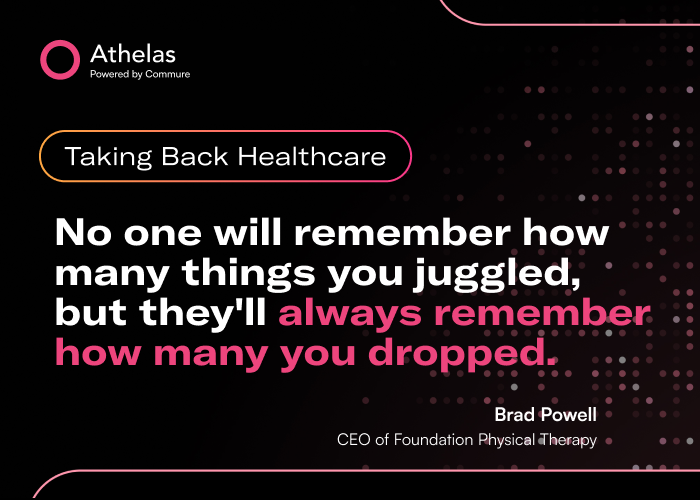
Brad Powell: Absolutely. I saw a video the other day and it was someone that asked a professional juggler, how many things, how many items could you, would you juggle in front of a crowd like in an event? And he said, well, he asked him, how many items can you juggle first? And he said 15. And he says, how many have you juggled in front of a crowd? And he says eight. He's like, well, why not 15? That would be so much cooler. And he said, he said something remarkable. He said, no one will remember how many things you juggled, but they'll always remember how many you dropped. And sometimes we got to choose to do a little less, right? Because it's what we drop that matters, not how many things that we juggle. And I've really realized that in practice, like spend the time with those people, that 10% that really, really need you. And then 90%, they'll kind of take care of themselves, right? And that's really what healthcare is about, is really truly caring for people.
Katrina LeCheminant: Yeah, I love that. Thanks so much, Brad. You're the greatest.