
Amy Gurske, CEO and founder of sayhii
February 25, 2026

In this episode, Amy Gurske, CEO and founder of sayhii, shares how her 20+ year career in corporate leadership—including roles at Amazon—shaped her perspective on burnout, engagement, and leadership. She discusses the inspiration behind building sayhii and why giving employees a real-time voice is essential to creating healthier, more connected workplaces.
Transcript:
Manish Shukla (Host): And welcome back to the Athelas Taking Back Healthcare podcast. Today we are joined by the founder of Sayhii, Amy Gursky. Thank you so much for being here.
Amy Gurske (Guest): Yeah, so great to be here.
Manish Shukla (Host): So just would love to hear about your journey of how you got here today, just your background and everything.
Amy Gurske (Guest): Yeah, so whenever I talk about my journey, I always say that everything was by accident. And it started with walking in the wrong info session my freshman year of college. I was trying to find a summer internship, and I knew that Harris, I'm from Rochester, New York, I knew that Harris was in Rochester, so I found Harris, found the room number, and then walked in the room and realized very quickly that it was the wrong company. They were hiring full-time people, but I was raised in a family where I'm not going to get up, embarrass myself, cause a scene. So I stayed. And at the end of it, they went around and did introductions and everyone's like, senior looking for full-time employment. This rotational program sounds great. And they get to me and I was like, freshman walked in the wrong room, looking for an internship. Totally know you don't have them. I'm just going to slide out the side door. And everyone's like, So I do. I slide out the side door and then two people come chasing out after me and they said, we don't have an internship, but do you want to create one? And that literally has been the entire story of my career. No job that I ever applied to because I technically haven't applied really to a job. Never really created before or never really existed until I was like, have we thought about, have we thought about. So it started with a company that had no internship to being in a rotational program and getting pulled off two months into it saying like, I think we can optimize the processes in DCs. We're not using technology at all. Can I take a look at that? And they're like, yeah, yeah, go play. So it's been this series of like, be aware, find a problem, know that you can provide a solution. And then just going to people empowering and saying like, hey, I noticed this, here's the solution. And they're like, yeah, go run with that. So literally story of my life for 22 years, no job. Literally, I never like said, I'm going to go do this. It was here's a problem. I know that I can fix it. Let me try.
Manish Shukla (Host): Right. And so, you know, when it comes to, you know, creating Sayhii, I know there's, you know, background history with, you know, Grainger and Amazon. So tell me how your experiences of those two places really led to the creation of Sayhii.
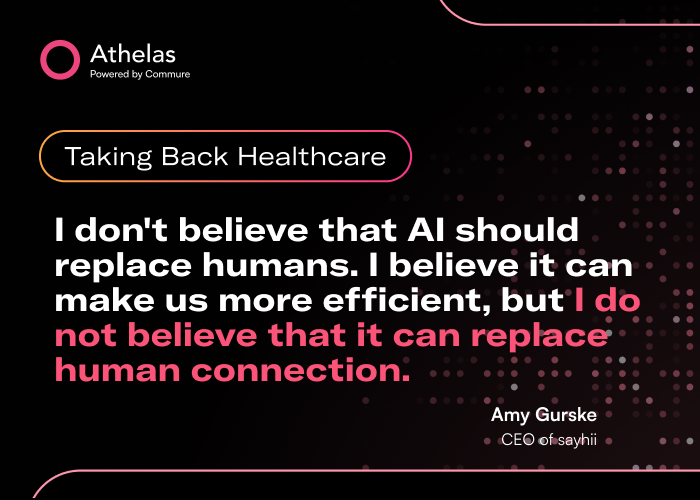
Amy Gurske (Guest): Yeah. You know, everything in life kind of leads up to where you are. And I was so grateful that I did work for some really great companies in corporate. So Granger, I was with for about 17 years. And that was one of those roles where like, hey, here's a problem. I've got the solution. Great. Go do it. They were really great with autonomy and letting you just go explore things. So that allowed me to be really curious. What that also allowed me to realize was my engineering degree. My undergrad got me so far, but I was working on streamlining process and implementing technology. Now, what I learned the hard way is people follow process and people utilize technology. So I knew nothing about people. So I actually went back to school to study industrial and organizational psych, behavioral analysis. Like I'm making all these great recommendations. No one's doing anything different. I need to learn that. So because Granger allowed me to be curious, that allowed me to go from very analytical skill set to understanding the extreme dynamics of humans and how those interplay. So fast forward, why would I leave this company after 17 years? They treated me great. They raised me. One of the consulting clients I was working for at the end of my tenure at Grainger was Amazon. And I'd gotten these degrees in IO and development, and there was a role reporting to the C-suite. And so I called my boss and I said, hey, can I apply for this role? And he said, you're a top producer. You're the only one doing global consulting. You're not married and don't have kids, HR issue. And I can't let you apply for the job because if I applied, I probably would have gotten it. I'd been there 17 years and it was a perfect fit. And so I remember being frustrated and I was with a client, Amazon, and they were like, hey, we have been trying to poach you for years. Like, would you consider coming? And it was because I had a glass ceiling put on me after 17 years that I ended up leaving and going to find another opportunity. So I would probably still be a Granger if it wasn't for that opportunity. but everything happens exactly as it should. So learned that I needed to understand more about people at Grainger. And then at Amazon, it's kind of that tech startup feel, right? Everything's moving so quickly. I go from the slow moving kind of very steady steamship company, right? Grainger stock is like this. And then you go to Amazon, that's like this and crazy. And we're splitting and doing all that stuff and forming divisions, moving very fast. I learned the importance of listening because everybody is moving so quickly that it's so easy to overlook the gaps that either individuals have or teams have because it's always the loudest voice or who's most in your face. And so what I learned with working for a very busy, very hectic, we were onboarding 650 people within a couple of years for one specific team. So talk about adding all those people. I learned that I had to do a better job listening if I expected the teams that worked for me to be able to show up at work because I had to help them figure out what they needed to be successful. Because when you're moving that quickly, sometimes you can't even slow yourself down. So my job as a leader became really trying to figure out what every single person needed to be successful and helping them get that. So I know that's roundabout, but I had to realize I had to get past engineering because black and white doesn't work in every situation. Then we had that color. But then the biggest skill, like I said, that I learned that brought me to today was we need to be better listeners. And so when I think about where we're going with technology, I don't believe that AI should replace humans. I believe it can make us more efficient, but I do not believe that it can replace human connection. And so I'm a huge believer in using AI to listen, diagnose, but always connect. Very similar to what you guys do. We always want to make sure that humans feel connected, that they don't feel like they're just working with tech, that there is something behind that, that there are humans there.
Manish Shukla (Host): Right. I mean, right before we were recording, you were saying, you know, people are the ones using technology. I think in the same way here you're talking about, you know, people are going to be using AI. Yeah. But when you're talking about it's really important to listen. I mean, I'm listening to you right now. But when it comes to listening, like what are, break it down, like what exactly matters there and what are people not doing?
Amy Gurske (Guest): Honestly, it's going to sound harsh, but we are, yeah, this is all about you. You know, we are selfish as humans, right? Like, so that example of I don't want to go work out because if I go to the gym, everyone's going to be looking at me and, you know, my arms shake when I run or my bum or whatever it may be. Like, we're so worried about ourselves. And what does your friend say to you? Hey, Amy, no one's looking at you. They're worried about themselves. And so one of the problems with listening is typically we're listening to respond. Like, I'm taking what you're saying, but I'm already thinking about how I'm going to respond, how I'm going to solve your problem, how I'm going to fix this. And that may not even be what the person's looking for. So I think for listening, the biggest piece is to really try to be present in the moment. And it's way easier said than done. But when you find yourself building what you're going to say next, which you could be doing right now, because we're in an interview, it's kind of helpful that way. But it's so important to slow yourself down and say like, okay, what actually matters in this moment? So I could have an employee sitting across from me saying, you know, I got these projects done. I had 12 projects. I got 11 done. I have one more left. And I see them like grimacing. They've got bags under their eyes. You know, maybe they're tapping their fingers a little bit. And what that tells me is like this person isn't OK. I don't know what's wrong with them, but they're uncomfortable. They're fidgety. They might be tired. But from what I'm physically, because there is like visual listening as well, which I think is also extremely important. Pay attention. You know, when people say like read the room, if someone's trying to get away from you. Let them get away from you. It's the same thing. Pay attention to the things that they may not be saying. Pay attention to what time they come in, how they're moving, who they're talking to. If they're looking down, if they're looking up, all that stuff matters. Right. And that does
Manish Shukla (Host): make sense when you're saying folks are typically selfish because when I think about it from a potentially management perspective, and I'm listening to my direct report who's saying I have 11 out of 12 projects done, I'm probably thinking about whatever metrics that I'm being measured on and how this person is really trying to, you know, let me get there. Whereas you're saying, okay, first and foremost, we need to put these people who are achieving this for us above those OKRs, KPIs, metrics, whatever you want to call it, and really kind of dig one or two layers deeper and saying, okay, you have one project left, that's great, but what's going on
Amy Gurske (Guest): here? And are you okay? Yeah. Because what if that person said to you, I am so sorry, I've been up all night. You know, I have a newborn, like my wife got sick. I literally didn't even sleep last night. Like I haven't eaten this morning. I'm running on like six cups of coffee, hence the jittery, hence the bags, hence the like not focused, right? What's the best thing that person can do is sitting there trying to work what they need to be doing when their brain is thinking about the kid. They haven't slept, they're fidgety, they're over caffeinated and underfed, right? No, go home because you staying here and trying to work, you're not going to get anything good done. I would rather you go take care of yourself and then tomorrow come back and be like, I'm going to crush that last project because I was given grace yesterday to go take care of myself, which is what I needed. So today I can come back and show up the right way. So I'm kind of the – I can be some people's arch nemesis when it comes to autonomy because I believe that every single person does need to manage themselves. And if they can't, then maybe it's not the right role for them. But we all have to take accountability. So as leaders, it's our job to then find the gaps where people can't see themselves. So you look really stressed. What's going on? Like you look really tired. What's going on? Like, great. You got 11 out of 12 done. Let's not even talk about the projects right now. Let's talk about what's going on with you.
Manish Shukla (Host): Like how do you train people to be emotionally intelligent or just caring?
Amy Gurske (Guest): So again, first, to be able to make a change in any behavior, you have to get enough pain. So one thing can be as a leader, if you're noticing that people aren't being attentive to their team, sitting down and saying, here are the things that I do want you to try to focus on. So for instance, I have an employee at SayHi that tends to be very negative. That can actually rub off on other people. So you're talking about emotional intelligence. This person is extremely talented. They've worked many, many years. But I had to sit down and have a conversation with this person and say, listen, one thing I've noticed, this is not a KPI. There's no measurement for this. I'm not going to be like, oh, this person was negative five times today. But it is something that I want you to work on. Because being negative in the workplace, shooting down every single idea can literally cripple culture. And we don't need to do that. That's that whole concept of yes and. We don't have to say no. We can say yes. And maybe we can do that three years from now. Or yes, let's put that on the roadmap and we can readdress it or whatever it may be. But we never just want to shut things down. And so that's an example of someone who is gossiping, someone who is negative, something whatever, sitting down with them and calling out a behavior that they may not be able to see. But what I will tell you is awareness is key. Once you are aware of something, you can't be unaware. So that same person that I had to sit down and have that conversation and say like, hey, I want you to be mindful about when we're immediately negative towards things, has said to me since on calls, they'll start to say something and immediately the person says, I was being negative. I don't even say anything now because I made them aware. Once you're aware, you can't be unaware. So you're going to notice it and you'll tolerate it until you get in enough pain to want to make a change. And what specifically this person will realize is, I'm actually bringing myself down. I'm not just bringing the other people around me around, but having a negative attitude actually affects me. And that's actually that whole roundabout story. That's what happened.
Manish Shukla (Host): Right. But do you think someone needs to get to a certain point of pain? Or is it really also people should just regularly be practicing that type of mindfulness?
Amy Gurske (Guest): I think that's the best option. But do I think we're there? no I think people are opening TikTok um I'm guilty of that yes so am I oh my gosh dancing animal videos really I think people falling I'm totally in for it um yeah I love when hey listen I study humans there's nothing more human than falling you used to watch America's Funniest Home Videos I'm sure absolutely I did Tom Bergeron was a big part of your life VHS record those I know Now I'm dating myself. But yeah, so it's just it's really important that we stay present because what I will say is after this conversation, when you go have conversations later today, you're going to notice when you're not listening. You're also going to notice when you're planning your next thought. And you're already going to start to change that behavior if it's something that you do. I'm doing it right now. Oh, my gosh, that's creepy. But that's the power of awareness, right? So as leaders, really all we have to do is make people aware in a kind way while giving grace. Now, that is not something that we like to do. We have built a society that is built on outcomes and deliverables and KPIs and how much I can do and all of these external things that we forgot about the internal things. And so I do hope that the world slows down. But without regulations around the use of technology, I don't know that we're going to get there. But I think that if you look at what we face systemically through generations, we're actually, we've been going into a renaissance period. We're going to continue to see that happen. I can see the newer generations wanting to be off their phones more. I have heard people say, like, I want a flip phone. I'm like, okay, I'm here for the flip phone. I probably still have one in my closet or my old original Nokia. We actually revert all the way back to the things that we used to do. So gardening, sewing, those woobles came out, crocheting. Has crocheting been cool for the last 20 years? You're like, no, no, my grandmother crocheted. And now it's cool again. So we're going to go through it. And I think we're going to see a drop in technology because people are getting so sick. And I mean mentally unwell.
Manish Shukla (Host): Yeah.
Amy Gurske (Guest): That there's they're going to have to.
Manish Shukla (Host): What I'm curious about is just, you know, from even things we've talked about just now, like walk me through how you actually go about communicating with companies and leaders. How Sayhii is enabling and helping these different companies?
Amy Gurske (Guest): Honestly, Sayhii and even starting Sayhii was very much like my corporate career. I had decided to leave Amazon because I had burned out. I was 245 pounds. I wasn't sleeping. I wasn't eating and I did nothing different than I'm doing today. So weight to me doesn't make a difference. Again, it's one of those external things, but it's a really good indicator. Like something's going on. Something is happening that doesn't normally happen. So I went to my doctor. She sat me down, took my blood pressure and told me it was 220 over 110. I was about to have a heart attack if I wasn't already having a heart attack. And I had no clue I was that stressed. So when I ended up leaving Amazon, I got called by the Mayo Clinic and they said, hey, we want you to come lead innovation. In that moment, like it almost felt like not a matrix moment, but it was like everything stopped. The last 22 years of my corporate America career came back. I just burned out of Amazon. You want me to go into healthcare? You want me to innovate in healthcare? And what do I know about healthcare? It's typically very slow moving. We were coming out of COVID. So I knew healthcare was extraordinarily burned out and I had just burned out myself. So I'm sitting there thinking like, this isn't gonna be a great fit. And they asked me to do a bunch of conversations. And I did with the intention of not taking that job. And my final conversation, he said, what's your most innovative idea? And that's where those 22 years just flashed back. And it was, you know, I found a problem. I knew I needed a solution. And so let's do that, right? Like, so let's just find problems, make solutions, roll those out. But to do that at scale, which was then what Amazon taught me, because I went from working with individual customers that I could very much manage to scaling this startup within the world's largest organization. That's where listening and being able to listen at scale became so important. So in that moment, I just had this like snap moment. My most innovative idea, I literally said, I know you want robots rolling around the floor handing out medications. I know you want AI fixing medical billing on the back end. Thank you for helping us with this, by the way. And I said, but before any of that can happen, I need real-time data on humans. And I need the ability to ask a question and get responses in real time if you want me to successfully implement anything. Because I need to be able to know which teams are struggling so I can go tackle that. Because you know that some teams work through change faster. And you know, as a tech provider, that some teams with implementation, some lag behind, some are ahead. If you're working with a solution architecture team, they're like, yeah, we already customized our entire setting. And like accounts payables, like I can't quite figure out what the password is, right? Like so we have all these different skill sets. We need the ability to be able to listen, ask people the right question at the right time. So I said to them, my most innovative idea is this. We Sayhii once a day. It's essentially scaling human listening, but with the purpose of always acting. Because you go to your friend and you share what's going on and you expect a response. If someone's just going to give us data and we don't give them a response, they're never going to come to us. So we knew that we needed to listen with purpose of connecting humans to skills, resources, and other humans in their time of need. So it all just came from things that I experienced and then just figuring out how can I scale something that was the biggest problem that I faced, which was being able to listen to scaling teams.
Manish Shukla (Host): Right. I like that a lot, especially when I feel like you can kind of feel that even innately where you walk into the office, someone you work with all the time. If they just immediately come up to you and go, I need blah, blah, blah. And as a joke, people go, hello to you too, right?
Amy Gurske (Guest): Yeah.
Manish Shukla (Host): So I guess innately you do realize like, hey, you're not treating me like a person right now. I want to be listened to. But to the point of needing that data, what are the metrics that are important there to kind of really understand people?
Amy Gurske (Guest): Yeah. So we actually look at everything under the iceberg. Traditional annual surveys that most companies or healthcare do are typically asking about things that the company can change. What we know is those aren't the things that are tearing organizations apart. The things that are tearing organizations apart are things like broken trust on teams, bad culture, lack of autonomy, poor communication, a lack of development, right? Like those are the things that actually get people to want to stay in an organization. They want to work for a leader who's going to help them achieve something, right? So we have to be able to help them get there. And to do that, again, we need this real-time data so that we know where our gaps are. Because I can tell you what I think my gaps are, and I'm a pretty aware person. But I can tell you that I checked our Sayhii scores for Sayhii itself. And I'll be surprised sometimes at some of the answers. And I'll use that real-time data, bring it back to the team, be like, hey, guys, let's talk about this. What's going on with this? You know, I've been traveling a ton. I'm not around all the time. Tell me. What's going on? But if I didn't have those indicators, I don't want to see what happened to one of the biggest companies of the town that I was from and also why I moved back. When I graduated college, I was not able to move back to my hometown because one of the biggest companies there was Kodak. Had Kodak had direct feedback loops from their frontline employees helping them innovate, do you think they would have gone on a business? They had a great culture until they didn't have a great culture. Organizations don't catch the decline. They're staying optimistic, hoping it's going to keep pulling up. The problem is it doesn't. So if you're not measuring that in real time, you never know until it's too late. So people whisper before they resign, right? People are telling you what's going on. We're just not really listening well. And it's really easy to dismiss a conversation. It's much harder to dismiss data.
Manish Shukla (Host): Right. What are some examples of companies that you think are doing this well? And what are some processes that you think they employ?
Amy Gurske (Guest): Yeah. So I think some of the best, well, some of our best customers I know that we're working with, they are actively using the data. And I think that that's true for anybody who produces data. You want the data used. So the best clients are the ones that care enough to check the data and then empower their teams to do so by leading from leadership on down. So if the CEO of a company isn't doing their monthly conversations, so we have a networking algorithm that will connect people randomly. You never know why you're getting connected, but you're getting connected for a reason. So if that CEO isn't going to go sit down and have a conversation with another functional member of the team, why would anybody else do it? If I am the CEO of a company and I only come in on Monday, why is my whole company going to come in five days a week? So I think the most important thing is leading by example and having a servant leadership style. I should be able to step in and help any person in my company at any point in time. And if I, at any point in time, think I am too big for that, then I'm probably the wrong CEO. Because people want to work for people that they can see themselves in. And if you are putting yourself on a pedestal and not doing what you expect other people to do because you are too important or you don't have time, then, A, you're just making them feel less important and making them feel smaller. And it's not going to get them to do the behavior that you're trying to do. So the companies that are doing it best have leaders that have servant leadership styles that are going to do every single thing that they would ask somebody else to do. And I think that there is a lot of leaders these days that are doing that. And I think there are some that aren't. And I think that we are seeing that show up in retention numbers. Some of the best health care systems that I talk to say our CEO, our CHRO, our CFO, our CTO, we see them on the floor all the time. They're down here asking us questions, checking in. How are you doing? They're stepping in in times of crisis. Those people want to stay at those organizations. The ones that don't are the people that never see their leaders.
Manish Shukla (Host): Right. You want to see them in the trenches, not in an ivory tower or anything.
Amy Gurske (Guest): Yeah, exactly. Because they should be willing to do anything that you are. Anything that a leader asks you to do, they should be willing to do. I say this to my niece all the time. She's 16 years old. She got her first job. It's in food service. And she said, she's like, they asked me in my interview if I was willing to take the trash out. I said, well, what did you say? She said, yeah. She's like, I take the trash out at home all the time. And the person responded with, you would have no idea how many people are unwilling to take the trash out. And she told me that story. And I said, Katie, I said, I'm really proud of you. Because, yeah, taking the trash out is a very normal thing. And anybody that thinks they're above taking the trash out, do they not have trash? So I said, the goal is you might be taking the trash out in your first job. And I said, and by the time you retire, I guarantee you, you're still probably going to be taking the trash out. I said, because that's going to be a good leader. I said, because anything that you ask anybody to do on your team, including the janitorial staff, you should be willing to do.
Manish Shukla (Host): And that's a good first job. I think retail and food service.
Amy Gurske (Guest): 100%.
Manish Shukla (Host): If you do those two jobs, I think your life's actually going to be a breeze.
Amy Gurske (Guest): Heck yeah. That's where I started. Food service followed by retail.
Manish Shukla (Host): Yeah, exactly. Yeah. So I saw you talk about how you want Sayhii to be a bridge between generations. Yeah. Talk to me about what that looks like because Gen Z is very different from millennials, is very different from Gen X to baby boomers.
Amy Gurske (Guest): Yeah. I think it's so important to listen to everybody because we all have different thoughts. So Sayhii is a tool for everybody. The interface couldn't be more simpler. It's three seconds a day. There's no training to have to learn how to use it. And the purpose is to be able to get those perceptions from every single generation to pull them together. So as a part of Sayhii, we always do team development every month. It's something that we send out to all of our participants. And the purpose is to create stronger bonds on a team. And so we use, we'll give them like a team icebreaker. Tell me about the strangest food you've ever eaten. And you go around the room. And what it's doing is it's taking away your age, your gender, your race, ethnicity, any of that disability. All those are gone. And all of a sudden we're talking about the fact that you ate a pig's head and I had a black egg. And all of a sudden we're laughing because everyone's like, where did you find a black egg? I'm like, why did you find a pig's head? Why did you eat a pig's head? Like now I've got a connection with you that has nothing to do with who you think I am and who I think you are. I am connecting with you because I think that what you said is absolutely absurd. And I need to know more about how you ended up with a pig's head. So, yeah, so we have to find those commonalities. So we got to scrape away the things that divide us. And I think we're in a world right now that has a lot of divide and we can scrape those things away and say, where are we similar? Where are we different? Where are we similar? How can I help you? How can you help me? Because the skills that you bring to the table are different than mine. So how can we optimize yours? Will you optimize mine? Right? So for a lot of new people like coming out of college, I love them. I'm like, I don't know how to use this tool. I don't know how to do that. I'm the queen of asking people how to use tech. Because again, I might be a tech founder, but I don't love tech. So essentially the point is we need to get the perception of everybody. And that's the goal of Sayhii. We're asking you this question that you need to tell us. And then we want to provide this data back so that we can have better conversations at work that actually pulls together and find those commonalities instead of those divides. That's how Sayhii can help bridge gaps. Perceptions do are very different, right? Newer generation coming in wants a lot more autonomy. They have a lot of expectations coming into the workforce that I'm not going to lie. I think we all had the same ones. I think there's just more communication channels for them to share it than when we started. Because I remember when I started thinking, these people are so old and they are doing things so slow and so weird. And why won't they do this? And why haven't they thought about it? This generation is no different. And so we have to listen to them. They've got the best ideas. So I always go to younger people and say, hey, can you help teach me this? Because I guarantee you they got the tips and tricks. That's going to take me forever. And then they call me and say, hey, Amy, can you connect me with this person? Because one of the best things that you can get after 22, 25 years in corporate America is a network. But that's not something that someone coming out of college has. So they might be able to help me integrate six different AI apps to create a seamless process for me. Well, I can network them into the six different startups or companies that they want to work with because one thing that time gets you is network. So that's how we can show up for each other. We all bring different things to the table. And when I'm not looking at who I think you are because what I think of you and we're brought together by our commonalities, that's how SayEye's beating it. It's saying, like, tell me what you think about trust in the workplace. And they might say, I think it sucks. And you say, it's always sucked. Your boss is always going to lie to you or this is going to happen. Or you have a positive experience and say, yeah, and call him on it and I'm going to support you. So we need to communicate better and to do that we need to listen better. The point of Sayhii is to take all of those data points, bubble up those insights, and get the teams to talk about exactly what they need to be talking about at the right time.
Manish Shukla (Host): Right. So, I mean, we keep talking about data a lot. Like, what are some specific metrics that we can take away from these activities?
Amy Gurske (Guest): Yeah. So, for us, we believe in measuring every single day. This real-time data, we're not going to measure once a year. You're going to keep measuring every single day because you constantly have people coming in and out of the organization. and the biggest one that we can focus on, well, there's a bunch of them. One, culture. I think it's really important. It's a great indicator if people are going to stay or leave an organization. I believe engagement as well. And we do measure that. That's always a metric we give people in real time so companies can go in and see what their current scores are. But one of the biggest ones that we're seeing impact retention right now is work-life balance. So that is something really important to look at along with burnout. So those are both metrics that we measure in real time. if people don't have a good work-life balance they're going to burn out they're going to leave our biggest goal is to make people aware of when their work-life balance is going sideways so that they can make the change because the organization can't change your work-life balance they can't take your phone away from you at night when you're going to bed they can't pry it pry your laptop out of your hands when you're trying to watch tv with your partner your kids you know like they can't do that so we again measure those things that will break organizations apart trust the first thing we start with. That's also a huge leading indicator into culture. So if trust is broken, that is a foundational need. We're going to keep hammering on trust until we figure out how we can optimize trust within the teams where it's broken. Trust is one thing that if you're not measuring
Manish Shukla (Host): that on a daily basis, you're never going to know when it starts to slide. Right. I'm curious to hear about any like war stories there. Like what's like, have you encountered any situations where It was like trust is at an all-time low and we flipped at 180.
Amy Gurske (Guest): I have a really good – yes, we have good stories about trust, but I have an even better story, which I am not even making up. I cannot make this up because I'm not that good. But I got a call. So we were working with a cryptocurrency company. Now, we do mainly work in healthcare, but, of course, I mean, we Sayhii to everybody. So financial services, technology. Well, we got a call from a cryptocurrency company that said, hey, we'd love to work with you. We've been doubling year over year. We want to make sure that we keep a pulse on how our people are doing, especially because we're not in office. You know, we're everywhere. So it's easy to ghost people. It's easy to ignore people. It's easy for people to take things sideways just over virtual calls. So we roll out to this cryptocurrency company and one of their C-suite individuals ends up calling me for one-on-one after he gets his monthly activation. I said, okay. So I get on the call. I'm like, where is he going to go with this? I'm like, and he said, you saved my marriage. I'm like, I'm sorry, what? He's like, you saved my marriage. I'm like, tell me more. That's kind of one of those yes and yeah. I'm like, yeah, yeah, or what? And he said, so he got his report and his work-life balance was terrible. Absolutely terrible. And he literally brought it home to his wife and said, you are not going to believe this. Because he always talks to her about like the stuff going on in his company, whatever. Brings it over, shoves it across the table. And he's like, you're not going to believe this. They say my work-life balance is this. And she's like, I believe it. She's like, and she literally at the same time slid an envelope over and it was divorce papers. And he was like, I will fix it. He's like, I genuinely had no idea. He wasn't listening. He was moving so quick. And so they actually are still, they were married like 32 years. Like this wasn't going to like end quickly. I'm like, oh my, what is happening? And it literally, what did it do? it did exactly what it was supposed to do, just happened at home instead of at work, which was it brought up the right conversation. And he said, what does it look like for you if I made this better? And so for me, it's not necessarily about organizations, you know, crushing their KPIs. Do I hope that happens? Yes. But if I can save a marriage, if I can keep a kid from like hating his parents down the road because they're never around, if I can get people to see that when they're super stressed, typically things come out sideways and we got to be aware of that. Like those are the biggest things because it's changing those little micro moments of our life that when you're starting to see those span across multiple organizations, across throughout the whole entire organization, like that is one small story. But I've also had people say to me, you know, I was going to leave the company. This is common. I was going to leave the company. Sayhii happened to notice that they were very low in trust. What happens at Sayhii is if you're very low in trust with your manager, we are going to route you to go have a conversation outside of your department. Because if you got hired into the company, chances are you're a good fit, but maybe it's the wrong team. And so we teed up. And again, we always connect with purpose. So if I got connected to you, you also got connected to me. I have a question I answer to you. You have a question you answer to me. That person ended up going to work for this person's team. It was because we always want to connect someone with someone who is high in the theme that they are low on. So it ended up they had a great conversation around trust. Her question actually wasn't around trust. His question was, tell me about a time when I didn't trust my manager. What did I do? And what was the outcome? Because she needed to hear it, not him. So he probably got that question was like, why am I answering this? You never know why just answer the question. And it then she ended up saying to him, I'm in a very similar situation right now. And it turned out for the best. That's which could be a different team or a different department.
Manish Shukla (Host): Right. And I think sometimes folks forget that there are multiple spheres of life, right? I used to think it was corny when I'd hear someone be like, I'm a father and a brother and blah, blah, blah. But it's like this person in one capacity is moving so quickly at work, but then in the home life, it's actually your head is stuck in the sand and you're not going anywhere.
Amy Gurske (Guest): It's so hard. And to try to balance that, it is hard. So if we're not measuring it, People step on a scale to measure their weight every day. I would much rather people measure their burnout and their work-life balance over their weight. Because guess what? They're both going to affect your weight. So it shouldn't matter anyway. But as a society, we're looking at the wrong things. We look at the KPIs. We look at the outcomes. I want to look at how we got there. What's the culture rebuilt? Because those are the things that last, not the KPIs. You're going to get new ones next year anyway. But culture, culture is going to sustain the business. What is culture built on? Trust. So those are, I would say, the two most important ones for the organization, for the individuals, work-life balance and, again, trust. We measure well-being as well, but I would say trust.
Manish Shukla (Host): So what have been some of the biggest challenges in scaling Sayhii?
Amy Gurske (Guest): You know, I made a conscious decision to move back to Rochester, New York to launch Sayhii. We don't have a unicorn female in the state of New York yet, and I do want to break some glass ceilings. Like I said, I wasn't able to move back to Rochester after I graduated college. I had to leave essentially upstate New York to be able to get a job. And I wanted to bring higher paying jobs back to a place that I call home. So deciding to move from Boston, Massachusetts, or San Francisco, which is also where I lived, all these markets known for startup, I decided to literally move to a more rural community to try to break some glass ceilings, but also change the culture of the community as well. with being a female founder. So I would say seen as a upstate New York company versus a New York City company or Boston company or San Fran company, that's been hard. Other than that, the truly the largest challenge is when you are creating something that doesn't exist, kind of the concept behind Blue Ocean, you are constantly compared to something that you do, but it's not what you are. So like, oh, you're a culture tool. Well, we measure culture. We're actually like a workplace diagnostic tool. You can diagnose whatever you want within your workforce. But they'll lump us into a culture tool or an engagement tool when really the organization can ask about whatever they want to ask about. It's just the, it's a new way to communicate with employees and get data back in real time. So we're constantly lumped into things that we aren't because what we do doesn't exist. So that's been the biggest struggle is educating people. And then once they understand it, because when you sell something, I don't want to have to teach you what it is. I would really hope that you get that. But when you create something that doesn't exist, having to educate along the way slows your sales process. But I will tell you the clients that buy in, buy in because they have not only learned the why behind what you did, but they're seeing it in action. Right. So very blue ocean.
Manish Shukla (Host): And you said that you're selling to HR departments, which are people-centric roles. How do you see, in the age of AI, how do you see these more human-centric, people-centric roles evolving?
Amy Gurske (Guest): So I think we're going to see a shift. I think we're going to see a shift to more agentic coaches. I think that we're going to see more models you can query in real time to get the data that you need instead of going to a human. So human resources is going to be about aligning the right people with the right skills at the right time, which is going to actually be more of the human side of it than it's been in the past. I think in the past it's been benefits. You know, we're going to throw an annual party. We celebrate birthdays. And now I think it's going to be elevating them to a new level, saying, like, how can we help every single individual in this organization get to where they need to be? Because everything else is going to be taken care of. So the one thing that AI can't do is be human. And so human resources is going to lose a lot of that busy stuff. And my hope is that they do become more of that human that can take that day to go sit with a leader and say, listen, I noticed we're having a trust issue on the team. What's going on? Let's have a conversation. How can we turn it around? That's my hope for HR.
Manish Shukla (Host): And, you know, as these companies are like, you know, being built as they're growing and they're scaling, like how do you help them manage that culture?
Amy Gurske (Guest): The biggest thing is using Sayhii. So, you know, as I scale, I have to, I check our scores all the time. When we're adding new team members, I have no idea what that's going to do with the dynamic. I checked my scores this morning. We're looking good. I didn't have to make any phone calls. But if you're, like I said, if you are not measuring these invisible things, then you're not going to know when they're out of whack. I'm sure in your experience working, you have heard of people not liking a leader or having like struggles with leaders. There's no easy way to bubble that up, right? Because communication organization goes top down. It's got to start going bottom up. We really need to make a shift at doing better and measuring the things that matter. And we just haven't been. Yeah, OK, everything seems good. We're going to do an annual survey. No one's really complaining about anything. It doesn't exist. So you can't let culture slide. You got to stay on top of it. It's not a quarterly activity. It's not an annual activity. It's a daily activity. And if you're not measuring it, it's going to slide.
Manish Shukla (Host): So we're talking about, OK, typically communication is top down. Now it needs to be bottom up. But sometimes I've seen trust go away because a leader has been hired from outside the company. Yeah. But how do you ensure that we're hiring the right types of leaders to not erode that trust and in fact increase it? Yeah. How do we hire leaders effectively?
Amy Gurske (Guest): Yeah. I think that organizational values and mission are very important. I think often get overlooked. I think a lot of people love someone who looks very good on paper. For me, again, the technologist here, I want that human connection. I don't necessarily care what it says on paper. I care how you show up to an interview, how you talk to me. Are you making eye contact? Talk to me about times that you failed. Talk to me about times that you helped people succeed. You know, your biggest regret. I love asking the human things because the more human the person. Humans can learn anything. Skill sets are one thing. But when you're hiring leadership specifically, you want to make sure that they have the right human skills. So that's the most important to me. So I would actually say I don't necessarily care about all the accolades or that you went to an Ivy League. I care like what you've done with that, how you think, how you work through things. Because again, A, I can do the rest. So we got to bring those human elements to the table. So at least when I'm looking at leaders, I want to make sure that the first thing I hear out of their mouth is my job is to remove barriers for my team. If I'm hiring anybody who is managing people, if the first thing out of their mouth isn't my job is to support my team, they're not the right fit. If you're coming here to prove something for yourself, it should be by helping your team succeed. That's your success. If you're coming here to achieve something just for yourself, it's probably not going to work. So another important factor, and we actually do measure this, is looking at the personality traits and characteristics of a team. So we actually track everyone's personality type within the organization. It actually goes into our networking algorithm. You never really want to connect a dominant person with a conscientious person. They'll probably sit there with one person talking.
Manish Shukla (Host): Are you doing like Myers-Briggs, the Enneagram? What are you using for that?
Amy Gurske (Guest): If you actually scrape all personality tools back to their roots, it's just traits and characteristics. I can be a different color. I can be a shape. I can be an animal. I could be a M-B-T-B-I-S-T-I-B-M-A-B-C. It doesn't matter. It all comes down to traits and characteristics. that kind of matrix you see whenever you look at personalities. So we ask all those basic, we deliver them in DISC with a little I because that's non-patented and universally accepted. But at the end of the day, we can correlate them to any personality types. But what we do know and why we measure personalities is because certain personalities don't get along. So if an organization is using a tool like Sayhii and they are replacing a leader, they can look at the makeup of their team and figure out that the direct, essentially adjacent, is exactly what they should be looking for. Yeah. So you don't have to do any personality assessments to do it. It's just happening every day through Sayhii. So yeah, you can use it for optimizing hiring as well.
Manish Shukla (Host): Right. And to the point earlier where you're talking about asking questions about, we want you to fail, all that kind of stuff. Earlier you were talking about it's important for people to see the leaders out on the ground floor. And when they are in the trenches with you, A lot of the times when I bonded with people in the past, it's being vulnerable. It's those embarrassing, you know, I hate a pig head type stories. And so it really just sounds like, can this person be honest with me? Can they be vulnerable? Because then I can trust them. Yeah. Because they're not trying to put up front.
Amy Gurske (Guest): But are we giving them the opportunity? Like how many leaders don't have weekly one-on-ones? How many leaders don't have monthly one-on-ones? So I was telling you before the interview that I worked for someone who literally met with me once a year. And I worked for this person for 10 years. That means I had 10 phone calls with this person. over 10 years. And I saw them in person once, maybe twice a year. And that was it. Never came to work with me in the field. Never really cared. At that point in my career, I wanted the autonomy, but I wanted to continue to progress. And I needed those conversations to have a different direction if I was going to stay at that organization. And they didn't. And so I mentioned one of the important things to measure is trust. You would have seen my trust score drop over the last two years when it came to trust my manager, trust my team, trust that I would stay here. Like that all started to shift, but it happened over two years. It didn't happen overnight. Nothing typically happens overnight. But we have to create opportunities to connect in those weird moments. That's why we give out these icebreakers every month. One was like, do you want to be without your phone or internet for a week? And people were like, does your phone have cellular and can you connect to the internet? Just the conversations that came off of it were enough to literally start every single person's day in the right direction. Just nothing to do with work. Just no phone, no internet. They're like, oh, that's really hard. Plus and minus column. I need the whiteboard. Like, it's hysterical. So, strangest food you've eaten. What did you want to be when you first grew up? Like, it's so human, but we forget to be human because we want to be respected, but people respect humans. They don't respect people on pedestals.
Manish Shukla (Host): Right. So I actually have, I'd like some advice from you. So we're about to have our company sales kickoff in a couple of weeks. It's going to be the first time in person so far. A lot of us have just been virtual. How do I effectively make sure that I'm saying hi to everyone that I work with, that I'm now meeting for the first time?
Amy Gurske (Guest): I would challenge them to also come up and Sayhii to you. Because if you're a one to many, make it a many to one and challenge them and have something to give them. Have something silly in your pocket. Have a bag of Skittles. Give them each one Skittle. But make it a game. Make it something funny and be like, listen, my goal is to Sayhii to each and every one of you. Am I going to remember your names? Absolutely not. But this is a question I'm going to ask you. I would love to hear your answer. Pick one question. What's your favorite car? What car would you be if I hated that question? I actually still have that question because I'm not a car person. My answer was Mini Cooper because there was only one and now there's like multiple versions. So I don't know what I would be. But pick a question. Ask every single person the same exact question. And honestly, you're going to have the best day. But then other people are going to start asking other people that question. It's so cool. Like one person starts it and you will see the entire crowd start doing it.
Manish Shukla (Host): Okay.
Amy Gurske (Guest): Yeah. Okay. Let me know how it goes.
Manish Shukla (Host): I'll let you know how it goes.
Amy Gurske (Guest): Do you need an icebreaker? I can send you one.
Manish Shukla (Host): I do. What are some other good ones?
Amy Gurske (Guest): Some other good ones.
Manish Shukla (Host): Because I like the weird thing you ate question as well.
Amy Gurske (Guest): Yeah. Yeah. The strangest thing you've ever eaten. If you could have a conversation with someone, anyone in the world who would be like, that's an obvious one. What career did you? What was the first career you ever wanted? Or when you were a kid, what did you think you wanted to be? I'm not saying it right.
Manish Shukla (Host): You know what mine was? What was yours? I was just going to ask. It's actually kind of embarrassing. I remember kids, well, not embarrassing, but just like it's not creative. I'll make it embarrassing. I remember kids would be like, I want to be a cowboy. I want to be an astronaut. Every Wednesday growing up, my family had pizza night. And so we would get pizza delivered. I would rush to answer the door because I liked carrying the pizza box back to my family like this. And I was like, I want to be a waiter because just walking around like this is super fun.
Amy Gurske (Guest): I am totally here for that. I love that. I thought you were going to go for like chemical engineer.
Manish Shukla (Host): No, no, no.
Amy Gurske (Guest): I wanted to be a waiter.
Manish Shukla (Host): So I was like, I get to just hold things like this.
Amy Gurske (Guest): That makes absolute sense. You get it.
Manish Shukla (Host): Yeah.
Amy Gurske (Guest): Yes. I wanted to be a cash.
Manish Shukla (Host): Well, this will make you feel even better.
Amy Gurske (Guest): If you feel bad about yourself, I wanted to be, and this isn't an official, I guess it is. I wanted to be a cash register operator.
Manish Shukla (Host): That's a good one.
Amy Gurske (Guest): I was obsessed with cash registers. I used to make my mom bring me to Staples.
Manish Shukla (Host): Did you have one of those toy ones?
Amy Gurske (Guest): I wanted, on my Christmas list every year, was an actual cash register from Staples. You could buy them at the store.
Manish Shukla (Host): I used to take my mom, like some kids would want to go to the library or like the park.
Amy Gurske (Guest): I'm like, can you take me to Staples? I just want to, I would sit there and play with the cash registers, which was why retail was a great second job. Because I got the cash register. But no, I had a little money thing and I would like write out invoices in my, like, I just, I don't know why. I loved, I wanted to work a cash register. There was something really cool about like the transaction. I loved it. It was like one and done, one and done, one and done.
Manish Shukla (Host): And you see getting printed out.
Amy Gurske (Guest): That's always cool. And I did have a printing calculator. I did get that for Christmas because it was slightly cheaper.
Manish Shukla (Host): You had a green visor.
Amy Gurske (Guest): Did not. I'm putting it on this year. This year. May 10th birthday. I expect a green visor.
Manish Shukla (Host): Okay.
Amy Gurske (Guest): I'll pull out my money box for you and get you a picture.
Manish Shukla (Host): And just like that, I trust you that much more.
Amy Gurske (Guest): Done. You know I'll do it.
Manish Shukla (Host): Amazing. So just to kind of round it out here, I mean, obviously you've been on a long journey. Now you're doing something I think that's incredibly commendable. For anyone who is looking to, you know, found their own company, what's some advice you have for them?
Amy Gurske (Guest): I say it's kind of what we talked about, get really quiet. When I started Sayhii, I didn't start in a bubble. I had the idea and I reached out to some of my closest friends. I reached out to people who had started businesses. I ran the idea past them. And I made sure that it was 100% in alignment. When you start your own business, and I guess it very much depends on where you are in life, the type of support you have. Every founder's journey is very different. I'm a solopreneur. If I'm not working, there's no income. I'm not married. I don't have kids. So when I made this decision to essentially be without income for four years as I bootstrapped it, I had to be in alignment. So for anybody who is thinking about starting a business, get really quiet with it, give it a week. If it's still there, make three phone calls to people that you trust. I can be one of them. If you are listening to this, call and they will give you my phone number and call me. But seriously, you have to run it by someone and have them give you feedback. And then if it's the right thing to do, it's going to be the right thing to do. And you're just going to know the universe doesn't guide you wrong.
Manish Shukla (Host): Amazing. Well, is there anything that you want to plug?
Amy Gurske (Guest): I mean, I, of course, I'm going to plug Sayhii. If you're interested in measuring culture, engaging better with your employees and increasing retention, you can look us up at sayhi.io, S-A-Y-H-I-I. But if not, honestly, just keeping human. That's why I want to plug. Give grace, be empathetic, Sayhii to people that you pass on the street because you have no idea who needs it. So the tech behind Sayhii, really cool. But the concept of just saying hi to someone every day makes a huge difference. So I'm going to plug saying random highs.
Manish Shukla (Host): Right. Well, I hate to say bye, but Amy Gursky, thank you so much for being here today.
Amy Gurske (Guest): You're welcome.