
Troy Vander Molen, CEO of Kinetic Edge Physical Therapy
January 21, 2026

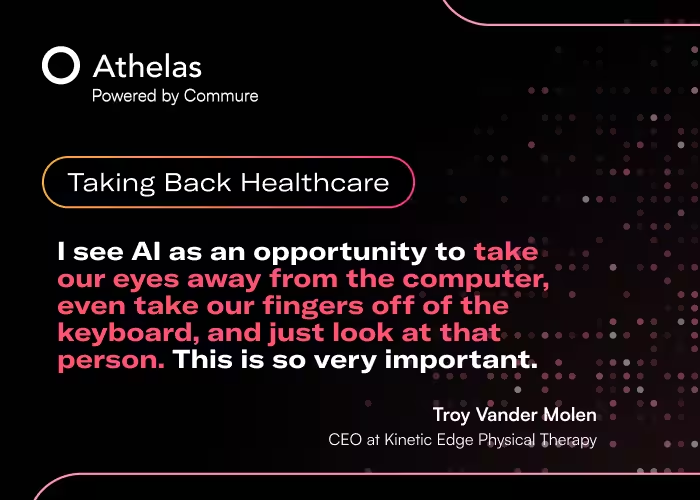
In this latest episode of Taking Back Healthcare podcast, Troy Vander Molen, CEO of Kinetic Edge Physical Therapy, shares how he’s building a high-performing PT organization while keeping patient care and team culture at the center.
He discusses how AI is helping clinicians reduce administrative burden so they can focus on meaningful human interactions—making eye contact, truly listening, and delivering better care—while still scaling sustainably.
Transcript:
What I'm excited about with the technologies that are emerging on the AI side of things is that that connection to an individual starts by looking them in the eye.That ability to connect, seeing the whites of their eyes, and the technology that we've used early on has made it harder and harder to do.And I do see definite opportunities to take the eyes away from the computer, even take the fingers off that keyboard, and just look at that person.I think the ability to make eye contact, the ability to communicate in non-verbal ways is so very important.Well, Troy, it's great to have you with us today, and we appreciate you spending some time talking us through kind of your background and your company a little bit.Yeah. Well, I've been around for a little while now. I'm a proud graduate of the University of Iowa's program way back in 1996, when it was a master's program.And I've spent my entire career doing outpatient physical therapy. Started out in a hospital-based outpatient setting and moved around just a little bit as a young physical therapist.But I've been a part of what we're doing now in Iowa with Kinetic Edge Physical Therapy for over 24 years and seen a lot of change over that time.So for people who don't know Kinetic Edge Physical Therapy, what would you say or describe, if you could put a sentence or two to describe who you are and what kind of the vision is behind the company, how would you say?Well, I would say we're definitely a missional organization. Our mission officially is transforming lives and restoring hope through movement.We love collaborating with a lot of other groups that transform lives and restore hope, but our special vehicle is movement. And so we're very therapist centric.We try to create a work environment and a culture that facilitates the individual's passions. We love it when we're able to attract clients and clinicians that share in that personal mission, share our corporate mission with their personal mission.And so I think, you know, maybe in small town Iowa, we're in some of the larger communities as well, but we're in a lot of rural locations where family connection is really strong.And I think when you participate in a rehab program with us, it feels like family and that's what we like. We want to have strong, deep relationships with the people that we serve and certainly see them as part of our network of family and friends.Yeah. I think in the industry right now, you mentioned attracting individuals and therapists. Obviously, finding staff and PTs in the industry now is really hard.How have you found success in the market that we live in, finding good PTs that kind of have that mentality?Yeah, this has changed over many years. We're known as Kinetic Edge Physical Therapy now, but our behind-the-scenes name is Work Systems Rehab and Fitness. We started as a work injury management prevention company and did all consulting.We did not even have a brick-and-mortar therapy location. So, we're a little bit unique. We brought on the traditional physical therapy services after.We had already created a network of relationships with local employers to help them solve their injury-related issues.And back then, because we were small and growing and a little bit outside the box, we attracted people who had been part of large organizations and didn't feel a connection to that mission.So, most of the people that we got early on had 10 or 15 years of experience. But about 11 years ago, 12 years ago, we underwent a change within our organization.It's a therapist-owned practice, and the founder of the business, we ended up buying him out because visions were changing. And really committed ourselves to the four disciplines of execution. And that's led to a lot of growth over the last 12 years.We found ourselves having locations that are put together in such a way that we can attract the younger therapists and related professionals.And that's been an exciting thing to see, a different generation of physical therapists entering our workforce. But now we've entered in kind of what I consider the third phase of our business, where we have such a shortage of physical therapists.And attracting them to rural locations in particular seems to be a hard thing to do. It's a place where you can have a really, really good quality of life, but you don't know that until you get to experience it.And that's gotten a little bit harder recently.Switching gears just a little bit.
Vision for PTI know through social media, you maybe have told a story before about an early hospital meeting where PTs were excluded from the vision of providing proactive care for patients. Do you want to tell us a little bit about that experience?Yeah. So, this is one of my early work opportunities, and it really was a great place to be. I was learning a lot.I was a young physical therapist with not much experience. Back then, it was pretty common in hospital settings. It's really common today for hospital settings to have outpatient satellite clinics.But this is over 25, almost 30 years ago, when that was not nearly as common. At least, it wasn't in the Midwest.And so, I was working as an outpatient physical therapist in a hospital-based department, and they would have people go every six months to a new area of service. So, you would go to the orthopedic floor and see post-surgical people.You'd be on the geriatric floor or the post-surgical floor. And I entered into that workplace saying, I really want to do outpatient physical therapy. That's where my passion is.That's where I am fruitful and fulfilled as an individual. And they let me do that a little bit longer than six months.And it was a little bit after I had been there, maybe seven or eight months, where we were called into a meeting, and they made the announcement that they were bringing in a new service to do speed and agility training. And my heart leapt.I'm like, that is so awesome. That is proactive. And they announced that they were going to be doing this in an external location to the hospital.And some of you will recognize it's the Frey-Piers Acceleration Program. That was really growing in prominence 25, 30, 35 years ago. And I thought, oh man, I'm finally going to be able to do something with a little bit more vision.And actually went and talked to my supervisor at the time. I said, hey, anything that I can do, I'm willing to be a part of this. And I was kind of met with a pretty bland response.I hadn't even really considered that. That vision did not exist of what a PT could be with regard to a broader part of the healthcare experience. And it became pretty clear after that, that that was not the vision of that program.It was a standalone thing. It was separate from what they had envisioned physical therapy services could look like.And it's interesting because that organization, like many has changed significantly since that time, where they have brought these different worlds together and they have got multidisciplinary teams that are working together.And that's a vision that I had that at that point, the organization did not have yet at that point.And I'm pretty well renowned within our organization of people understand that I'm a passionate person, I'm a person that has some vision, but I'm not great with large organizations.And so it actually was a seminal moment for me to understand what I was created to be. And that led to my eventual joining a small private practice, which I was the second person in in 2001.And all that's changed in the 24, almost 25 years since that time are things that I would not have imagined.But it was a result of me finding out how I ticked what I needed to do and having some autonomy in making my decisions and bringing along other people on this team that could share in that vision as well.And I think that's, I think, the thing that I'm most proud of about what Kinetic Edge Physical Therapy has become in all these years later.You talked a little bit about the beginning about being patient-centric, right?
Patient-Centered ApproachVery family, wanting to make patients feel at home. I feel like we hear that from many clinics, right? Or at least they purport to have that mentality.What does Kinetic Edge do differently in that, in your practice that would immediately stand out to like a therapist that was looking to join?Yeah. Well, one of the questions we get very regularly is, do you have performance expectations? And we do have a base plus system whereby when the practice is successful and the clinic is successful, your contributions to that are also rewarded.But we don't have hard productivity standards. We want you to develop a relationship with the individual. We encourage you, we train you in how to develop that therapeutic alliance.That's really important to us from the first day that you come in the door with that.And so, you know, our first visit with an individual, we're going to do some of the things that you think a physical therapist naturally does to understand the nature of their problem.But I would say at least half of the time that we spend with that is listening and answering questions.There was some research done 15 years ago that, and I don't know that I remember the details perfectly, but the average individual, when they go see a medical specialist, talks for about eight seconds before they get interrupted.And we teach our people to not talk, to listen, to let the client tell you what they need. There are things as a physical therapist that I feel are very important with regard to range of motion and strength.But I want that individual to understand that I know what's important to them. It's the significant emotional event that we're trying to connect to. And I think you see a difference when a person walks in our door.One of our clinics in particular, probably 50% of the people that walk in the door get a hug when they walk in the door. Not from our providers, but from the lady at the front desk, who's kind of the chief relationship manager of that clinic.I think there's touch points, physical, real touch points. And I think sometimes in physical therapy, we forget that. That we have the ability to truly touch people on a deeper level, but that can also happen in a physical level, too.I don't practice anymore myself, but having that touch on a deeper level with a patient, that I think is something that's unique to our industry, that I don't know if providers really have, you know, providers outside of our interests have the time,or sometimes even the interest to kind of get at that level, especially though when we know that healing or the perception of pain can be affected so much by that relationship with the provider. So, I like that.Yeah, and there are certainly exceptions to this, and we're seeing more and more of this now as well, but I do think the way that I grew up interacting is different than what the modern person grows up. We didn't have technologies.We didn't have those cell phones. We made our own fun, and so that physical connection is something that maybe comes a little bit more natural for me as a result of that too.But it's been really been a joy seeing the younger population experience what that's like in our clinic, and you can see our younger therapists change over time as they experience that as well.Yeah.Are you seeing a shift, especially as patients get younger as well, kind of that newer generation that maybe don't have that experience connecting on a deeper level, that when you put in that effort, that they respond really positively, or maybe in asense, maybe are not looking to reciprocate that. Are you seeing a shift in kind of patient demographics and how that operates?Yeah, I think to some degree we're seeing that. What I'm excited about with the technologies that are emerging on the AI side of things is that that connection to an individual starts by looking them in the eye.That ability to connect, seeing the whites of their eyes. And the technology that we've used early on has made it harder and harder to do.And I do see definite opportunities to take the eyes away from the computer, even take the fingers off that keyboard, and just look at that person.I think the ability to make eye contact, the ability to communicate in non-verbal ways is so very important. And that's what I'm most excited about, about the next wave of technology and AI.And I think we need that to be restored a little bit in humanity as well.Yeah, I actually love that you brought it up because I know in our industry, new grads want mentorship and one-on-one care and a healthy culture.
Technology and StrategyBut in the PT space, margins are getting so thin that it's more and more difficult to perform some of the stuff that you know is needed for a deep connection with the patient. Obviously, technology is part of that answer.So, you know, I'd love to hear your take on how we manage relationships with margins, and then how technology can kind of have a positive role in that.Yeah. You know, a saying that we use quite often within Kinetic Edge is that people are fruitful and fulfilled in their place of service when they can align their gifts and their passions.So, we look for people that have a passion for the fields of physical and occupational therapy, have obviously got some gifts that have gotten them through school and then we want to set them free to do what they were created to do.And that, in doing so, they will be fruitful and fulfilled for the longest possible time.I think there are things that get in the way of feeling fruitful and fulfilled that potentially, technology has the key of unlocking that just a little bit more.You know, the documentation side of things is a growing problem that takes more and more time and the weight of unfinished documentation inhibits our ability to develop relationships.Not those relationships are part of that client experience, but those relationships that we have with each other within the clinic space as well from professional to professional.I think that's also touching back on something that we talked about a little bit ago is people feel that we love each other, that we like each other, that we respect each other.And when all those things that are considered necessary evils continue to pile up, they become blocks to our ability to have that interaction, that is successful interaction with our clients.So I'm really looking forward to getting better and better at that. We don't have that figured out yet. And I do believe that a fellows has some things available that will enable us to do that a little bit more better as well.It's awesome.And I think we've talked a lot about specifically the patient side and maybe technology that can affect that. What excites you most about applying technology into your business as a whole?Is there other aspects beyond just the patient provider interaction that I think excites you about the potential of AI in the space?Well, you know, the ability to make good business decisions relies upon having easily accessible, reliable data. That's something that we've struggled with in the last several years in particular.And you know, the information that's available for us needs to be easily accessible and it needs to be practical information. But better information, we like to say that knowledge is power, but it has to be knowledge that you can put into practice.So real time information, so proper technology will enable us to do that better as well. I think it's also an opportunity for us to bring people into that conversation. It's not a hierarchical decision that we're making.We want everyone to have ownership, whether they have real ownership in the business or not.And that information that's readily available, accurate, tells a story, it shares a picture, that me just sharing information as a supervisor is not going to land with that individual.So I think that provides a level of ownership at every level of our organization that makes us stronger and enhances our ability to live out our mission, to transform lives, and to restore hope through movement as well.If you could change one thing about US outpatient care tomorrow and actually change the industry, what change would you make in life?
Industry OutlookThat's a really, really big question.I do know that the hassles, limitations, and mental gymnastics, that insurance and the authorization process is a problem that has not been solved. And I think it creates this disconnect between the individual and the health that they desire as well.So if I could change anything, I would want to provide easy and easier access to movement specialists for people that would benefit from the services that we provide.I believe the statistic is today in America, 54% of Americans are dealing with some kind of a musculoskeletal issue. 10% plus or minus may actually get to the movement specialists that can benefit them. That is a problem.And that is a problem that has lots of consequences at the personal level, and it has lots of consequences broadly financially for our company as well.So reducing those hindrances, enhancing capacity to get to the expert that's going to do what it is that you need to do so you can live a longer and healthier life, that you can do the things that you love to do.I mean, that's a big problem, and there's lots of potential solutions to that.But we need to find a way to align the individuals that would benefit from our expertise and get them into our clinics or get them to the point where they can ingest the knowledge and expertise that we have to benefit them much easier.And I don't know that doing that through the insurance-based system is going to be the most efficient way to accomplish that.For sure. So doing it through the insurance system is probably not the best way.Going back to your story over 30 years ago where the hospital didn't even think of our movement specialists as PT's being a solution for some of the programs that they're putting out.What are things that you would recommend physical therapists of the next generation or leaders in this space do in order to try to change the systems that's broken, as you kind of mentioned before?I think probably the most important thing is to try something, okay? Don't get stuck in an analysis loop. Action brings clarity.Do something, fail from time to time. We've made many mistakes over the years. We've had plenty of failure over the years, and fear of failure prevents you from action, but action is going to bring you clarity.So don't be afraid of acting. Don't be afraid of some degree of failure. Calculated risk is necessary.And I think that's what I brought to our organization more than anything, this balance between risk and how to find actionable solutions through that. I touched on this a little bit ago.One of the most important things when we bought out the founder of our practice, as we put into practice something called the Four Decimals of Execution, Michesney et al.and for companies, and I think this is true of almost every organization out there, big and small. Bringing an idea from the point of an idea to the point of execution is really difficult unless you have a structured operating system to use.And that means that you have to be able to pick the things that are most important to you. You can't say yes to everything.You have to figure out that which is most important to you, the thing that's going to have the biggest impact on you fulfilling your mission as an organization. Then you gotta act, you gotta try things.And you need consistent feedback loops so that you can understand if your successes are occurring or that needs alterations to that.So I think of figuring out how to act and leveraging the science behind execution is something that would be really, really beneficial for everyone.Yeah, are those the four principles of the execution?So the four disciplines of execution. You put me on the spot here. But number one is understand your wildly important goal.Okay. Wildly important goal is something that would have the biggest impact in your ability to live out your mission. If you could snap your fingers and make it change.And we have to remember that wildly important goal or goals must be limited. You can't have too many of them. You got to pick out one, maybe two.And that leads to the next discipline, which is you go from determining your wildly important goals to determining, what are your lead actions? What are you going to do on a regular basis? What are you doing every week?And when we implemented this, we did this because it allowed for a more horizontal organization. As the CEO of the company, I didn't tell people what to do. You have unique gifts and passions.So you figure out what you can do. You know what our wildly important goals are. What are your unique contributions to that?That gives people autonomy in what they do. And that needs to be done with regularity. That's actually the most important thing you do.That's even more important than helping your clients. Because if you stop doing those action items, you're going to run out of clients. So that leads to step number three.I'm a big baseball guy. And baseball has all kinds of statistics, especially in the age that we are now with the advanced analytics. But the most important things on game day are on the scoreboard.So step three is designing a compelling scoreboard where everyone within your organization understands at a glance, are we winning or are we losing?That scoreboard needs to have information about your wildly important goals and all the lead measure actions that you're doing so you can create a feedback loop.If I'm doing all these things and I'm not seeing the needle moving on the wildly important goal, I either need to change my goal or I need to change my actions.That's that consistent feedback loop that allows you to be agile and give up the things that are hard work that aren't bringing about anything with fruition. And then finally, number four is there's this cadence of accountability.Every week, you have a WIC meeting. It is laser focused on your most important WIC. And it's an opportunity to interact with each other to say, here's what I did, here's what I'm gonna do.Let's look at that scoreboard. Where are we going? And again, once again, provides ownership and autonomy in how people live out their weekly and day-to-day functions within the organizations.When we implemented that, we actually implemented it in 2015. And we had two wildly important goals. One was related to CPT visits.What we saw was our insurance-based care, and the consulting units, and the stuff that we were doing with organizations. Those were our two wildly important goals.And if you look at the arc that we've taken since that time, one thing it's been interesting for me to see is they say you can focus on one, maybe two. It's clear we focused on one more than another.Yeah.But that's providing good information for us. We've gotten lots of good growth on the insurance-based side of things.But with margins changing, now we're saying we need to shift our focus a little bit more to the consulting and cash-based side of things.That is directing our future because we've been living in this world and getting this feedback on a regular basis day in and day out.So the next five to 10 years, I want to be as successful at growing the cash-based side of our business as what we have been in growing the insurance-based side of our business over the last five to 10 years.And what was the book you said that those four disciplines are based off of?It's called The Four Disciplines of Execution. 4DX is what most people call it. We've also looked at a book called Traction.Wickham wrote that book. That's also very good. And probably one of the benefits from Traction, that when you're in the 4DX model, you are looking week to week.You're pretty myopic. And I think with Traction, it forces you to get outside of the week to week and look at your five and 10 year goals a little bit more too. So there is some benefit to that.So we try to go back to that from time to time and say, are we really, you know, don't get lost every day in what's happening right now. You got to kind of pull back and think about that future a little bit more too.And having been practicing now for almost 30 years, you know, it's not close to time for me to hang it up yet, but we got to start talking about what that X's strategy eventually looks like for us too.Because if you start to look out 10 plus years, that's going to come quicker than you think too. So that's another thing we're shifting our focus to a little bit more as well.Is there anything else that that's burning in your mind that you want to talk about?We underwent EMR change last year. Okay. We have been on one system for 19 years.We were early adopters. We started in 2006 and then started another system last year because we felt it was time to make a change. And we have learned a ton to that process.We're going to be now making another change real soon here because that product is sun setting. We learned a ton through that whole process. That change for us was significant because we hadn't made a change of that magnitude in 19 years.We had never made that change. The change in the past was to use a system that didn't exist prior to that. And so bringing our organization in about a year through that same thing we went through a previous year is a daunting challenge.But we learned so much through that process, too. And so we're actually pivoting to the point where we see this as a huge opportunity. And the decision making we're doing today is far different than we did a year ago.Bringing more people into that decision making process. And we're finding that there are people that had gifts that we didn't know existed before because we gave them the opportunity to be a part of this process.We're leveraging more people's input this time around than we had before. It's actually been a pretty life-giving experience for us.And I can say maybe I'm different than the average person within our organization, but we are really looking forward to that change when it comes later on this year now. And we definitely see it as a pivot point for us.It's going to put us on a trajectory that, frankly, what we've been experiencing the past year, we were not on.So it's a big situation, but we're going to be able to do with it what we just talked about with these four disciplines of execution, bring people along with us and on board with us and help them.Realize some skills and leadership capabilities that they haven't had before. And that's been an enjoyable part of this experience.I like that.So, to kind of wrap up here, as somebody who's now vetted multiple vendors, probably in the last year and a half or so, multiple times, what would you say is the biggest pillars of a relationship with a vendor that you're looking for in this next
Oh, that's a really good question.You know, I do believe that anything that we do in business is about relationships. And a trusting relationship goes a long, long way. So our vetting process is about an individual's ability, not just to make promises, but to keep promises.That's what people that are in relationship with each other do. And so that is a huge thing, to have a trusting relationship. That doesn't mean we never expect that everything's going to be unicorns and rainbows.It's the struggle is part of the process. There's always change as a challenge. But having someone that we truly trust, that we know has the capacity to help us, is easily the most important thing in this process as well.And, you know, the questions, I think some vendors want to give a lot of answers, but the questions that we get from them help us understand how much they know or want to know about us within that organization and how they are going to serve us inthat process. And so I think probably, you know, I would put that as kind of maybe the foundation more than a pillar, anything, if anything, with that then too.So maybe I'm changing your question just a little bit, but that relationship is truly the critical foundation that we're searching for as we make that next step.
Yeah, well, we appreciate you being on the podcast with us today and hope you've enjoyed the couple days we have here in California.It's been excellent. We appreciate having the opportunity to be here and, yeah, look forward to developing this relationship with the Athelas.