
Greg Todd: Founder of Smart Success Healthcare
April 29, 2026

Transcript
Host- Manish Shukla
Guest-Greg Todd
Manish Shukla: Hello and welcome back to the Athelas Taking Back Healthcare podcast. Today we are joined by physical therapist and coach Greg Todd.
Greg Todd: Thank you for having me, man. Yeah, appreciate it.
Manish Shukla: So, I would just love to hear about your background and pretty much how you got here today.
Greg Todd: So I'm a physical therapist by trade. I became a physical therapist because I didn't want to be like my dad.I like my I actually like my dad, but I didn't want to be like him. He was in sales. He was uh selling insurance, variable annuities, uh financial services, you know, business. He's still in it, you know, today. Uh, but I always said I didn't want a job that would open me up to be rejected. I wanted something that was I was gonna always be in demand. I would never have to sell like my dad has to sell. Uh, and and my mom always told me, you got to get a skill, you know, you have to get a skill. So, that really is the reason why I got into physical therapy. was really because back in the mid 90s that was the in demand job that pharmacy you know nursing I was like you know physical therapy sounds cool sports injuries okay I could do that so that's what got me into physical therapy um and I thought that you know what I can live the American dream you know as an immigrant kid from Jamaica I can get the house the white picket fence the dog named Sparky two and a half kids you know work from 9 to5 and I thought physical therapy was going to do that for me. Um, about 4 years in, I started to realize like, okay, it's cool, but it it's it's not giving me that time work life balance that I thought I was going to have. And you're about you're about how old at this point? At that time, I was became a physical therapist, 23. Got it. So, you're like Yeah, I'm probably like 26, 27 at the time. Um, my wife at the time, you know, was like, "Hey, you know, I want more time from you. I want you to She was pregnant with our second child. Um, you know, and this ain't cutting it. You're working, you know, from 7:00 a.m. to coming home sometimes at 10:00 p.m. You're doing notes, you're working with tennis players, you're doing all this other stuff. And I was like, look, I don't know how else I'm supposed to do this except if I do one of two things. Either go into management because that's the ascension for a physical therapist, or I start my own business. So, I ended up uh doing option B. I started my own business, took out a $180,000 loan on my house at the time, went for it, did three businesses. Two of them totally failed. One of them was physical therapy. It ends up making us, you know, collectively about $40 million over the last couple not not a couple years, but the last, you know, 15-20 years. And um and yeah, that's basically what happened. And through that journey, I became somebody totally different. I actually started to fall in love with entrepreneurship. uh learned a lot of things, became a consultant uh because as a physical therapist that has a business, you have to gain other skills besides being a good physical therapist. And so I use those skills to consult with other companies um and and then fast forward to uh 2016. So funny, I was out here 10 years ago, like nearly to the day, and I was consulting with a company out here. And that's what started my new mission, which is to help other therapists, other health care providers learn different skills that make you more valuable outside of the clinic besides just your typical, you know, you know, clinical skills. And so for the last 10 years, I've now helped 19 different health care professionals in different niches. Um, 5,700 customers build businesses online, offline, brick and mortar, cash-based businesses. And that's how we got here today.
Manish Shukla: Amazing. Something I'm curious about as you're talking about something we talk about a lot here is provider burnout. But from the providers' perspective, we rarely ever talk about it or even think about it from the provider's family's perspective, which you know your whole inciting incident is your wife talking about you and your uh involvement with the family. That's four years in. I'm curious about so she's kind of the one who brought that up. What was going through your mind even before she brought that up? Did she uh make you realize that you felt the same or were you just kind of on the hamster wheel in the rat race? You were just kind of nose to the ground, not even thinking about it.
Greg Todd: I think for many providers, you're nose to the ground. You're just providing. You're doing your thing. You're doing your work. And you know, if it's up to me, I just work all day, work all night. It's just kind of how I'm built. You know, it's um but then, you know, you have somebody at home, they're not happy. you know, it's like, oh crap, you know, what do I do? You know, and so you realize that, okay, I have to switch things up and and I just didn't know like the only like if I work less as a clinician, I'm going to make less if I and I was a clinic director for the company I was working for at the time. So, it it made me just, you know, have to start to ask questions. And usually that's what happens. we become uncomfortably uncomfortable with our situation. And for me, it was because of my spouse at the time, you know, made me uncomfortably uncomfortable. And and hey, I'm very grateful for it because it made me realize that maybe you're not going to just be an employee for a clinic or company for the rest of, you know, my life. It just made me have to decide, do I take the blue pill, the red pill? Do I go left or do I go right? But I can't continue on this path or, you know, I'm going to have repercussions.
Manish Shukla: Right. That makes sense. And so, you know, obviously consulting, coaching is a really big part of what you do now. I'm curious like when it comes to folks who are interested in being coached by you and learning from you, do you find that they're already burnt out or do you think that they're kind of just taking a flyer and seeing like what else is possible or a mixture of both?
Greg Todd: Yeah, I think it's the first. I think they're already burned out. I think most people when they are there's there's those that are curious and then there's those that are serious, right? So curious is, oh, you know, that's interesting. Not trading time for money anymore. online products, memberships. Oh, that sounds cool, but that sounds like more work to people, right? Because it is. It's you're doing something totally different. They're already tired, but they're curious initially. Then something happens, right? For me, it was, you know, my ex-wife, but my wife at the time, it was, "Hey, if you don't do this, we're done. Crap. I'm serious now. Okay, I need to I need to change something." Right? So I I think when people start to inquire about coaching from me says I want to be coached by you, they're already at that uncomfortably uncomfortable mark. I am super uncomfortable. I'm at a crossroads. My clinic is going to go under. My family's going to leave me. You know, I can't pay my employees anymore. They're there, right? And then you have those, but they don't start there, right? They they they start at what we call in sales topunnel where they start, hey, I got to be aware of you. like do you even who is Greg Todd, right? Okay, cool. All right. So then you got to be aware of me and then you know I got to do things to get you to at least consider the concepts that I'm talking about, right? and see the value and then something usually happens, right? You don't know when that's going to happen for them, but when that thing happens, that's when it's like, all right, like let's talk, you know, what does this look like? How do I make that change in my life? Right?
Manish Shukla: So,when people are uh you know engaging with your content or you know whatever it is when they do typically find that point of value where they go hey let's talk what what do you feel like those areas typically are where the light bulb really clicks for them?
Greg Todd: Yeah. You know usually it is you know they understand that right now the the the setup that they're in is they are using a limited resource and they're using a physical resource to generate value. And when you're using a limited resource and you're using a physical resource, it's capped, right? So what so what's a physical resource? A physical resource is your body. When I when I first became a physical therapist, I averaged 3.1 patients per hour. So I was seeing 25 patients a day on average. My first year I was 23 years old. Okay? I could do that at 23. It it it was exhausting, but I can do that at 23. I'm 48 today. I I can't do that today. Right? So physically I'm 48. I'm 25 years older. It's no different than you know LeBron James. LeBron James is one of the best basketball players of all time. But he is 41 today. Yeah. Okay. He is not the 19-year-old kid from Akran, Ohio that came to the NBA. He can't do the things that he used to do before. So when you're using that physical resource over time, you become less valuable because you just become older. Okay? And then you have the limited resource. The limited resource is time, right? You have 24 hours in a day. You're not going to work all 24 hours. you could work maybe 8, 10, 12 hours tops, right? So, when you're using physical, there's limits there and you're using time limits there. You bring those together and there's a distinct cap. There's a distinct cap. And so, so when I could make people like, crap, he's right, you know, fine. And and by the way, that's okay. It's meant to be that way, right? We're physical beings. I'm not saying to stop treating patients. I'm just saying to use your skill and your influence that came from treating patients and use it to be able to bring more value to people in a way that's not limited to time and that's not limited to your body, right? And that is through productizing yourself, right? Taking whatever your brand is, your your um you know your notoriety, your influence over patients and give them things that could bring them value. But it doesn't have to be you physically being in front of them, you know. So I I'll give an example. I used to work um with the tennis store, right? And there was uh these two girls, I'm sure you know them, Venus and Serena Williams, right? They were like the big Yeah. So they're like the big tennis players at least at that time, right? And there was this time I remember it was around 200 four five where Venus was getting into like doing um like a clothing line. Now, she's a killer tennis player, right? Okay. But, you know, she was young girl. She's been doing this probably since she was 10 years old. And it's like, all right, you know what? People are buying all my clothing stuff. This is cool, right? And she was able to create a pretty successful clothing company, but it only happened because of her influence in tennis. Then she totally went away from tennis, went right into the clothing company, which is a product company. And then over time, the clothing company started to die off. Why? because she didn't have the same influence that she had before in tennis. And she realized that it's probably best that I do both. I play tennis. I use tennis, which is my wheelhouse, just like a clinician uses their ability to treat as their wheelhouse, but then I add these other products, these other services into play that aren't linked to me hitting a ball with a racket, and that's how I'm able to leverage myself. So, that's basically it.
Manish Shukla: Right. That makes sense. It kind of even sounds like you're like you're talking about like time goes on and you know that physical resource kind of I'll just say dwindles like you're advocating for let's work smarter not harder which then converts into like really let's start our own businesses.
Greg Todd: Yeah. And let's and let's build assets, right? So what are assets? Assets are uh ways that I can bring people value without me physically having to deliver it. Right. So you know you can have you can have an Airbnb, you can have a rental property. That's an asset. Okay. That's cool. that's great, but not everybody can do that, right? Um, but a digital product is an asset. I can tell people, if I'm a a clinician, I can tell people, look, you might not have the money to come and see me in person, but I can give you a system, a protocol, a framework of how you can minimize or uh, you know, lessen the problem that you're currently going through. It's not the same as them coming in to work with me, but it's better than nothing, right? And I can charge 25, $50, $100 for it. And I can get paid, you know, from that. And people can buy that at any time of the day. They can buy it from 6:00 p.m. to 9:00 a.m. while I'm working from 9:00 a.m. to 6 p.m. So now I have what you call a 168 value model, which means 24 hours a day, 7 days a week, I'm able to bring value. Some of it might be when I'm physically in person with someone. Some of it might be from other, you know, products that I have that people can buy at any time of the day.
Manish Shukla: Yeah, that makes sense. And there's there's even other models or similar models where it's like there's a pretty prolific creator across all platforms, Squat University, physical therapist who like pretty much like talks about the types of treatments that he sees that ends up being like a top of funnel to convert into people coming to see him where I think he's based in Missouri or Mississippi. He has people flying from all over the country just to see him because they consume his content regularly. Um, but on the topic of, you know, you starting out, something that you talk about pretty frequently is you had to leverage new skills that you developed, sales, marketing, whatever else, just entrepreneurship in general. You know, like a lot of people run into like the Mottown problem where it's like, hey, I want to be an artist, but I don't know how to run a business of being an artist. So when it comes to, you know, you coaching these uh PTs into, you know, becoming entrepreneurs, starting their own businesses, like what are the things that you really have to drill into them and work with them on to build new skills?
Greg Todd: Yeah. The the first thing I like to do is just teach them the foundations and the theory behind what they already know and what we need to build that they don't know. So I like to teach them the value ladder. There's four levels of value. This is something that I learned from one of my mentors. He said, "Look, in in the world, you know, everybody's, you know, believes in whatever they believe in, right? But I believe in God and I believe that we're all equal in the image of our creator, right? But in the world, we're all valued in a different way in the marketplace, right? And so there's four different levels of value. And those levels start at the base level. Implementation. Okay? Implementation is the bottom level. That's where I started when I was working, you know, at my first, you know, retail job when I was 16 years old. Um, to me being a physical therapist. An imple is someone that actually does the thing. Okay. So whether you're working at In-N-Out Burger, you're working as a physical therapist, you're working as a orthopedic surgeon, you're working at the implementation level. You are doing the thing, right? Okay. Um, and then and and that's great, but that's where most of us were trained. We're trained to do the thing, right? So we're in college, we're trained to do the thing. come out, be the engineer, be the physical therapist, be this. Okay, that's the lowest level of value. Okay, I don't want my clients to work at that anymore because you've already done so much work at that. Okay, there's a cap on that. Remember, physical them, time, limited resource. Okay, next level is unification. Unification is you learning the skill of how to oversee implementers. So like here you guys have you know three 400 employees you know you know through through your company I'm assuming there are some managers out on these floors right so the managers oversee the implementers right okayise we you're supervising you're delegating so for me becoming a physical therapist in 2000 my boss when I got my first raise which was a lot less than what I thought I was like well how do I make more money here I got a 1.5% raise she's like you got to become a manager yeah it's a 1.5% raise. I was making 39,500 a year at that time seeing 3.1 patients an hour. She's like, "You got to become a manager." And what I realized, you know, I mean, I didn't realize it at the time, but what I realized after my mentor, you know, talked to me, he said, "Look, that's called unification. Unification, you're going to get paid more than all implementers because you are doing a higher level of value in the marketplace." Okay? You are overseeing people. Oversee the people so the people don't kill each other. Okay? So, the managers at In-N-Out Burger make more than a licensed physical therapist, right? Because it's not because In-N-Out Burger is more valuable. It's just that a management position is deemed as a higher level of value in the marketplace. Right? Okay. No, this is what I tell my clients. That level, management and implementation level is what you all have already learned. Okay? We don't need to do any more of that. What we need to do is we need to do the two higher levels of value. Two higher levels of value is communication. Communication is where I'm using my mouth to be able to speak to people and move them through my message. Okay? If you're in sales, it's communication. Okay? If you are um writing a book, it is communication. If you are running a master class, it's communication. When you guys bring in speakers here and you show me that stage back there, that's communication. If you are writing or you're you're doing a song on Spotify, that's communication. Okay? actors, actresses, Kevin Hart, Will Smith, those are all communicators. There are communicators that are struggling, but if you do it at a very high level, you can make millions and millions of dollars. Okay? So, that's really what I'm teaching my people. Okay? How do you get in front of people? How do you um create a message that is going to move people? How do you create a message that's going to get people connected to your service, your opportunity, your clinics? How do you get better at that? Because that is not something that we learn in school. Okay? So that's the communication level and then the highest level is imagination. Imagination is where I am using my mind to be able to see problems and create solutions for those problems. So I am teaching my clients how to see all the problems that we have in healthcare right now and how do we not look at it and gripe about it but how do we say hey based on these problems what are solutions that we can create for the problems and so much of us in healthcare are so used to griping about the problem saying oh this things this blah blah blah politics uh this no we're entrepreneurs let's build on our skill set of imagination and of visionary and let's find solutions for the problem. And if we could find solutions for the problem and we could communicate it to people like this is the problem, this is the solution I found, here's what my product is, that's where your opportunities become limitless.
Manish Shukla: That makes sense. And that's how you can ultimately, you know, potentially come up with a concept, find a partner, build something, get funding.
Greg Todd: You got it. Communication. I mean if to to start this I I I don't know how the CEO did this but you know the founder of the company did it but um it's like somebody had to talk to somebody right and so somebody had to have an idea and then from the idea there had to be communication with other people and either that communication was hey I have this idea to solve this problem and I'm going to either need your backing or I'm going to need to collaborate with you and you do that with one person. and you do that with another person. You do that with another person and you do the same thing with, you know, somebody's coming in to get a job here or you're trying to convince someone to work here. It's all communication and visionary. That's really the highest levels and that's really what I'm trying to teach health care professionals. Work at those things and the other things will will take care of itself.
Manish Shukla: Well, what are some of the like kind of success stories from your from the people you've coached?
Greg Todd: You know,I think of this guy, his name is Jordan. He when I started in 2016, uh what I would do is I would just allow people to just talk to me on the phone totally for free. I had a lot of time. So it's like, all right, whenever my my son would go to basketball practice, I just say, "Hey, my phone's available. You guys can call me, whatever." So I had a lot of students at that time, you know, call me and just ask me questions like, "Hey, what do you think I should do coming out of school? How could I be a consultant? What things could I do? How can I stick out in the marketplace? How could I get people to want to work with me more?" So this guy named Jordan and he was asking me those questions and he took me up on like two or three calls. I didn't hear from him for like two or three years and he says, "Hey, I opened up my first clinic, man, just from that conversation that we had, you know, I worked for somebody for a little bit and then I decided to open up my clinic." I was like, "Man, that's awesome." He was and then I didn't hear from him again for like a year. He's like, "Hey, I just opened up my third clinic." And I was like, "Wow, cool." He's like, "Can I start working with you?" you know, and so now today he's got I think he's got 95 employees, eight clinics throughout the Tennessee, you know, region, you know, making probably about eight, you know, 9 million a year, you know, and doing and doing really well, you know. So that's like a a practice story. You know, I've had people that just been working for somebody for their entire life, you know, in 200 $250,000 worth of debt, just basically paying their minimum payments, you know, end up starting a business, whether it's in public health or it's in, you know, just taking one girl. She she used to live in Sterling, Virginia. Um she started a business in 2020. She actually left her job March 13th, which was the day that the cut the country shut down from COVID and um you know within a year and a half um she had her first million dollar year in her business from scratch. You know most people don't think they don't even know what else is available. So it's just you know they just need the exposure and then you take it from there.
Manish Shukla: So when it so obviously like they were fairly successful in what they were able to do but a lot of the times success comes through like learning from failure. What do you think are like common mistakes that a lot of PT practice owners make that are potentially killing their growth?
Greg Todd: Yeah. Um them having to fulfill everything? I think the biggest mistake that most practice owners make is they are involved in the majority of the fulfillment. they are the one that is treating all the patients or the majority of the patients. And so they're not because they're doing that, they can't grow the business because they're not allowing other people to take over the fulfillment part. The majority of my time in my businesses that I have that I when I'm working on or even in the business, it is doing communication work and visionary work. And the majority of practice owners that are stalling are doing the majority of their work in fulfillment work. They are the ones that are on the floor. They're the ones that are treating in in our case, they're treating the patients from 7:00 a.m. to 7:00 p.m. And they don't have time to work on the marketing. They don't have time to create new partnerships. They don't have time to um create new offerings and new products that we could present to patients. they don't have enough time to invest in the staffing that they have the other clinicians and they burn out. The clinicians don't feel rewarded. They don't feel um that they have a clear common mission and that's usually the biggest reason why they fail.
Manish Shukla: Interesting. So, cuz I could see myself being a practice owner and you telling me that and I'm saying that sounds great, but I don't have enough time. How do I fix that? So, like what how do you communicate that to someone who says like they're like too in the weeds and they don't know how to get out of it?
Greg Todd:Yeah. No, it's it's it's a very hard thing to do. You know, usually something really bad has to happen. Something bad has to happen. It's like if it's broken, but it's still bandaged up and I can continue to go, I'll continue to go. But something usually has to happen. Like for me, the bad thing to happen is I got sick. I mean I I mean I was that practice owner. I got like physically ill like I could not treat at the level that I was treating before. I was working 45 to 55 hours of clinical treatment. I was seeing for my clinics I was seeing probably anywhere between 65 to 90 patients a week. And I and and at that time I was I was running marathons. I was training. I was waking up at 4:00 4:30 in the morning, running 8 miles, seeing 20, 25 patients a day, and then, you know, coming home, sometimes doing doubles. I I I I kid you not, I'm remembering this right now because when I got really really sick and had to do the things that I'm telling you today, it was because I came out here. I actually did the San Francisco Marathon in 2009 and I was, you know, I was uh, you know, training for the San Francisco Marathon. I did the marathon and after the marathon I'm like, you know, I'm working like crazy. I took off that week obviously to be out here and remember going up up the road know there's Great America, right? I took my kids and my family to Great America and we stayed out here for, you know, about 7 days, but I got super sick and you get to that point where it's like I physically could not work. My doctor said, "Dude, you have HIV without having HIV." I'm like, "What do you mean? What like what are you talking about?" And he basically said, "No, you have no immune system."
Manish Shukla: I'm sorry, that's a crazy doctor.
Greg Todd: That's what he said to me. But you know what? It caught my attention. Manisha did it. It It caught my attention. And he said, "You have no immune system. That's what HIV looks like. You have zero immune system. Immune system is shot. Your body needs rest." And I'm like, "I can't rest. If I rest, I'm not going to make money." And you know, you get to that point where you're you're done. You realize I have to do something different. So that was my moment. And and everybody's got to have their moment. I I can't I can't convince anybody of anything. What I can do is I can persuade you. Convincing is when I am trying to get you to do something I want you to do for my reasons. That is not fun. Okay. Persuasion is different. Persuasion is you already want to do it. Okay. So, I am just presenting something to you that you already want to do and I'm just justifying to you why you already want to do it. Yeah. Okay. And so for me, nobody could convince me, hey dude, stop treating all these patients in your practice. My my mindset at the time is everybody wants to work with me. Everybody wants to see me. Like everybody's coming here for Greg, right? They call me GT. Greg Todd. So it be like everybody's coming here for GT, right? Until I can't do it anymore. Now there's no other option. Now it's like, hey, I actually have to invest in you. Now I have to make sure now I have to I have to persuade people that it's actually in your best interest to not see me because I'm like physically useless right now. This is our next best option and I'm going to put all my energy and effort into training this person to basically do what I have been doing for you. And that's what I did and within an year I was totally out of the clinic.
Manish Shukla: Right. Right. And and I can see how you know kind of quite literally coming to a breaking point you have to re-evaluate. But you're like, "Okay, I'm on that implementation stage. Time is valuable. My health is valuable. And I need to make sure that I'm like maximizing both of those because then like if you get to that, you know, innovation imagination level, the yield is hypothetically like limitless.
Greg Todd: It's exponential. It really is.
Manish Shukla: Switching a little bit into like kind of like the model of like running a practice. I believe one of the things that you talk about is you like you advocate for a membership model, right? What does that look like when actually trying to get an actual patients buy just because it's a a little bit different from what they may expect?
Greg Todd: There's there's two ways to do it. You have the majority of my clients take insurance, right? And so um so there is one way to do it if you're taking insurance and there's another way if you're not taking insurance to present it to clients as this is going to be how I'm going to serve you. So let's talk about the insurance way because probably most people that's that's their situation. So the first thing is understanding that the fastest way to be able to grow your business is just by getting your current customers to buy more from you. It's the fastest way. I don't need to add any like if I have to add more patients, I have to add more clients, that means I have to add more staff to be able to help the clients because we're in a service based, you know, you know, business. So, so if I can get my current customer base that's already trust me enough to where they're paying me money to come into my business, how can I just get them to pay me more? And so the the first mindset shift that I have to do for practices is get them to understand that discharge should not be in your vocabulary. When I say discharge, that is okay. someone comes in, I treat them and after I treat them and I get one particular outcome, that is all we're going to do with them. I don't believe in that. I believe that we are in a business to where people are having to change behavior. If if I've got a bad knee or I got something going on with my knee, that is not something that I do for 6 weeks or eight weeks and then after that I don't have to do it anymore. So the first thing is can I get my clinicians, my practice owners to understand that discharge should not be in the vocabulary. What we need to make patients understand is that we are going to work with them and there's a certain amount of work that it's going to take to get to I can't walk good to I'm running six miles a day, okay, for training for, you know, a race or whatnot. Okay. So, so when we get there, that's one thing. But then there is work to stay there. Okay. And the work to stay there, you have to do work. You have to do work in order to maintain the level of competency, the level of strength that you've gotten. So, if I can get people to understand that discharge is no longer in the picture, the work to stay there is where the membership comes into play. Okay? So, we're going to work together and we are going to get you from not being able to walk good to getting you to be able to run. But if you stop doing the work, you are going to go back down to not being able to walk good. So, I am positioning to my clients that we need to change the way that we are presenting things to our customer base. Okay? It's no different than if you go to the dentist. You might have a cavity, okay? and or you might have a a tooth that needs to come out all together. So they might have to either extract a tooth, they might have to give you a crown. Okay, great. That's wonderful. And that is what you are paying for. But then when you get to the top, okay, we got the crown fixed. How do we make sure that you don't continue to get holes in your tooth? Yeah. That's through us taking care of your mouth a bit better, right? And so that means you're going to come in for maybe, you know, quarterly cleanings. You're going to come in for, you know, uh, by-early x-rays. That's where the membership comes into play. So for someone that's doing insurance, treat it very similar to way that you treat a dental practice. Okay? You come in, you have a problem, we will take care of your problem. Your insurance will pay for a portion of it. The rest of it you're going to have to take care of. And when we get the problem solved, let's now start to do more preventative care so that the problem doesn't resurface over and over again. And that's how I do memberships.
Manish Shukla: Got it. Okay, that makes that makes a lot of sense. Um, and I mean it sounds like there's been a lot of success with that like with you and your uh practices and and your students. Um, going back to the types of skills that we're working on like developing with these PTs who are transitioning into entrepreneurs. Um, obviously here you're talking a lot about how you package a concept, how you're selling that to the patients and even to the, you know, these PTs themselves. Um, what do you feel like PTs are typically good at innately already and that they have to like really make sure they're spending the effort on it getting better at?
Greg Todd: Yeah, I mean the things that they're good at, they're good at treating. They're fantastic at that. They're very good at explaining conditions. They're very, very, very good at that. The thing they struggle with is they struggle with trying to solve only one thing at a time. So as a physical therapist, somebody comes in. So let's say you come in, you have a back problem, right? You come into my clinic, you have a back problem. I examine your back. I listen to you and then I come up with a treatment plan. And as a therapist, our treatment plan usually is comprised of short-term goals and long-term goals. So, the short-term goals is something that we're going to achieve together over the next two to three weeks, right? That could be, all right, I'm going to make sure that you understand how your back moves. I'm going to make sure that you understand the things that you should not do to piss it off anymore. I'm going to make sure you understand this. I'm going to make sure you understand that, etc., etc. Okay, so that's the short-term goals. I usually come up with three to four of them, right? And then we have long-term goals, which are things that we are going to achieve over six to eight weeks. Okay, these are, you know, all right, I'm going to get you back to, you know, you know, martial arts. I'm gonna get you back to doing this. I'm gonna get you back to doing that. So, usually what what what we do when we're working with clients is we come up with eight to 10 goals. When I am trying to get them to go online, you only do one goal, one thing. And so, I have to get them to go from trying to solve all these things to just one thing. Okay, you got a back problem, you hurting with sitting. Let's just focus on how to minimize your back pain when sitting. That's it. The program, the product that we create is a back pain product. Focus on just being able to tolerate sitting more. Not your medication, not this, not that, not how you do this, not how you pick up stuff better, just sitting. So, it's getting them to go from I'm going to try to solve everything to solving one thing. Okay? And so when you're able to do that, that's usually what that's probably the biggest thing that I have to work with them on.
Manish Shukla: That's that's fascinating because like there's that saying, I don't know who said it, where it's like how you do one thing is how you do everything. So it's like when you do start to shift into that like hyper focus on one thing and doing it as perfectly as you can, that hypothetically then will compound to like the other types of things that you're doing.
Greg Todd:Yeah. And and and it's hard. It's hard because we're so used to to to doing so many different things. And also the majority of probably clients that you guys have here, you know, they they don't just work with one client. They don't just work with back patients. They work with, you know, people that have jaw problems or they work with people that have knee problems or people that have neck problems. We have So, it's just getting them to be able to zero in on just helping that one person with one problem and then I could create other products over time just like what you guys did here. You know, started with one thing. it either works or it doesn't work and then let's see if we can scale that and then do that extremely well and then we can you know we can add add one more layer. Okay, now let's start to help people in this area. Let's figure out how to do it. Okay, we're doing it. It's working. Proof of concepts there. Okay, can we get more people? Can we get more people? And you just kind of grow that way. And it's hard for therapists to do that.
Manish Shukla: And and so do you or have you heard or seen that like in making that shift that the actual quality of care is better?
Greg Todd: I can't say it's necessarily better, but what I can say is that they can help more people. So if I'm in front of you, most of the time it's going to be a better experience because I'm in front of you. But the reality is is that I can't get in front of the majority of people. Like I just can't. Here, let's just talk about this. As of January 1st, 2026, you know, we had a massive shift in our country. Um, we had a bill that was implemented and because of that bill, a lot of there's a lot of great things that might have happened from it, but one of the terrible things for healthcare is that 24 million people lost their subsidies. Okay. So, there are probably about 20 of those 24 million people that just said, "Screw it. I can't afford insurance anymore." Yeah. Okay. So, what are we doing for those people? Okay, because those people can't come and see you or me. They're not going to. They don't have the money. They don't have the funds. They don't have the resources. They were already being helped by the government before and now they're not being helped at all. So, is helping people with a product where you're just solving one problem for one person better than someone coming into your practice and seeing you for eight weeks? No, it's not better. But the alternative right now is they're not getting any care. they're not getting anything. So, me having a product to where I can help you with that one thing that is the most pressing thing right now and that product is a hundred bucks or less. Well, I can get that in front of 2,000 people. Whereas, I'm would be lucky to get 2,000 customers in my clinics in three months, right? And I can get that in front of 2,000 people in a month. Yeah. So, it's not better, but it's expanding our care and it's giving people an alternative to what they're getting right now, which is nothing.
Manish Shukla: And so, on a semi-related note, you know, we're talking about, you know, one kind of plan of care for one specific person. Uh, as far as uh your consulting and coaching goes, I believe you now work with like 19 different specialties.
Greg Todd:Yeah, I've had 19 different specialties take one of my programs.
Manish Shukla: So what does that tell you about the problems that folks are facing in healthcare?
Greg Todd: It's all the same.Every everybody's dealing with this the same thing. You know, we've been we were indoctrinated that if we spent our money and spent our time to become these providers that we would we would have great work life balance, we'd have good money. We would feel valued. And that might be working for some people, but it's not working for most. Uh, and a lot of people are like, uh, I need I need another alternative. I need something else. The the math ain't math in. There's too much month and not enough money. Um, and the only way I know how to provide value to people is if I work more and I can't physically do it anymore. Like, I can't add 10 more hours to my work week. And so it's happening in nursing, it's happening for massage therapists, it's happening for orthopedic surgeons, it's happening for physical therapists, occupational therapists, speech language pathologists, physician assistants, it's just h chiropractors, it's happening across the board. And so it for those people that are looking for a solution, you know, that's that's what I have, you know, for them. But most most professions are feeling this.
Manish Shukla:Right. And then are are folks who are in things like you know SLP or nurses are are they also being advised to kind of be more entrepreneurial or how how does the care for some of those other types of
Greg Todd: I don't I feel like they're they're talking about it in school a little bit more but I don't I feel like they're maybe bringing and and I'm only talking about when schools are reach out to me you know they're bringing in outside people and it might be a lecture right but the end of the day like that's not going to cut it. It's It's good at least to give people awareness. Um, but not everybody wants to be an entrepreneur. And I get it. That's an interesting point. I get it. Like not everybody wants to do this. I So So what I do is I I I kind of explain to people I break it up into three different categories. I think there's entrepreneurs, there's employees, and then there's entrepreneurs, right? And so I I think everybody just has to everybody needs to understand all three and then figure out what makes sense to you. So I can explain it. An entrepreneur is someone who owns and operates a business and does so at a very high financial risk. Okay, that's an entrepreneur, right? Business is going great, I got a lot of perks. Business is not going great, I got to continue to pump money in there, right? Not everybody wants to do that and not everybody should do that, right? Okay. But everybody still has the problem, right? Okay. So, this the the problems that we're we're we're dealing with, you know, today. So, that's that's an entrepreneur. Um, an entrepreneur is a great alternative to entrepreneurship. It's actually what I think I would have preferred. Okay? And that is someone who takes ownership and operates a business but doesn't do so at a high financial risk. They don't do so at any financial risk. The entrepreneur gets paid every single week or two weeks or however your pay is, but you are the one that's coming up with solutions. You are the one that's actually creating new products or new initiatives for the company. You are the one that you're giving more sweat equity. You're not giving financial equity, but you're willing to say, "Hey, if I need to come here on a Saturday and work, I'll work. If I need to, you know, stay, you know, until 10 p.m. I'll stay till 10 p.m. Okay? I just don't want to pony up the money to do that." Okay? That's what I try to do. I just try to find a crap ton of entrepreneurs. Most people don't even know entrepreneurship exists. So, I just try to make sure people understand that if you're going to work at my company, there are entrepreneurial opportunities. You can make some really, really good money and not have to pony it up. You could create digital products here. You could create memberships. You can do those things. You are going to do the work though. Yeah. Okay. I am the entrepreneur. I'm the one that's funding it. Okay. I'm going to get some of the pay, too. Right. But if you do the work,
Manish Shukla: there's there's also kind of like a like a see-saw of entrepreneurs and entrepreneurs where there's some folks I've seen who like they still work, you know, their 9 to5, get paid every two weeks, but then they kind of have that side hustle that gives them like a handsome amount of income.
Greg Todd: But here's my question to you. Do you think they have that side hustle be? Because we know they want the income, right? But do they have that side hustle primarily because there's no entrepreneurial opportunities at their main hustle?
Manish Shukla: Probably. But then also like they get to be entrepreneurial without the financial risk of going all in And not having that paycheck.
Greg Todd: I think a lot of people would take that opportunity if it was available at the workplace that they had and if they had the time. So um so then there's employees, right? Employees are are people that operate a portion of the business and do so at no financial risk. There are people that are like, "Hey, this is when I'm clocking in. This is when I'm clocking out. This when I have to be here." And obviously our country is founded off of that. That's extremely important. I do believe that they want those opportunities as well. And I what I just do in my company is I try to find ways for employees to be able to grow. I try to find ways for there to be entrepreneurial opportunities and then look and see who are the people that want to be entrepreneurs. and working with me is just a stepping stone towards that. And so once we can understand that these three categories exist, um I I think it makes you not lose some of your best people because a lot of your best people I I feel like I was that person. I was the employee that was looking for more, but I didn't see the opportunity there. So I had to go the entrepreneurial route, even though that's not really what I wanted to do. I mean, it worked out for me, right? But um that's not what I wanted to do. I feel like if there were entrepreneurial opportunities available at the companies that I was working with for the first four years of my of my physical therapy career, I would have done that instead.
Manish Shukla: Right. And then you get to kind of like soft develop those skills that will be relevant when you are ready to take on that risk.
Greg Todd: You got it.
Manish Shukla: Instead of figuring it out when it matters the most.There's nothing like there's no awful feeling like you have all the risk in the world and you fell flat on your butt and you're like I have to get up and yeah it sucks the life out of you.
Greg Todd: It does. It really does. It sucks the life out of you. So, you know, I think I always say I am the most anti- entrepreneur entrepreneur out there, right? I did not want to do this. I did it. Yes, it worked out for me. Um but if there were entrepreneurial opportunities I would have taken that over entrepreneurship but there wasn't. So now my mission is hey a lot of places don't have entrepreneurial opportunities. So let's create the thing for people that we always wanted for ourselves right and so today I'm feel very proud of the fact that I've been able to create entrepreneurial opportunities for people to give them the thing that I wanted. So I have a lot of entrepreneurs, former entrepreneurs that work with me as entrepreneurs in my companies. And that feels good, you know, feels good.
Manish Shukla: You know that old adage of like, you know, plant seeds of trees you know you won't sit in the shade of.
Greg Todd: You got it. I love that.
Manish Shukla: You know, in the topic of kind of like, you know, trying to give some, you know, knowledge to the folks that are watching. Um, what do you feel like are some other common mistakes that folks are making that, you know, as they're getting started, as they're maybe risk appetite's getting a little bit bigger that they can be sure to like avoid that you see pretty often?
Greg Todd: Yeah, I I think it's it's how you're allocating your time. You know I talked about this earlier uh the fulfillment you know spending so much of your time doing fulfillment work which is for us in healthcare is treating patients you know just understanding that you need to allocate your time to doing awareness based activities getting in front of people that don't know you exist. you need to do um you need to spend some of your time creating interestbased products which is for people that are not ready to pay you money and dig into their wallet but they are raising their hand that they're interested in what you're talking about. There's got to be time allocated towards doing that every single week.It's content you know content is one of those things but even just like hey man I have I have something for free that I want to give you. you know, it could be a book, it could be it could be just something that is not making people have to jump full force in to work with you. Um, and I just don't think a lot of practice owners even spend any time even think about that, you know?
Manish Shukla: But that's crucial because like that's the first point of value that someone can get from you to make them go, "Oh, I need more and I'm willing to shell out."
Greg Todd: I want people to get from me for free something that they've already paid money for and mine is better. And that gets people once people get that a lot of people like why am I going to do that? That's devaluing myself. No. When people see that they're like, well, if he gave me that for free. Yeah. What does this paid stuff look like? Yeah. And so we most practice they don't spend any time doing any of that right and then understanding that not everybody is ready to take the plunge but they need you to stay in their world. So are we creating communication that's when people are in that phase of I'm considering what you're talking about and they go from consideration to I intend to now do the thing you tell me to do. Right? For instance um a car right? I don't know if you you drive to work you Okay. All right. So, um not every day you're looking to buy a new car, right? Okay. You might buy a new car every what four to six years or something like that, right? So, you know, if maybe Tesla is the next car, I don't know if you're electric guy or not. Okay. But but if but if if Tesla's on your mind, right, it's it's helpful to get information. They don't do commercials, but they'll send you emails, right? Um, it's helpful to be in for them to be in your mind even though you're not ready to buy a car yet. But if your car breaks out on your way home and you find out that, oh my gosh, I'm going to need to get a new manifold, a new carburetor, a new this, a new that, it's going to cost me $8,000 worth of repairs. Well, now you're you've gone from I consider an electric car in my future to okay, I actually need to do something because I need to get to work tomorrow and I need to Okay, so I need to get a car this weekend. So understanding that that's a huge space of where people are at between consideration and intent. They're considering your concepts. They're considering your company to I now intend to buy a new car to then I move to evaluation. So again, are practice owners spending any time serving people when they're at that those levels? And and that's usually what I see. I think I just see most people are just like, "All right, patients are in. I'll treat them." That's it. And and then, you know, the business just goes up and down, up and down, and they're literally one life event away from everything crashing, right? You know, and so those are the things that they need to work on
Manish Todd: Right. Do you think it's possible for students who are like in school to become PTs right now to, you know, start learning and developing these skills?
Greg Todd: That's a huge part of who I work with. You know, it's um understanding that this is probably your best time to start to learn these things. You know, you have to become the clinician. Um but there are other things that you're going to have to do. That's literally how I built my entire mission. You know, there are things that you're going to have to learn if you don't want to be, you know, in a stronghold to any particular company. You're gonna have to learn these skills. And I call it skill stacking. Yeah. Right. So, so you learn the skill and you stack it upon the clinical skill that you already have and now you become really really valuable, you know? Right. So, yeah. And that compounds, you know, I tell people, you know, when I told you earlier in the interview, um, I was trying to decide between the jobs that I saw were in demand back in the '9s. It was physical therapy, it was pharmacy, it was occupational therapy, it was nursing, right? You know, physical therapy was the one I wanted to do, but it was the one that of all those I was not going to do it. And you want to know the reason why I I was going to do a pharmacy, by the way. Do you want to know why?
Manish Shukla: Yeah, please.
Greg Todd: It's because I have struggled with stuttering my entire life. And I didn't think I would be able to be a physical therapist because of my poor communication skills. Now, I don't know how long we've been doing this podcast, but it's probably about 40 minutes or so or whatnot. Do you think I'm a pretty decent communicator?
Manish Shukla:Perfect.
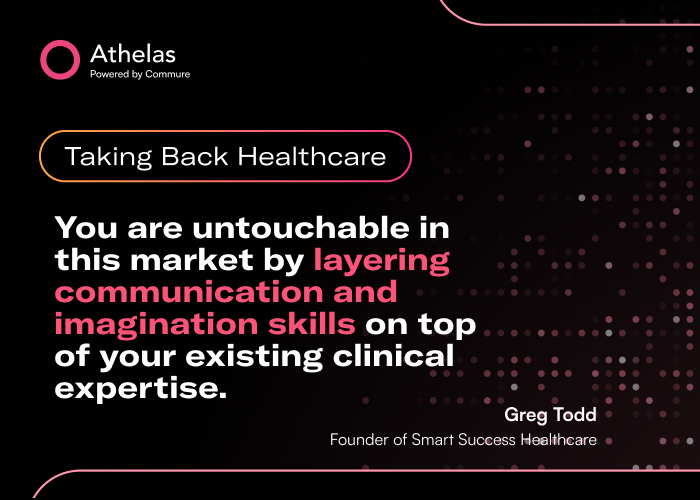
Greg Todd: Okay. It's because I work on it. I used to like everything. I couldn't even get out sentences before. So, I just want people to understand that just like how when you learn how to do a physical therapy evaluation or you learn how to do treatments or you learn how to do gonometric me uh measurements or manual muscle testing, everything is learnable. And so if you can just understand that yes, you just went to school for three and a half years to learn these skills of how to evaluate a client, if you could spend even a tenth of that time working on the communication skills or the imagination skills and you stack it on top of your clinical skills, you are untouchable in this market. You're untouchable. So that's really the biggest thing. And if they can do that, do that from early out and then you don't have to like unlearn bad habits, right? you know, just have that as part of what you do. Open up YouTube, say, you know what, I'm going to learn something AI like how like how do I learn something new? Whether it's claude code or it's chat GPT or it's co-work and stack it upon what I already know. You're untouchable. You're untouchable if you do that.
Manish Shukla: And just to kind of round it out here, um I'm curious what you think the future of healthcare or even more specifically practicing physical therapy looks like.
Greg Todd: Man, you know, I I I think it's going to I think it's going to be more of the same. You know, I don't want to do, you know, doom and gloom. I think that uh it's just extremely important that we as therapists um start acting like business owners outside of therapy. And if if if there was one thing I could tell everyone, you know, is that if you just said, "Hey, I'm going to look at other industries and what they're doing and if you you can take what they're doing in other um industries." And by the way, this is exactly what I did for myself. I was ne there was never business conferences for healthcare providers. So, I had to go to business conferences for anything. And I just took that stuff back to healthare. And what I have come to realize is that healthcare we are five years behind everybody else. So what does healthcare look like five years from now? What it looks like for everybody else today. Sure. That's it. Okay. So what is going on today? AI is taking over a good amount of it's it's replacing our poor efficiencies, right? and it is allowing systems and processes to work a little bit more efficiently and I think that's what you're going to continue to see in healthcare. Um I think that we I I don't think patentric is going to go away. I think that is still going to be there. What I do see is I see that there's going to be more productizing in healthcare. Meaning that as insurance premiums continue to go up and up and up, it's going to thin out the middle. And the middle is that person that's typically coming in and getting a plan of care from you, working with you for 6 weeks, 8 weeks. I feel like that's going to thin out. And I think what's going to happen in healthcare is you're going to have people that are wanting premium level service. And then you're going to have people that are wanting, hey, just teach me how to do this one thing so I can get this one problem eliminated and I'll pay you 50, 100, 150 bucks. I'm not going to come in and work at you for $250, $300 three times a week for 10 weeks. No, I'm not doing that. That group is being limited. I think there's going to be a group that's like, "Hey, not only will I work with you three times a week, but I'll actually do a private retreat with you as well, and you can add an additional $5,000 onto it." I believe that group is growing. And then I believe that the group where it's like, "Hey, I don't have any money, but I can afford 50 bucks if you show me how to do this, this, this." I believe that group is growing as well. I believe the middle is going to be eliminated. That's what I think is going to happen over the next five.
Manish Shukla:Interesting. Greg Todd, is there anything you want to plug?
Greg Todd: Um, you can follow me on Instagram, Greg Todd PT. If you want to learn how to create um, different income streams besides you physically being in front of somebody, I have a book. It's called Clinician's Guide to Multiple Income Streams. can find that at clinician's guide to multiple incorre.com or find it on Amazon